Why in news?
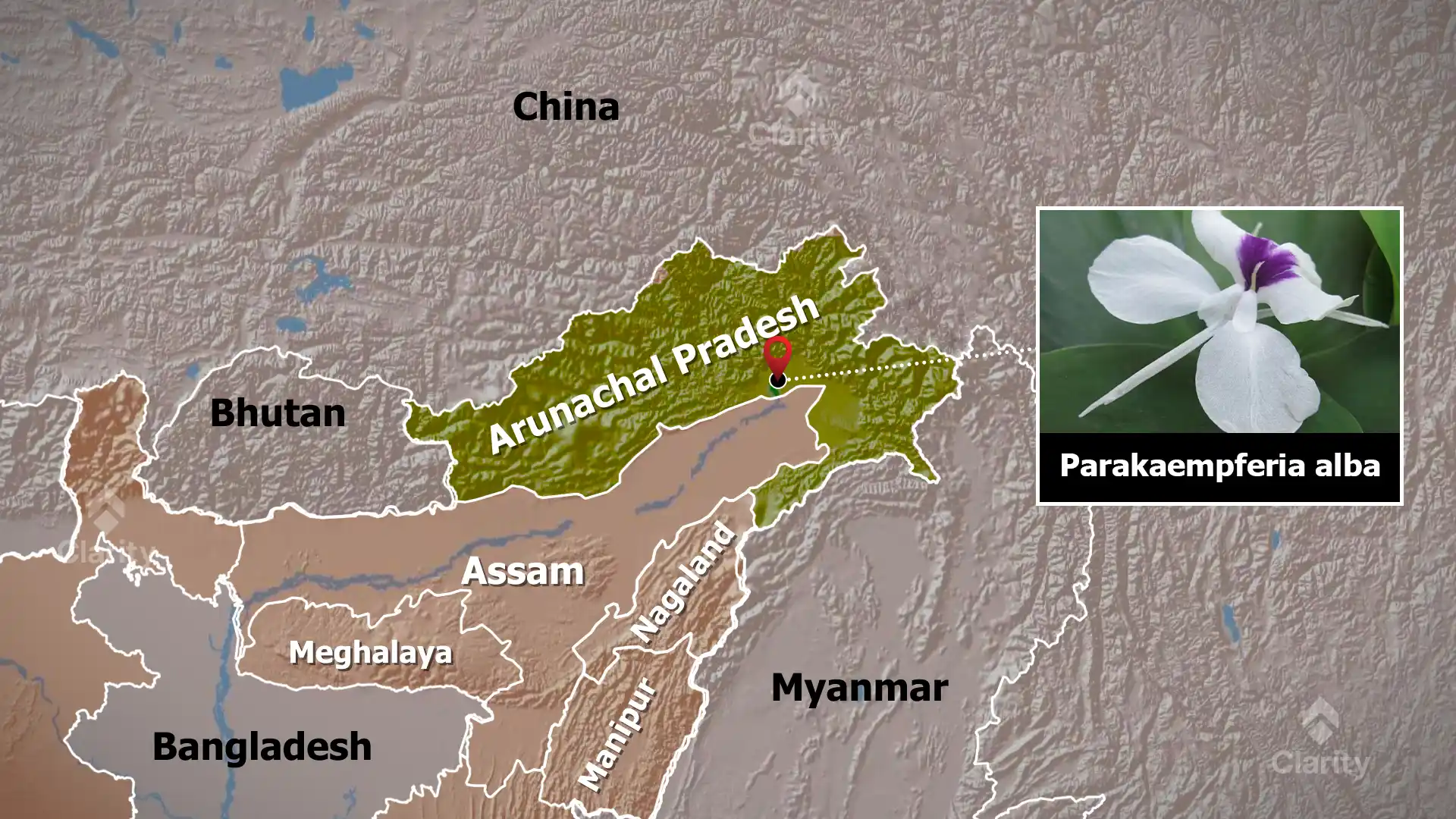
Botanists have described a new species of the ginger family, Parakaempferia alba, from the humid valleys of Siang district in Arunachal Pradesh. The discovery highlights the rich biodiversity of India’s north‑eastern hills and the importance of exploring remote habitats.
Background
The genus Parakaempferia was long considered monotypic, containing only P. synantha from Assam and Mizoram. During field surveys along shaded stream banks at 150–400 m altitude in the Miglung area, researchers found plants with pale white flowers and a compact inflorescence. Detailed study showed sufficient differences to warrant a new species name, P. alba. The species grows in moist, sandy soil and flowers in late monsoon.
Key characteristics of P. alba
- Habitat: Prefers humid, partially shaded streamsides in the Siang Valley of Arunachal Pradesh.
- Leaves: Broad, dark green leaves that form attractive clumps; they differ from the narrower leaves of P. synantha.
- Inflorescence: Short peduncles bearing multiple spikes; bracts and bracteoles are ovate and pale. The white flowers have a triangular labellum and an orange staminode. Two linear glands are attached to the ovary, a feature absent in P. synantha.
- Flowering time: Blooms in September–October, coinciding with the post‑monsoon season.
Ginger family at a glance
- Large and diverse: The Zingiberaceae family is the largest in the order Zingiberales, with around 56 genera and about 1,300 species. Familiar members include ginger (Zingiber officinale), turmeric (Curcuma longa) and cardamom (Elettaria cardamomum).
- Rhizomatous herbs: Most species are perennial herbs with fleshy underground stems (rhizomes) used for storage and vegetative reproduction.
- Economic uses: The family provides spices, dyes and medicines. Many species are grown as ornamentals for their colourful flowers and foliage.
- Distribution: Zingiberaceae members grow in humid tropical and subtropical regions, though some can tolerate seasonally dry climates.
Conclusion
The discovery of Parakaempferia alba adds to our knowledge of India’s plant diversity and underscores the need to document little‑known species before they are lost to habitat change. Protecting the moist forests of the Eastern Himalaya will help preserve many unique plants that are yet to be studied.
Source: NET