

A tiger needs more than a protected patch of forest. It needs enough prey, safe breeding space and routes through the wider landscape. People living nearby need safety, reliable livelihoods and fair treatment. Tiger conservation succeeds when these needs are addressed together.
India's Project Tiger began in 1973, when hunting and habitat loss had severely reduced tiger populations. Recovery since then has been substantial, but uneven. To understand the programme, we first examine the animal itself. Its biology explains why prey, territory, corridors and community cooperation matter.
1. Meeting the tiger
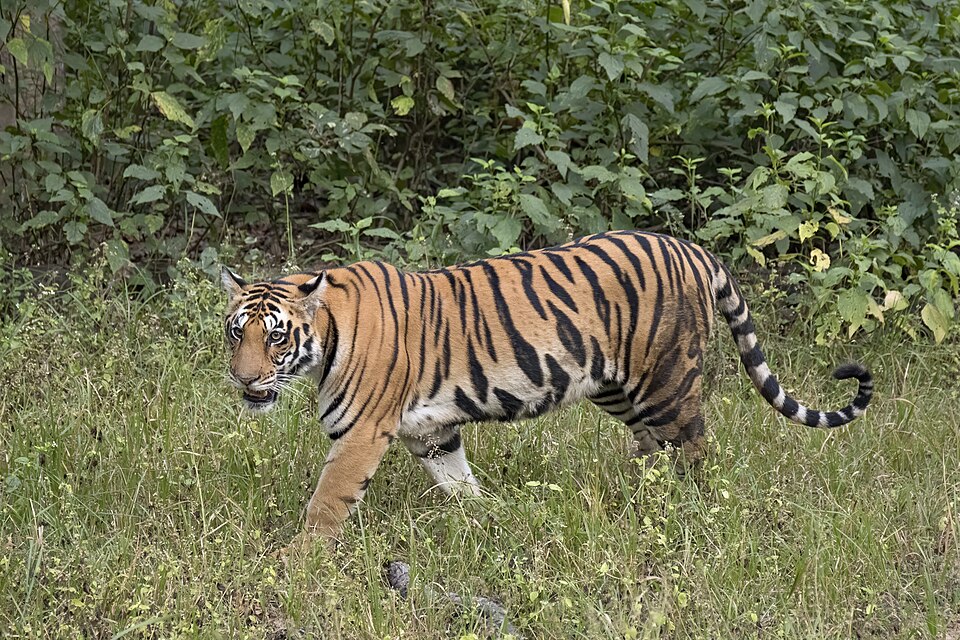
The tiger, Panthera tigris, is a large Asian cat and an ambush predator. It usually stalks prey before making a short, powerful attack. Deer, wild pigs and other ungulates provide important prey in many landscapes. Its survival therefore depends on the wider food web.
_female_3.jpg)
1.1 Why stripes matter
Stripes help disrupt the tiger's outline among vegetation and shadows. Camouflage works in relation to the background and the prey's visual system. A pattern that looks conspicuous in an open photograph can be less obvious in habitat. It does not make a tiger invisible in every setting.
Stripe patterns also differ between individuals. Researchers can compare clear photographs of the same side to identify a tiger. Cameras placed on both sides of a trail help record both flanks. Identification still requires careful matching, image quality checks and consistent records.
1.2 Territory, food and dispersal
Adult tigers are generally solitary, although mothers remain with dependent cubs. Their home ranges vary with prey, sex, habitat and social conditions. A male's range may overlap several females' ranges. “Solitary” does not mean tigers never interact.
Young tigers eventually disperse to seek territories and breeding opportunities. They may move beyond a reserve into forests, farms and settlements. Dispersal is a normal biological process, not proof that conservation has failed. Its safety depends on habitat connections and effective conflict management.
1.3 Swimming, roaring and communication
Tigers can swim well and use habitats that include rivers and wetlands. They also communicate through scent marks, scratches, vocalisations and body posture. Roars can carry over distance, while softer chuffing occurs in friendly interactions. Different signals serve different social situations.
The tiger is one of the roaring big cats, alongside lions, leopards and jaguars. Snow leopards belong to Panthera but do not produce the same full roar. Cheetahs belong to Acinonyx and communicate differently. The informal term “big cat” should not replace precise classification.
2. Tigers and other large cats
Large cats share predatory adaptations, but their ecology differs. Comparing their coat patterns and behaviour helps prevent identification errors. It also explains why a conservation method successful for one species may need adjustment for another.
2.1 Stripes, rosettes and social behaviour
Tigers have stripes, while leopards and jaguars generally have rosettes. A rosette is a cluster of markings resembling an open spot or ring. Jaguars often have central spots within larger rosettes and a more robust build. Geographic location remains important: wild jaguars belong to the Americas.
Lions differ through their social organisation in prides. Adult males typically develop a mane, although its appearance varies. Tigers lack a lion-like mane and generally hunt alone. Cheetahs are more specialised for fast pursuit in suitable open terrain.
Useful distinctions between familiar large cats
| Cat | Visible clue | Ecological distinction |
|---|---|---|
| Tiger | Stripes | Usually solitary; ambush hunting; Asian habitats |
| Lion | Usually plain coat; adult males often maned | Social prides; wild Asian population in India |
| Leopard | Rosettes; versatile climbing ability | Wide habitat tolerance across parts of Africa and Asia |
| Jaguar | Large rosettes often containing central spots | Native to the Americas; powerful, robust build |
| Cheetah | Solid spots and facial tear marks | Specialised pursuit hunter; genus Acinonyx |
| Snow leopard | Thick pale coat, rosettes and long tail | High-mountain specialist; does not produce the typical full roar |
On smaller screens, swipe across the table to read every column.
These clues help organise recognition, but individual photographs can be misleading. Age, posture, lighting and camera angle affect appearance. Conservation identification should combine multiple features with location and expert assessment.
3. Why sources disagree about tiger subspecies
A species can contain geographically differentiated populations called subspecies. Tiger classifications have changed as researchers compare anatomy, genetics and evolutionary history. Different sources may therefore report different counts without discussing the same classification system.
3.1 The traditional regional forms
The familiar classification names six surviving forms: Bengal, Amur, South China, Indochinese, Malayan and Sumatran. Caspian, Javan and Bali tigers are the three traditionally named extinct forms. South China tigers survive in captivity but are considered likely extinct in the wild. “Surviving form” should therefore not be equated with a confirmed wild breeding population.
Regional names remain useful for describing conservation problems. A Malayan tiger population faces different landscape conditions from an Amur population. However, a regional name should not be mistaken for a separate species.
3.2 The 2017 two-subspecies treatment
The IUCN Cat Classification Task Force's 2017 treatment grouped tigers into two subspecies. The mainland group is Panthera tigris tigris. The Sunda group is Panthera tigris sondaica, with Sumatra representing its surviving population. Extinct Javan and Bali forms belong within that Sunda grouping in this treatment.
Subsequent genetic evidence and interpretation have kept the issue under discussion. The Cat Specialist Group currently notes that tiger taxonomy is under review. It is therefore inaccurate to present either “exactly six” or “exactly two” as an uncontested permanent fact. State the classification and source being used.
3.3 How to answer a classification question
Read whether the question asks about traditional forms, a specified taxonomic treatment or living wild populations. Those are different questions. A statement naming six traditional forms can be reasonable within that framework. It does not disprove the existence of the two-subspecies treatment.
Taxonomy also does not remove the need to conserve local genetic diversity. Even populations placed in one subspecies can have distinctive adaptations and histories. Conservation planning must consider population evidence as well as names.
4. The regional forms and their habitats
Tigers once occupied a much wider Asian range. Their surviving populations now occur in separated landscapes with very different climates. Regional comparisons show the species' ecological flexibility and the scale of its losses.
4.1 Bengal, Amur and Sumatran tigers
Bengal tigers occur across the Indian subcontinent, including India, Nepal, Bhutan and Bangladesh. Their habitats include forests, grasslands and the Sundarbans mangroves. A Bengal tiger should not be imagined as exclusively a rainforest animal.
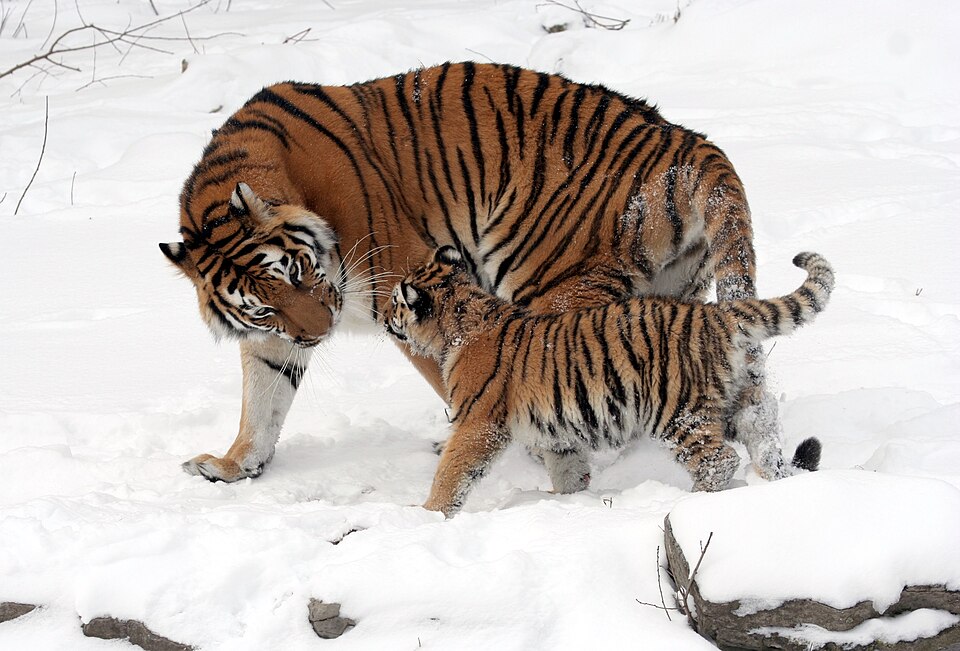
Amur tigers occupy temperate forest landscapes in the Russian Far East and northeastern China. Cold winters favour seasonal coat adaptations, while prey availability shapes range size. “Siberian tiger” is a familiar name, but the main modern range lies in the Amur–Ussuri region.
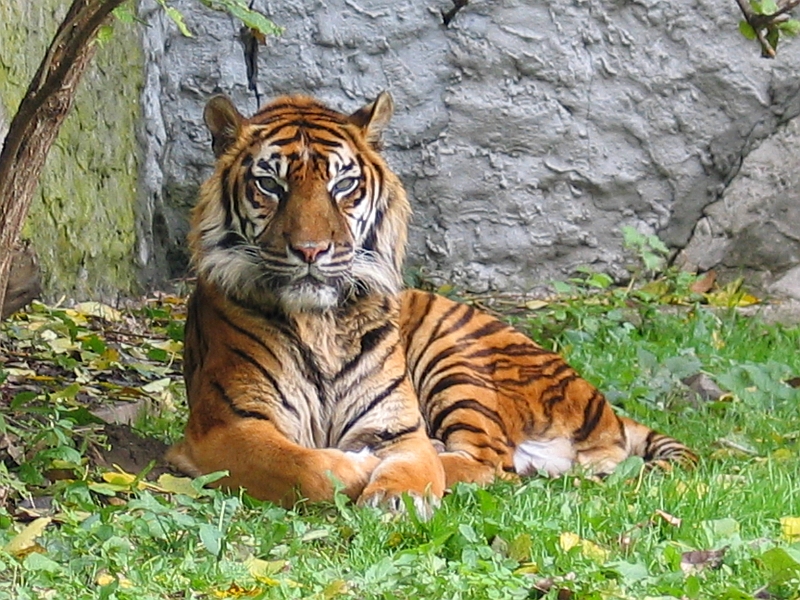
Sumatran tigers survive on the Indonesian island of Sumatra. They generally have smaller bodies than large mainland forms. Forest conversion, fragmentation and poaching threaten their remaining landscapes. Bali and Java should not be listed as present wild tiger populations.

4.2 Indochinese, Malayan and South China forms
The Indochinese form is associated with mainland Southeast Asian landscapes. Thailand and Myanmar retain important remaining populations. Former range in Cambodia, Laos and Viet Nam should not be confused with confirmed surviving breeding populations today.
The Malayan form is associated with Peninsular Malaysia. Habitat loss, prey depletion and poaching have driven a severe decline. The South China form now depends on captive populations, with no confirmed established wild population. Captive survival and recovery in natural habitat are very different achievements.
Traditional tiger forms and their geographic context
| Regional form | Geographic anchor | Important qualification |
|---|---|---|
| Bengal | Indian subcontinent | Occurs across several habitat types and countries |
| Amur | Russian Far East and northeastern China | Temperate forests; “Siberian” is the familiar alternative name |
| Indochinese | Mainland Southeast Asia, especially surviving Thai and Myanmar landscapes | Historical range is wider than confirmed current populations |
| Malayan | Peninsular Malaysia | Severely threatened regional population |
| South China | Historical southern Chinese range | Survives in captivity; likely extinct in the wild |
| Sumatran | Sumatra | Only surviving Sunda island tiger population |
| Caspian, Javan and Bali | Former continental western range, Java and Bali respectively | Traditionally recognised extinct forms |
On smaller screens, swipe across the table to read every column.
4.3 Why a fixed body-size ranking is unreliable
Adult males generally weigh more than adult females within a population. Age, prey availability, health and captivity also affect body size. Bengal and Amur tigers include very large individuals, with overlapping measurements. It is unsafe to claim that every Amur tiger is larger than every Bengal tiger.
A scientific comparison needs measured individuals, comparable ages and clear sampling methods. Photographs taken at different distances cannot establish a size ratio. The images here show appearance and context, not scaled anatomical measurements.
5. Conservation status and geographic range
The tiger species is globally classified as Endangered on the IUCN Red List. That assessment concerns extinction risk at the species level. It is distinct from national legal protection and from assessments of particular regional forms.
5.1 Why different threat categories can coexist
A species can be Endangered globally while facing greater risk within one country. Traditional subspecies assessments may also use a different taxonomic unit. For example, Malayan tiger sources describe that regional form as Critically Endangered. The word “tiger” alone does not reveal which unit an assessment concerns.
The same distinction applies to national Red Lists. Bangladesh's national assessment and the global tiger assessment need not share a category. Always state whether a label applies to the species, a named form or a national population. IUCN status is an assessment of risk; CITES appendices and India's schedules are legal instruments.
5.2 The thirteen tiger range countries
The established tiger-range-country grouping includes Bangladesh, Bhutan, Cambodia, China, India, Indonesia, Lao PDR, Malaysia, Myanmar, Nepal, Russia, Thailand and Viet Nam. This diplomatic and conservation grouping includes countries where wild tigers have disappeared. It is not a list of thirteen countries with confirmed breeding populations.
Cambodia, Laos and Viet Nam have lost their wild tiger populations in recent decades. Remaining wild populations occur in the other range countries, though their security varies greatly. Restoring tigers to former range requires habitat, prey, protection and social conditions, not merely a release announcement.
6. Reading country-level tiger estimates
Wildlife estimates are not exact real-time inventories. Surveys differ in year, coverage, methods and age groups counted. Combining unlike figures can create a misleading global total. Every number below therefore carries its reference period and an interpretation note.
6.1 Recent announcements can change an older picture
Nepal announced an estimate of 429 wild tigers on 29 July 2026. This supersedes the often-quoted 355 estimate from 2022 for a current overview. The increase also strengthens the need for coexistence measures around recovering populations.
Bhutan announced 131 tigers in 2023, while Bangladesh reported 125 in its 2024 survey. Thailand's 2024 announcement gave a range of 179–223. These figures demonstrate different national trajectories, not a synchronised census.
Selected documented national estimates; years and methods differ
| Country | Reported estimate | Reference period | How to interpret it |
|---|---|---|---|
| India | 3,682; reported range 3,167–3,925 | All India Tiger Estimation 2022 | Detailed national estimate, not a count conducted in 2026 |
| Nepal | 429 | Government announcement, July 2026 | Newer than the 355 figure from 2022 |
| Bhutan | 131 | National result announced in 2023 | Survey-based estimate, not an annual live count |
| Bangladesh | 125 | 2024 survey | Bangladesh Sundarbans population; do not merge with India's state count |
| Thailand | 179–223 | 2024 announcement | A reported range rather than a single exact number |
| Russia | At least 750, including cubs | 2021–2022 enumeration | Includes cubs; not directly comparable with estimates excluding them |
| Malaysia | Fewer than 150 | First National Tiger Survey, 2016–2020; reported subsequently | An older survey-based indication of severe decline |
On smaller screens, swipe across the table to read every column.
Russia's age-group qualification comes from the Amur Tiger Center's 2022 report. Malaysia's figure and survey period are documented by WWF Malaysia, a survey partner. The table intentionally does not sum these figures.
6.2 Countries without a comparable figure in this table
China retains wild tiger populations, including Amur tigers in the northeast. Indonesia's surviving wild tigers occur on Sumatra. Myanmar retains small, threatened populations in remaining habitat. Survey coverage and reporting differ, so this edition does not assign an unsupported current national total to these countries.
Cambodia, Laos and Viet Nam belong to the historical range-country grouping but lack established surviving wild populations. A “zero” in a historical summary must not be confused with a new field census proving permanent absence everywhere. Reintroduction proposals also do not themselves establish a recovered population.
For global context, the Global Tiger Forum reported approximately 5,574 wild tigers in 2023 using country information available then. This is a dated compilation, not a September 2026 count. It should not be combined with later national announcements into a precise new global estimate.
7. Why India launched Project Tiger
By the early 1970s, hunting, habitat conversion and prey depletion had badly affected tigers. Legal protection alone needed stronger institutions and habitat management. The Wild Life (Protection) Act was enacted in 1972. Project Tiger followed in 1973 as a focused conservation programme.
7.1 The original programme and its purpose
Project Tiger began with nine reserves in 1973. Its purpose was to secure viable tiger populations in their natural habitats. The approach included habitat protection, prey recovery, anti-poaching measures and management support. Protecting only individual animals would not address the ecological causes of decline.
The programme expanded as more landscapes entered the reserve network. Funding and technical guidance came through a centrally sponsored scheme, implemented with states. A tiger reserve remains a managed landscape rather than a self-enforcing label.
7.2 Why later reform became necessary
The disappearance of tigers from Sariska exposed serious weaknesses in protection and monitoring. It showed that official confidence could diverge from field reality. The crisis helped drive institutional reform and more rigorous population assessment.
The 2006 amendment to the wildlife law gave the National Tiger Conservation Authority a statutory basis. It strengthened the framework for tiger conservation plans and reserve governance. Project Tiger's 1973 launch and NTCA's later statutory establishment are separate milestones.
8. What the NTCA does
The National Tiger Conservation Authority is a statutory body under the Ministry of Environment, Forest and Climate Change. It provides national oversight, standards and coordination for tiger conservation. State governments and field staff remain central to everyday reserve management.
8.1 Chairmanship and legal basis
The Union minister responsible for environment and forests chairs the NTCA. The minister of state in that ministry serves as vice-chairperson under the statutory arrangement. The Prime Minister chairs the National Board for Wildlife, a different body. Confusing these institutions produces a common factual error.
The relevant provisions appear in the Wild Life (Protection) Act, including sections 38L and 38O. Legal mandates should be read from the amended Act. Older summaries may omit later changes or confuse the authority with the original Project Tiger administration.
8.2 Standards, plans and oversight
NTCA functions include approving tiger conservation plans and laying down standards and guidelines. It evaluates management and supports scientific monitoring and protection. It also considers ecological sustainability and coordination across tiger landscapes. The authority does not personally conduct every patrol or replace state forest departments.
- Planning and standards. Tiger conservation plans connect habitat needs, protection and management priorities. Standards help reserves work toward consistent conservation objectives.
- Monitoring and evaluation. Population estimation and management assessment reveal strengths and weaknesses. Evidence should influence budgets and corrective action.
- Coordination and support. Tigers move across administrative boundaries, while trade networks cross borders. Effective protection therefore requires cooperation beyond individual reserves.
- Ecological safeguards. Reserve decisions must consider habitat integrity, prey and movement. Conservation outcomes cannot be reduced to tourism revenue or a rising visitor count.
The NTCA's role is best understood as a combination of statutory oversight and technical coordination. Field success still depends on staff capacity, honest information and cooperation with local communities.
9. How a tiger reserve is organised
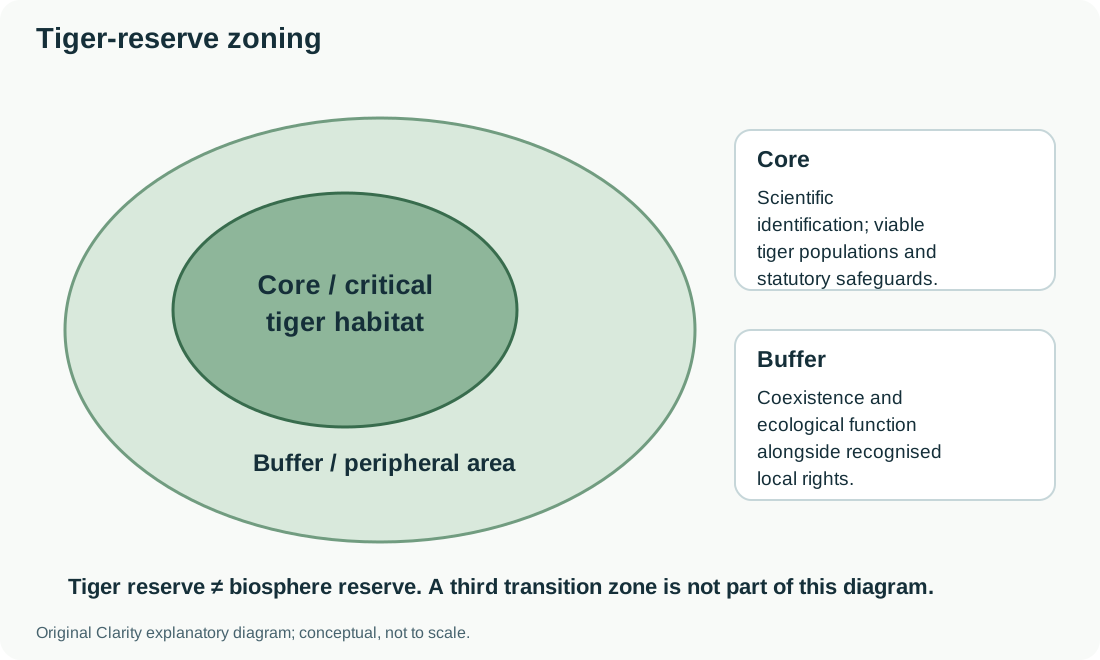
A tiger reserve includes a core or critical tiger habitat and a buffer or peripheral area. The zones have different conservation and management purposes. They form part of one wider landscape, where ecological processes and human activities interact.
9.1 Core and critical tiger habitat
The core or critical tiger habitat is identified on scientific and objective criteria. It is intended to support viable tiger populations and an inviolate conservation purpose under the law. Identification and management must respect the statutory process and rights safeguards.
“Critical tiger habitat” under the wildlife law is not the same term as “critical wildlife habitat” under the Forest Rights Act. The words resemble each other, but the legal provisions and procedures differ. An examination statement may test precisely this distinction.
9.2 Buffer and peripheral areas
The buffer or peripheral area surrounds or adjoins the core as determined through the applicable process. It supports coexistence and recognises local livelihood, developmental, social and cultural rights. Management seeks to reduce pressures on the core while maintaining ecological function.
A buffer is not an unrestricted zone for any development. Nor is it necessarily empty of tigers or other wildlife. Tigers may breed or move there, depending on local conditions. Land use must be assessed in relation to conservation objectives and applicable law.
9.3 Why this is different from biosphere-reserve zoning
A biosphere reserve uses core, buffer and transition zones within a broader conservation and development framework. A tiger reserve's statutory structure is described through core and buffer/peripheral areas. Adding a third “transition zone” to every tiger-reserve diagram mixes the two systems.
Some places have overlapping designations, such as national park, tiger reserve and biosphere reserve. Overlap does not make the categories interchangeable. Each designation has its own boundary, purpose and governing arrangements.
10. People, rights and coexistence
Communities living near tiger habitats experience conservation directly. They may bear livestock losses, restricted access or fear of attacks. Benefits can also arise through employment, tourism and improved services. Fairness requires attention to both sides of this relationship.
10.1 Rights safeguards and relocation
Tiger-reserve notification does not automatically cancel every existing right. The wildlife law requires safeguards when creating inviolate areas through relocation. Recognition and determination of rights, assessment of alternatives and legally required consent processes matter. Any relocation package must address livelihood security, not simply physical movement.
Voluntary, informed relocation can be part of an agreed conservation approach in suitable circumstances. Coercion or incomplete rehabilitation can create lasting harm and distrust. A rising tiger count cannot by itself justify ignoring legal and social obligations.
10.2 Reducing conflict in practical ways
Conflict prevention begins with understanding where and why encounters occur. Livestock protection, safer movement, prompt alerts and trained response teams can reduce risk. Compensation must be timely and accessible where applicable. Communities should not be expected to absorb repeated losses while waiting through opaque procedures.
Managing crowds is especially important when a tiger enters a settlement. Chasing or surrounding the animal can increase danger to people and wildlife. Trained authorities need space, information and suitable equipment to respond. Tourism income should also reach local people through credible arrangements.
10.3 Community knowledge and participation
Local residents often know seasonal animal movement, water availability and emerging pressures. Including this knowledge can improve monitoring and prevention. Participation becomes meaningful when people influence decisions rather than merely attend meetings.
Conservation institutions should report both ecological outcomes and social impacts. Habitat recovery, reduced conflict, fair benefits and rights compliance are complementary measures of success.
11. Corridors connect tiger landscapes
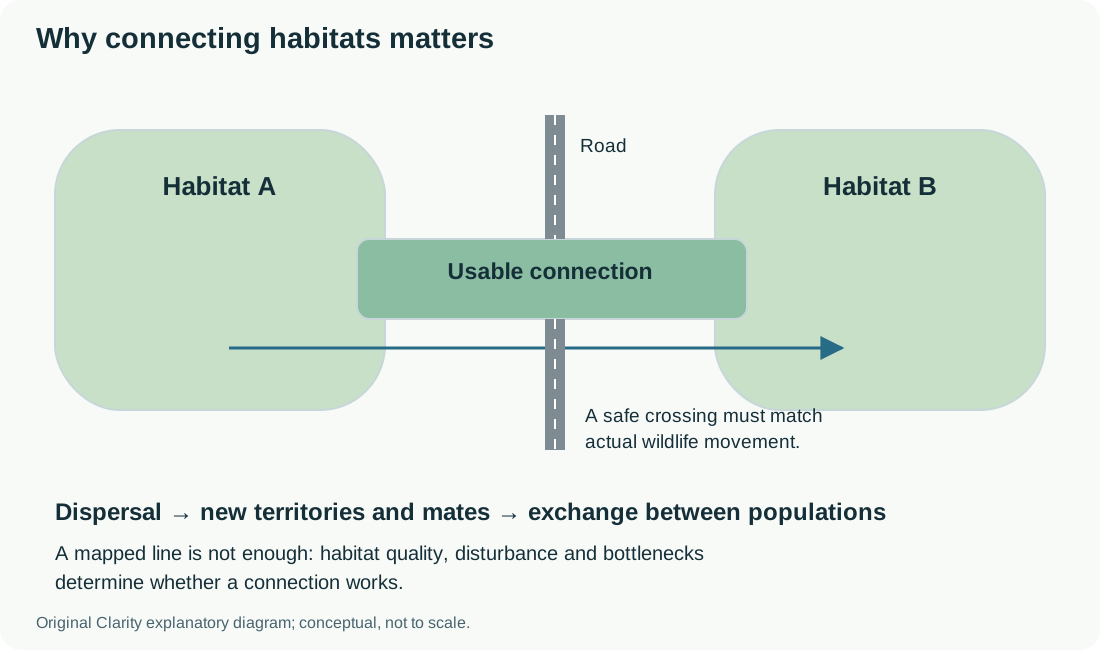
A reserve boundary does not contain every movement a tiger needs to make. Corridors connect habitat patches and support dispersal between populations. They may include forest, scrub, riverine vegetation and other usable land. Their effectiveness depends on width, habitat quality, disturbance and surrounding land use.
11.1 Why movement supports population persistence
Dispersal allows young tigers to find territories and mates. Movement between populations can maintain genetic exchange and help recolonise suitable habitat. Isolated populations lose these opportunities and become more vulnerable to local failures.
A corridor is not simply a line drawn between two reserves. It must connect habitat that animals can actually use. Roads, fencing, dense development and conflict hotspots can block or endanger passage. Monitoring should test whether the proposed connection functions.
11.2 Indian landscape examples
The Kanha–Pench landscape illustrates connectivity needs in central India. Roads and other land uses between protected areas affect movement opportunities. The Rajaji–Corbett landscape provides another example where connectivity and development interact.
The Terai Arc extends across parts of India and Nepal. Forests, grasslands, rivers, farms and settlements form a cross-border conservation landscape. Shared monitoring and habitat connections can support wildlife on both sides. Political borders do not stop tiger dispersal.
11.3 Infrastructure needs landscape-level assessment
Wildlife crossings can reduce some road or railway barriers when properly located and designed. Their effectiveness depends on animal movement, fencing, disturbance and maintenance. A crossing placed where animals do not move may provide little benefit.
Avoiding a critical bottleneck can be better than attempting to repair damage later. Cumulative assessment matters when several projects affect the same connection. Conservation planning must therefore consider the whole landscape before approving isolated interventions.
12. How India estimates tiger numbers
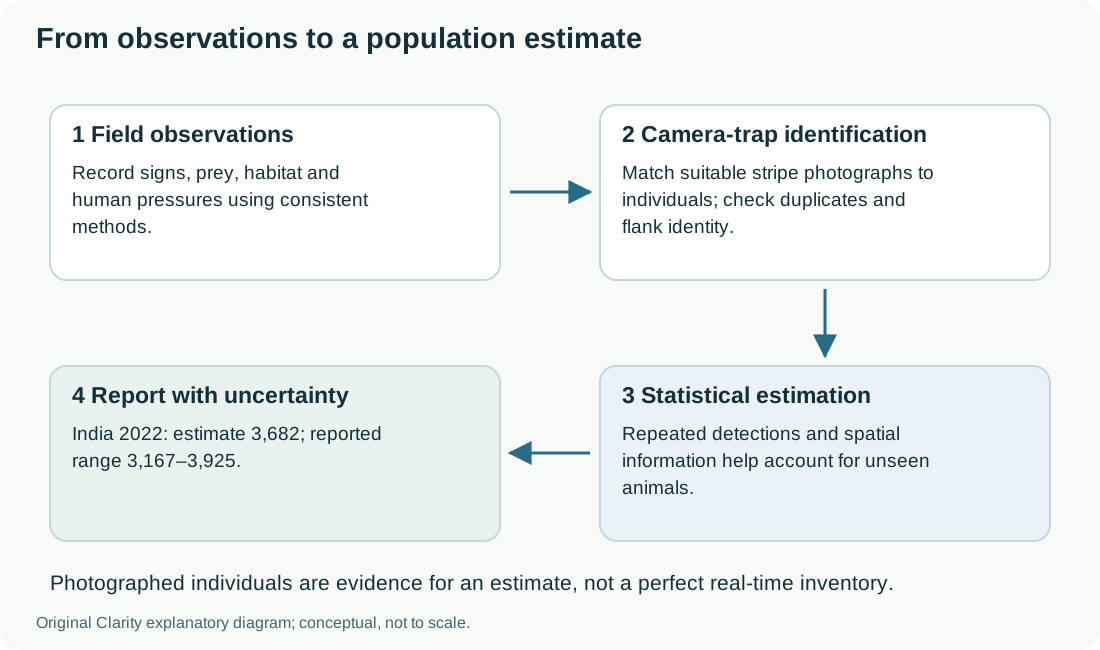
The All India Tiger Estimation combines field information, camera trapping and statistical analysis. It is commonly called the tiger census, but an estimate is more precise terminology. Not every tiger is photographed, and detection varies between places.
12.1 From field signs to camera-trap records
Field teams record tiger signs, prey indicators, habitat conditions and human pressures. Camera traps then photograph animals passing through selected locations. Stripe patterns help identify individual tigers from usable images. Records require quality control to avoid duplicate or incorrect identification.
Photographing 100 distinct tigers does not necessarily mean only 100 live in the study area. Some animals may never pass a camera during the sampling period. Camera placement, sampling duration and habitat influence detection probability.
12.2 Why statistical models are needed
Capture–recapture approaches use repeated detections to infer the number of animals not detected. In camera studies, “capture” can mean a photograph rather than physical capture. Spatial information improves inference by relating detections to where animals were recorded.
An estimate should therefore be reported with its uncertainty and method. A range is not a sign that counting failed. It communicates limits inherent in observing mobile, elusive wildlife. Comparisons between years must consider changes in sampling coverage and methods.
12.3 What M-STrIPES contributes
M-STrIPES stands for Monitoring System for Tigers—Intensive Protection and Ecological Status. It supports field recording, patrol monitoring and ecological information management. GPS-linked observations help managers identify coverage gaps and patterns of pressure.
The system is not simply a collar attached to every tiger. It does not replace camera trapping, field expertise or scientific estimation. Technology helps when records are accurate and managers act on the information. Past UPSC questions have tested its association with tiger-reserve monitoring and management.
13. Understanding India's 2022 estimate
The detailed All India Tiger Estimation 2022 reported 3,682 tigers, with a range of 3,167–3,925. The frequently quoted 3,167 figure came from the minimum estimate presented earlier. It should not be treated as an independent later population or confused with the detailed central estimate.
13.1 A dated estimate rather than today's exact count
The survey year remains 2022 even when the result is quoted in a later article. Births, deaths and dispersal continue after fieldwork. This edition does not turn the figure into a September 2026 census.
Earlier national estimates were 1,411 in 2006, 1,706 in 2010, 2,226 in 2014 and 2,967 in 2018. These indicate substantial recovery, while methodological and coverage changes require care in interpretation. The national 2006 estimate did not include Sundarbans in the same way as later rounds.
13.2 Recovery is uneven across landscapes
A national increase can coexist with decline or weak recovery in particular places. Strong source populations may grow while isolated populations remain vulnerable. Monitoring must therefore examine occupancy, breeding, prey and connectivity alongside total abundance.
Tigers outside reserves also matter. A reserve-only count would miss part of India's population and many dispersal routes. National success cannot be secured if surrounding landscapes become increasingly unsafe.
14. State-wise tiger estimates
Madhya Pradesh had the highest state estimate in the 2022 assessment, followed by Karnataka and Uttarakhand. These are estimated tigers within states, not counts of tiger reserves. A state with more reserves does not automatically contain more tigers.
The table reproduces the government's state figures for 2022. West Bengal combines 101 in the Sundarbans with two in northern West Bengal. Zero entries describe the result of that assessment; they should not become timeless claims that an animal can never occur there.
State figures from All India Tiger Estimation 2022
| State | Estimated tigers | State | Estimated tigers |
|---|---|---|---|
| Madhya Pradesh | 785 | Karnataka | 563 |
| Uttarakhand | 560 | Maharashtra | 444 |
| Tamil Nadu | 306 | Assam | 229 |
| Kerala | 213 | Uttar Pradesh | 205 |
| West Bengal | 103 | Rajasthan | 88 |
| Andhra Pradesh | 63 | Bihar | 54 |
| Telangana | 21 | Odisha | 20 |
| Chhattisgarh | 17 | Arunachal Pradesh | 9 |
| Goa | 5 | Jharkhand | 1 |
| Mizoram | 0 | Nagaland | 0 |
On smaller screens, swipe across the table to read every column.
These entries total 3,682. The geography becomes more meaningful when connected to habitat systems: central Indian forests, the Western Ghats, Terai landscapes, northeastern hills and the Sundarbans. State boundaries are administrative units within these ecological landscapes.
14.1 Reserve numbers are a different statistic
NTCA's December 2025 overview records 58 tiger reserves across 18 states. Madhav in Madhya Pradesh became the 58th reserve in March 2025. A reserve count changes through notification; a tiger estimate changes through population assessment. The two numbers should always carry their own reference dates.
Reserve area also requires a clear definition. Core area, buffer area and total notified area are different measurements. A question about the largest critical tiger habitat cannot automatically be answered using a ranking of total reserve area.
15. Sariska and Panna: recovery after local loss
Sariska and Panna show that local tiger extinction can be followed by recovery. They also show why translocation alone is insufficient. Habitat, prey, protection, monitoring and governance must support the released animals.
15.1 Sariska's reintroduction
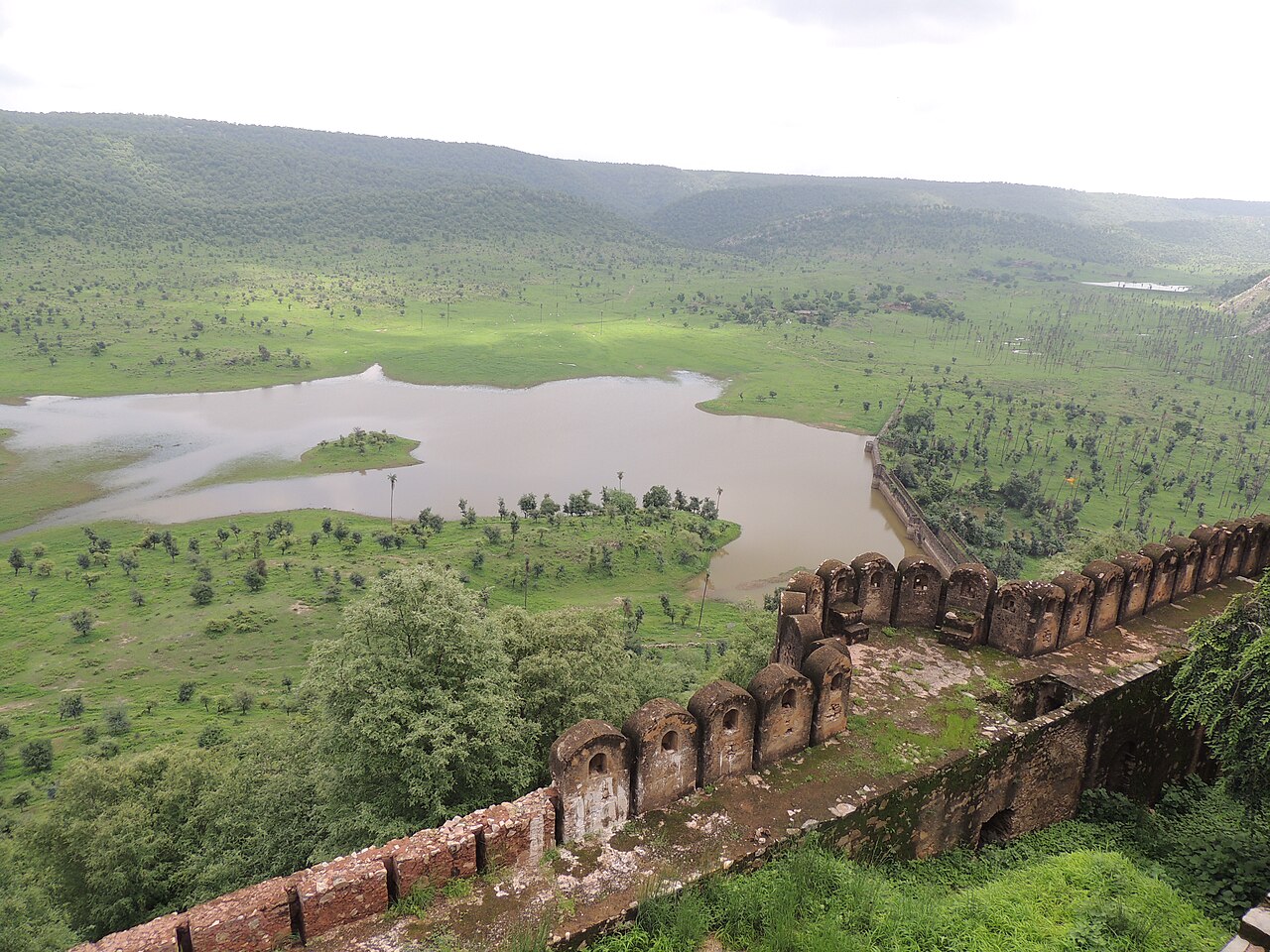
Sariska in Rajasthan lost its tigers during the crisis exposed in 2004–2005. Reintroduction began in 2008 using animals from Ranthambore. Radio collars and field monitoring helped track released animals and their adaptation. The intervention followed scientific and management planning.

The central lesson is institutional as well as biological. A reserve designation had not prevented poaching and local disappearance. Recovery required changes in protection and monitoring, alongside the return of tigers.
15.2 Panna's recovery programme
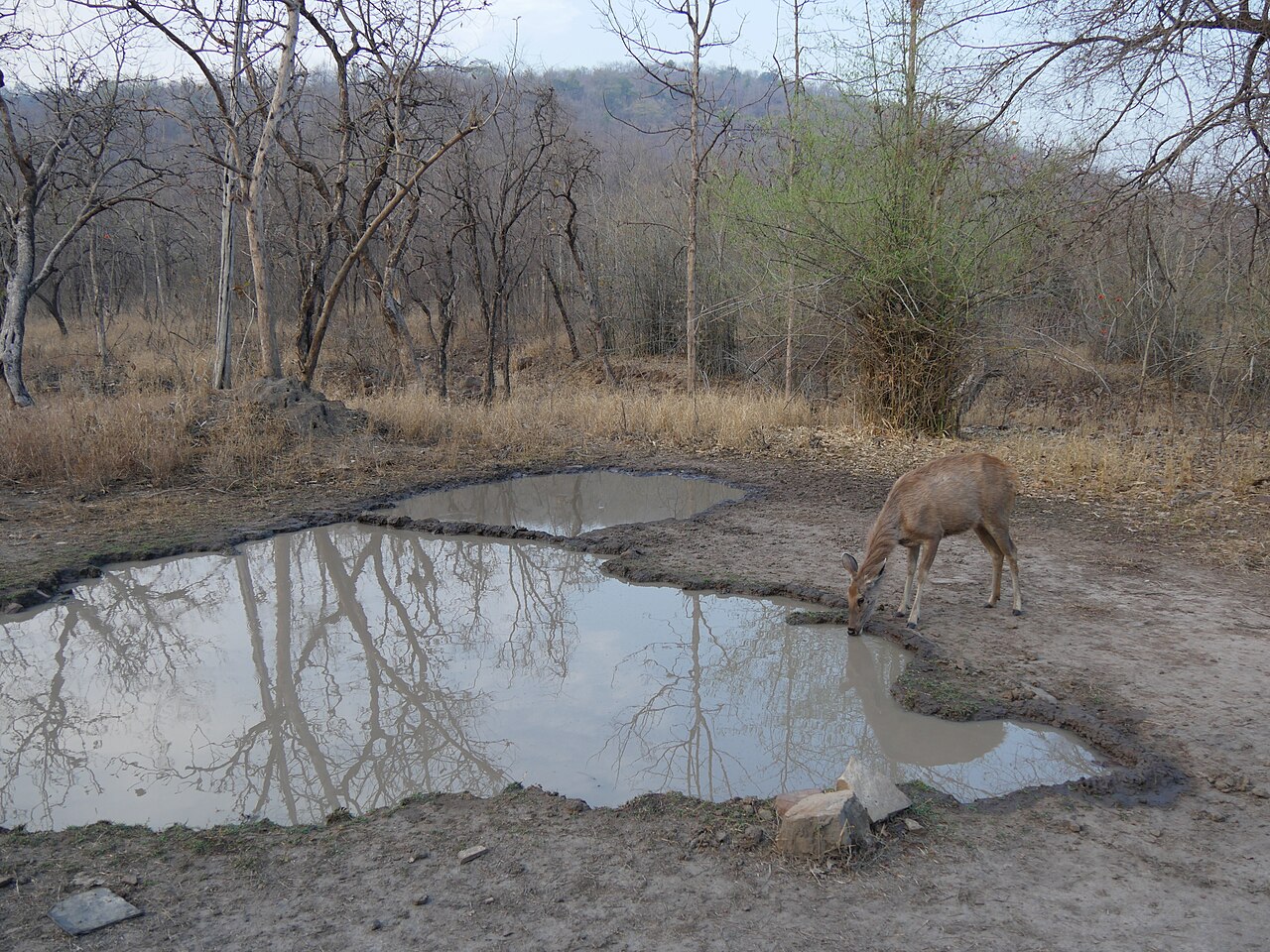
Panna in Madhya Pradesh lost its resident tiger population by 2009. Reintroduction began that year, including tigresses from Kanha and Bandhavgarh. Subsequent management and breeding enabled population recovery.

Moving animals requires attention to sex composition, genetics, prey and habitat suitability. Released individuals may move widely or attempt to return toward familiar areas. Continuous monitoring and adaptive management therefore remain essential.
15.3 What a success story should measure
A successful recovery is more than the arrival of a released tiger. Evidence should include survival, breeding and persistence across years. Managers must also track prey, habitat pressures and interactions with people.
Reintroduction can restore a lost population, but preventing local extinction is usually preferable. A celebrated recovery should not distract from the earlier failures that made it necessary.
16. The continuing threats to tiger conservation
Tigers face several interacting pressures. Some directly kill animals; others weaken the habitat and prey base needed for recovery. Understanding the causal chain helps match each threat with an effective response.
16.1 Poaching and illegal trade
Illegal demand for skins, bones and other parts can sustain organised wildlife crime. Tigers can also die in snares set for other animals. Removing a breeding adult can affect population growth beyond the loss of one individual.
Protection requires trained field staff, intelligence, investigation and prosecution. Trade networks connect source areas with transport routes and markets. Patrols inside reserves are essential, but cannot address the entire network alone.
16.2 Prey depletion and habitat fragmentation
A forest can appear green while supporting too little prey for tigers. Hunting, habitat degradation and livestock pressures can alter prey availability. Low prey density may force tigers to range more widely, increasing exposure to conflict.
Roads, railways, mines and expanding settlements can divide habitat. Small isolated populations face demographic and genetic risks. Infrastructure planning should protect key connections and avoid bottlenecks where possible.
16.3 Conflict, tourism and climate pressures
Livestock predation and attacks on people can provoke retaliation. Poor communication and delayed support can intensify local anger. Tourism can fund livelihoods and build public support, but crowding and intrusive behaviour can disturb wildlife. Revenue alone is not a measure of ecological success.
Climate change can alter water, prey habitats and disturbance patterns. The Sundarbans faces particular coastal pressures, including salinity and sea-level-related risks. These interact with freshwater flows, land use and human activity. A single-cause explanation would miss the complexity of the landscape.
17. International protection and cooperation
Tiger conservation is international because animal movement, trade and demand cross borders. Countries need compatible information and coordinated enforcement. Domestic habitat protection remains fundamental, but cooperation strengthens it.
17.1 What CITES Appendix I means
The tiger is listed in CITES Appendix I. International commercial trade in wild-sourced tigers and their parts is generally prohibited. Other movements are subject to strict conditions and applicable permit requirements. It is inaccurate to translate the listing into “no tiger can ever cross a border.”
Legitimate conservation, scientific or other permitted movements require the relevant legal scrutiny. Captive breeding does not automatically make every trade legal or beneficial. Domestic wildlife law and CITES obligations operate together.
17.2 Range-country cooperation and the Global Tiger Forum
The Global Tiger Forum is an intergovernmental body focused on tiger conservation. It supports cooperation among range countries and partners. The 2010 St Petersburg summit launched a global recovery effort with the ambition of doubling wild tiger numbers by 2022.
That shared ambition did not mean every country achieved the same result. Recovery has been strong in some South Asian landscapes while several Southeast Asian populations declined. Regional trends should therefore accompany global announcements.
17.3 Cross-border landscapes and enforcement
India and Nepal share tiger landscapes in the Terai. India and Bangladesh share the wider Sundarbans ecosystem. Cooperation can improve monitoring, habitat planning and responses to illegal trade. The ecological system continues across the political boundary.
International partnerships must also support local implementation. Funding, technology and training are useful only when institutions can sustain the work. Communities living with wildlife remain central to long-term outcomes.
18. What long-term success would look like
A rising national estimate is encouraging, but it is not the only test. Healthy source populations need safe connections with other suitable habitats. Prey populations, water systems and habitat quality must remain resilient. People sharing the landscape need safety and credible benefits.
18.1 From reserve protection to landscape stewardship
Reserve management should be connected with land-use decisions outside reserves. Corridors need protection before development closes the remaining bottlenecks. Restoration should recover appropriate native habitats and prey conditions. More intensive tourism or artificial feeding should not substitute for ecological health.
Monitoring should combine abundance, breeding, occupancy, connectivity and social outcomes. Transparent reporting makes it easier to identify weak landscapes before a crisis. Field staff also need training, equipment, institutional support and safe working conditions.
18.2 A balanced answer to the conservation challenge
India's model combines a long-running national programme, statutory institutions, scientific estimation and reserve expansion. Its continuing challenge is to make protection durable across diverse landscapes. That requires effective enforcement and fair, practical coexistence measures together.
The strongest conservation strategy protects tigers as part of living ecosystems. It also treats people near those ecosystems as participants in conservation decisions.
19. Writing an analytical answer
Use a clear claim, evidence and a mechanism linking the two. A tiger-count statistic establishes scale, but examples explain policy choices. The answer below balances India's recovery with the work still required.
Question: “The future of tiger conservation lies beyond the boundaries of tiger reserves.” Discuss.
Project Tiger has supported substantial recovery, with the 2022 national assessment estimating 3,682 tigers. Reserves protect important breeding populations, but tigers also depend on the wider landscape.
Young animals disperse to find territories and mates. Habitat connections therefore sustain genetic exchange and recolonisation. Landscapes such as Kanha–Pench and the Terai Arc demonstrate why roads, settlements and cross-border planning matter. An isolated reserve can remain vulnerable despite strong internal protection.
People living outside reserves also experience livestock losses and safety risks. Timely support, trained response teams, secure rights and meaningful participation are necessary for durable coexistence. Conservation that shifts costs onto local households can weaken public cooperation.
Policy should combine effective reserve management with corridor protection, cumulative infrastructure assessment and native-habitat restoration. Scientific monitoring must examine prey, breeding and connectivity alongside abundance. International cooperation can address shared habitats and illegal trade.
Reserves remain the foundation of tiger conservation. Their long-term success depends on connected habitats and socially credible management across the surrounding landscape.
20. Practice MCQs
These are newly written practice questions. The explanations distinguish biological facts, legal categories and dated estimates. They are not presented as verbatim previous-year questions.
1. Why can tiger stripes assist camera-trap studies?
- Every tiger has exactly the same stripe pattern
- Distinct patterns can help identify individuals from suitable images
- Stripe counts reveal exact age
- Stripes eliminate the need for statistical estimation
Answer and explanation
B. Individual patterns support identification. Image quality, flank matching and repeated detections still require careful analysis.
2. Which statement about tiger taxonomy is most accurate?
- The six traditional regional forms are six separate species
- All authorities permanently agree on exactly two subspecies
- The six-form tradition and the 2017 two-subspecies treatment use different classifications; the issue remains under review
- White tigers are a separate subspecies
Answer and explanation
C. State the framework being used. A white tiger is a colour variant, while regional classification remains scientifically debated.
3. Who chairs the National Tiger Conservation Authority?
- The Prime Minister
- The Union minister responsible for environment and forests
- The Chief Justice of India
- Every state's chief minister in rotation
Answer and explanation
B. The Prime Minister chairs the National Board for Wildlife, which is a different institution.
4. Which statement correctly describes tiger-reserve zoning?
- Every reserve has a statutory third transition zone identical to a biosphere reserve
- Core and buffer/peripheral areas have distinct purposes under the wildlife law
- No wildlife can occur in a buffer
- Notification automatically cancels all community rights
Answer and explanation
B. Tiger-reserve zoning differs from the biosphere-reserve framework. Rights safeguards and local circumstances remain relevant.
5. What does the 3,682 figure represent?
- The exact number alive on 9 September 2026
- The detailed national estimate from All India Tiger Estimation 2022
- The number of tiger reserves
- The global count of mature tigers in every survey
Answer and explanation
B. It belongs to the 2022 assessment and has a reported uncertainty range. It is not a live inventory.
6. Which state had the highest tiger estimate in the 2022 assessment?
- Karnataka
- Uttarakhand
- Madhya Pradesh
- Assam
Answer and explanation
C. Madhya Pradesh's estimate was 785, followed by Karnataka's 563 and Uttarakhand's 560. These figures count estimated tigers, not reserves.
7. The main ecological purpose of a corridor is to:
- Guarantee that all animals stay inside one reserve
- Support movement and exchange between habitat patches
- Replace the need for prey
- Create a tourist road through every forest
Answer and explanation
B. Corridors support dispersal and connectivity. Their value depends on actual habitat use and the barriers encountered.
8. Which reintroduction sequence is correct?
- Sariska began in 2008; Panna began in 2009
- Panna began in 1973; Sariska began in 1992
- Both began before the wildlife law
- Neither involved scientific monitoring
Answer and explanation
A. The programmes followed local losses and required protection, prey, translocation planning and continued monitoring.
9. Why should Russia's 2021–2022 tiger figure not be directly added to every other national estimate?
- Russia has no wild tigers
- It includes cubs, while other figures may use different age groups and survey years
- All national estimates use identical methods
- Only reserve counts can be added
Answer and explanation
B. Comparability depends on year, coverage, method and population unit. Adding unlike figures can manufacture a misleading global total.
10. Which statement best reflects CITES Appendix I protection?
- Every international movement is automatically legal if an animal is captive-bred
- International commercial trade in wild-sourced tigers is generally prohibited, with strict rules for other permitted movements
- It replaces all domestic wildlife laws
- It is simply another name for IUCN Endangered status
Answer and explanation
B. CITES regulates international trade through legal requirements. It differs from both extinction-risk assessment and national wildlife protection.
21. Frequently asked questions
These answers bring together the distinctions most easily confused in tiger conservation.
Are white tigers a separate species or subspecies?
No. White coloration is a genetic colour variant. It does not create a separate tiger species or subspecies, and breeding for appearance is not equivalent to conserving wild populations and their habitats.
Are there two or six tiger subspecies?
Six surviving regional forms are traditionally named. The 2017 Cat Classification Task Force treatment recognised two subspecies, while the Cat Specialist Group now notes continuing review. State the classification used rather than presenting an uncontested fixed count.
Does Endangered status conflict with a rising Indian population?
No. A global assessment considers extinction risk across the species' range. Recovery in India can coexist with severe declines elsewhere and continuing fragmentation or trade threats.
Is a tiger reserve the same as a national park?
No. A tiger reserve has a statutory tiger-conservation framework with core and buffer/peripheral areas. It can include areas with other protected designations. Boundaries and applicable rules must be checked for each designation.
Does a buffer mean no conservation rules apply?
No. Buffer management seeks coexistence while recognising livelihood and other rights. It remains important habitat and part of the conservation landscape. The legal and planning context still governs activities.
Why do reports quote both 3,167 and 3,682 tigers?
They refer to different presentations of the 2022 assessment. The detailed estimate is 3,682, with a reported range of 3,167–3,925. They should not be described as two successive annual censuses.
Does M-STrIPES track every tiger continuously?
No. It supports protection and ecological monitoring through field information and patrol records. Camera trapping, statistical estimation and other methods remain necessary.
Can tiger conservation succeed without local cooperation?
Protection may produce short-term gains, but durable coexistence requires safety, fair treatment and credible institutions. Communities need a meaningful role in decisions affecting their rights and livelihoods.
22. Sources and further reading
Primary sources used in this chapter are collected here for further reading.
View sources (22)
- Smithsonian tiger account
- Cat Specialist Group classification
- current tiger account
- CITES range-country record
- WWF's Southeast Asian recovery account
- WWF account of the government announcement
- Bhutan survey announcement
- IUCN Bangladesh account
- Amur Tiger Center's 2022 report
- WWF Malaysia
- GTF's 2023 announcement
- NTCA institutional history
- Wildlife law: tiger-conservation provisions
- Government statement on the 2022 result and range
- NTCA's official overview
- NTCA account of the reintroductions
- CITES appendices
- how CITES regulates trade
- National Tiger Conservation Authority
- All India Tiger Estimation 2022 summary
- Global Tiger Forum
- UPSC question-paper archive