

A cyclone is a large weather system in which winds circulate around an area of low atmospheric pressure. Tropical cyclones develop over warm seas. Some remain weak, while others grow into powerful storms with destructive winds, heavy rain and coastal flooding. To understand them, we need to connect three things: how air moves, how the ocean supplies energy, and how the surrounding atmosphere guides the storm.
What is a cyclone?
Air has weight. The air above us presses on the surface, producing atmospheric pressure. Pressure is not the same everywhere. When one area has lower pressure than its surroundings, a pressure difference develops. This difference pushes air towards the lower-pressure area. A weather map shows pressure using isobars, which are lines joining places with equal pressure. Closely spaced isobars show a large pressure change over a short distance and usually indicate stronger winds.
A cyclone is organised around such a low-pressure centre. Near the surface, air moves inward while also circulating around the centre. This inward movement is called convergence. Much of the converging air rises, encouraging cloud formation when enough moisture is present. A cyclone is therefore a whole circulating weather system, often hundreds of kilometres across. The spinning funnel of a tornado is a different, much smaller phenomenon.
The word cyclone describes more than one kind of low-pressure system. A tropical cyclone obtains much of its energy through exchanges of heat and moisture with a warm ocean. An extratropical cyclone develops mainly through contrasts between warm and cold air masses. Both have low pressure and rotating winds, but their structure and sources of energy differ. We will return to that comparison after following the life of a tropical cyclone.
Why winds spiral, and how an anticyclone differs
If pressure differences were the only influence, air would move directly towards the low-pressure centre. Earth’s rotation changes its path. This apparent turning of moving air, viewed from the rotating Earth, is called the Coriolis effect. It deflects motion to the right in the Northern Hemisphere and to the left in the Southern Hemisphere. “Right” and “left” refer to the direction in which the air is already moving.
Consider air approaching a low-pressure centre from its northern side. It initially moves southward. In the Northern Hemisphere, its path bends towards its right, which is westward. Air approaching from the other sides is also deflected. Together these motions produce an anticlockwise circulation around the low. South of the equator, the opposite deflection produces a clockwise circulation. Friction near the ground allows the winds to cross the isobars towards lower pressure, so their path spirals inward instead of forming a perfect circle.
An anticyclone is organised around high pressure. Near the surface, air spreads outward, a movement called divergence. Its circulation is clockwise in the Northern Hemisphere and anticlockwise in the Southern Hemisphere. Air commonly sinks within a high-pressure system and warms as it is compressed. This often discourages cloud formation, although fog or low cloud can still occur. In a developing high, convergence higher in the atmosphere can help supply the sinking air.
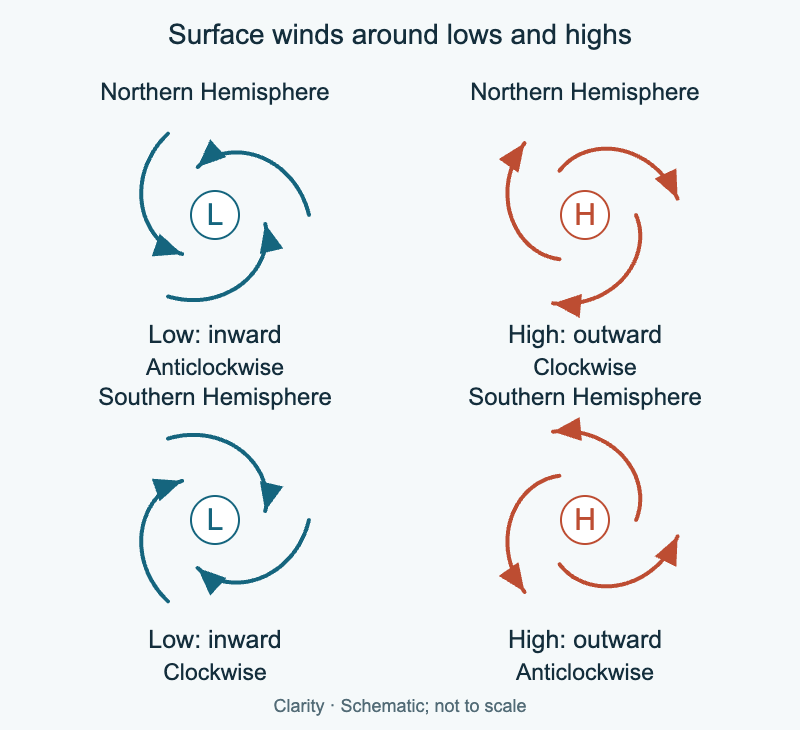
Biparjoy in the Arabian Sea in 2023 was a Northern Hemisphere cyclone, with anticlockwise circulation. Freddy, which crossed the South Indian Ocean towards Madagascar and southern Africa in the same year, was a Southern Hemisphere cyclone, with clockwise circulation. These are examples of the hemispheric pattern. WMO describes Freddy’s South Indian Ocean journey.
The Coriolis effect becomes weak near the equator and is zero at the equator itself. Tropical cyclones consequently form very rarely within about 5° latitude of it. This is a useful geographical pattern, not an absolute boundary: unusual disturbances with enough existing rotation can develop closer to the equator. Coriolis helps organise the circulation; it does not supply the storm’s energy.
How a warm ocean supplies energy
The ocean helps power a tropical cyclone by transferring heat and water vapour into the air above it. Evaporation changes liquid water into water vapour. This process takes energy from the sea, storing it in the moist air. Water vapour is an invisible gas; it is different from the tiny droplets that make a cloud visible.
When moist air rises, the surrounding pressure decreases, so the air expands and cools. Eventually some water vapour condenses into cloud droplets. Condensation releases the energy taken up during evaporation. This is called latent heat: energy absorbed or released during a change of state. The released heat helps keep rising cloudy air warmer and more buoyant than it would otherwise be, supporting further upward motion.
Thunderstorms can then become organised around a shared circulation. Air enters at low levels, rises in the storm’s deep clouds, and spreads outward high in the atmosphere. When the circulation removes enough air from the column, surface pressure falls. A stronger pressure difference can strengthen the surface winds. Those winds increase exchanges of heat and moisture with the ocean, helping the circulation grow when other conditions remain favourable.
This connected process explains why the sea is sometimes described as the storm’s “fuel”. The fuel is not warm water being sucked into the sky as a solid column. It is the continuing transfer of energy and moisture. A mature tropical cyclone also develops a warm core: air within its central region is warmer than air outside the storm at comparable heights. Condensation heating and sinking air in the eye both contribute to this structure.
The conditions that help a tropical cyclone form
Warm seawater alone does not produce a cyclone. Large areas of tropical ocean are warm without containing an organised storm. Development requires several oceanic and atmospheric conditions to work together, usually around an existing disturbance such as a cluster of thunderstorms or a weak low-pressure circulation.
A sufficiently warm and deep layer of water
A commonly used guide is sea-surface water near or above 26.5°C, with warm water extending through roughly the upper 50 metres. These are useful guides to favourable conditions, not a universal on–off switch. The atmosphere above the ocean also matters. Depth is important because strong winds stir the sea. If warmth is confined to a thin surface layer, mixing can bring cooler water upward and reduce the energy supply. A deeper warm layer is harder to cool in this way. NOAA explains these formation conditions.
Moist air and vigorous upward motion
The air must contain enough moisture to sustain deep clouds. Rising air also needs to remain buoyant relative to its surroundings. This is easier when the atmosphere becomes sufficiently cooler with height. If very dry air enters the storm, evaporation of cloud droplets can cool the air and disrupt the organised thunderstorms. Moisture several kilometres above the surface therefore matters as well as humidity near the sea.
Existing rotation and a location away from the equator
A developing storm needs a starting circulation. Converging winds can strengthen the rotation already present in a disturbance. Earth’s rotation helps maintain an organised, large-scale vortex away from the equator. The combination explains why cyclone formation is concentrated in particular tropical belts rather than occurring uniformly across every warm sea.
Limited change in wind with height
Vertical wind shear means a change in wind speed or direction between lower and higher levels of the atmosphere. Strong shear can tilt a developing circulation and carry its thunderstorms away from the low-pressure centre. This separates the organised heating from the circulation it needs to strengthen. Low shear makes it easier for the lower circulation and the deep clouds above it to remain aligned.
Air must be able to spread outward aloft
Air rising through the storm cannot simply accumulate overhead. It needs routes to spread outward in the upper atmosphere. This upper-level outflow completes the broad circulation. A favourable outflow pattern can assist development, while a disturbed upper atmosphere can hinder it. Even with all these ingredients, many disturbances fail to become named storms.
Inside the storm: eye, eyewall and rainbands
A strong tropical cyclone has several connected parts. These parts explain why conditions can change sharply as the storm passes a place. They also explain why the point of lowest pressure is not the place with the strongest surface wind.
The eye is the central region of a well-developed storm. Air commonly sinks there, becoming warmer and drier as it descends. Winds are relatively light, and cloud cover may break. The surface pressure is lowest near the centre. An eye is not present in every tropical cyclone, and a storm can be dangerous without a clear eye on satellite images.
The eyewall surrounds the eye. It contains deep thunderstorms, powerful rising air, intense rain and usually the strongest surface winds. The pressure changes rapidly across this region. Beyond it, curved bands of clouds and thunderstorms extend outward. These rainbands can bring repeated bursts of rain and squalls far from the centre. The US National Weather Service describes this structure.
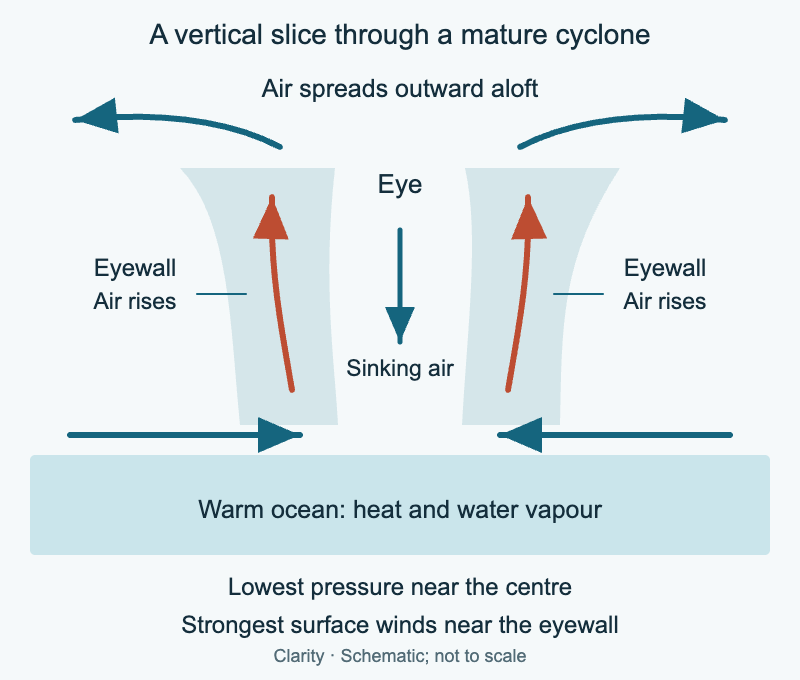
Near the surface, air spirals inward towards the storm. It rises most strongly in the eyewall and other deep clouds. High above, much of this air flows outward. A vertical drawing shows this inward–upward–outward movement, while a map viewed from above shows rotation. Both views describe the same storm.
If the eye passes over a place, a temporary lull can be followed by violent winds from a different direction when the opposite eyewall arrives. The lull is therefore not an all-clear. Official warnings, rather than a brief improvement outside, determine when it is safe to leave shelter.
How IMD describes a storm’s strength
A disturbance may strengthen from a low-pressure area into a depression, a deep depression and then a cyclonic storm. It may also weaken before completing that sequence. These terms describe its strength at a particular time, rather than separate kinds of weather with unrelated causes.
For systems over the sea, the India Meteorological Department uses maximum sustained surface wind to distinguish the categories below. “Sustained” means averaged over a period, not the strongest momentary gust. IMD uses a three-minute average at the standard observing height of 10 metres in an unobstructed setting. One knot is one nautical mile per hour, equal to 1.852 km/h. IMD’s cyclone FAQ provides the categories and observing convention.
Low-pressure area
A low-pressure area has lower pressure than its surroundings, but its wind circulation is comparatively weak. In the wind-based classification, maximum sustained winds are below 17 knots, shown by IMD as below 31 km/h. Clouds and rain may already be present. The word “low” describes the weather system, not a promise of low rainfall or negligible flood risk.
Depression
A depression has a better-defined circulation and maximum sustained winds of 17–27 knots, or 31–49 km/h in IMD’s published bands. Converging moist air can produce widespread rain. Depressions associated with the monsoon are particularly important for rainfall over India, even when they never develop the compact structure of a powerful tropical cyclone.
Deep depression
A deep depression has strengthened further, reaching 28–33 knots, shown as 50–61 km/h. It remains below the threshold at which a newly forming North Indian Ocean storm receives a name. That naming threshold is an administrative and meteorological convention; it does not mean that rough seas, squalls or heavy rain begin only after naming.
Cyclonic storm
At 34–47 knots, shown as 62–88 km/h, the system is classified as a cyclonic storm. A newly developing storm in this basin is assigned the next name from the agreed list. The circulation is now strong enough to meet the named-storm threshold, although an eye may still be absent. Its subsequent category can change while the name remains the same.
Severe cyclonic storm
A severe cyclonic storm has maximum sustained winds of 48–63 knots, shown as 89–117 km/h. The stronger wind increases the threat to exposed boats, trees and vulnerable structures. Montha reached this category before its Andhra Pradesh landfall in October 2025. The category describes its maximum wind; rainfall and surge still require their own forecasts.
Very severe cyclonic storm
The very severe category covers 64–89 knots, shown as 118–166 km/h. Such winds can cause extensive damage where buildings, power lines and vegetation are exposed. Biparjoy was in this category when it crossed the Gujarat coast in June 2023. A storm’s size, movement and the strength of local construction still influence how widely that damage occurs.
Extremely severe cyclonic storm
An extremely severe cyclonic storm reaches 90–119 knots, shown as 167–221 km/h. Biparjoy reached this category earlier in its life over the Arabian Sea before weakening. This is why a report describing a storm’s lifetime maximum may use a stronger label than a report describing its landfall. Both can be correct when their times are stated.
Super cyclonic storm
The highest IMD class begins at 120 knots, shown as 222 km/h or more. A super cyclonic storm is an exceptionally intense member of the same tropical-cyclone family, rather than a storm with a new energy source. The label warrants serious attention, but it still cannot replace separate information about coastal water levels, rainfall or the geographical reach of dangerous winds.
The sequence below brings these wind ranges together for comparison. A real disturbance can stop strengthening at any stage or move back down the categories as it weakens.
IMD wind categories for the North Indian Ocean
| Category | Maximum sustained wind | IMD’s published km/h bands |
|---|---|---|
| Low-pressure area | Below 17 knots | Below 31 km/h |
| Depression | 17–27 knots | 31–49 km/h |
| Deep depression | 28–33 knots | 50–61 km/h |
| Cyclonic storm | 34–47 knots | 62–88 km/h |
| Severe cyclonic storm | 48–63 knots | 89–117 km/h |
| Very severe cyclonic storm | 64–89 knots | 118–166 km/h |
| Extremely severe cyclonic storm | 90–119 knots | 167–221 km/h |
| Super cyclonic storm | 120 knots or more | 222 km/h or more |
Swipe across the table to read all columns.
The kilometre-per-hour bands follow IMD’s published rounded values; they should not be reconstructed by rounding each knot endpoint independently. Also, agencies elsewhere use different averaging periods and classification systems. An Atlantic hurricane category cannot be substituted directly for an IMD category.
Wind category alone cannot describe total danger. A weaker, slow-moving system can cause severe river flooding. A large storm may push seawater towards a broad stretch of coast even if its peak wind is lower than that of a compact storm. Always distinguish intensity, the storm’s strength, from size, the area covered by its circulation.
Hurricanes, typhoons and tropical cyclones
The same broad type of storm has different regional names. In the Atlantic and the eastern and central North Pacific, a sufficiently strong tropical cyclone is called a hurricane. In the western North Pacific, it is called a typhoon. The term tropical cyclone is used in the Indian Ocean and around Australia and the South Pacific. These names do not imply different physical engines.
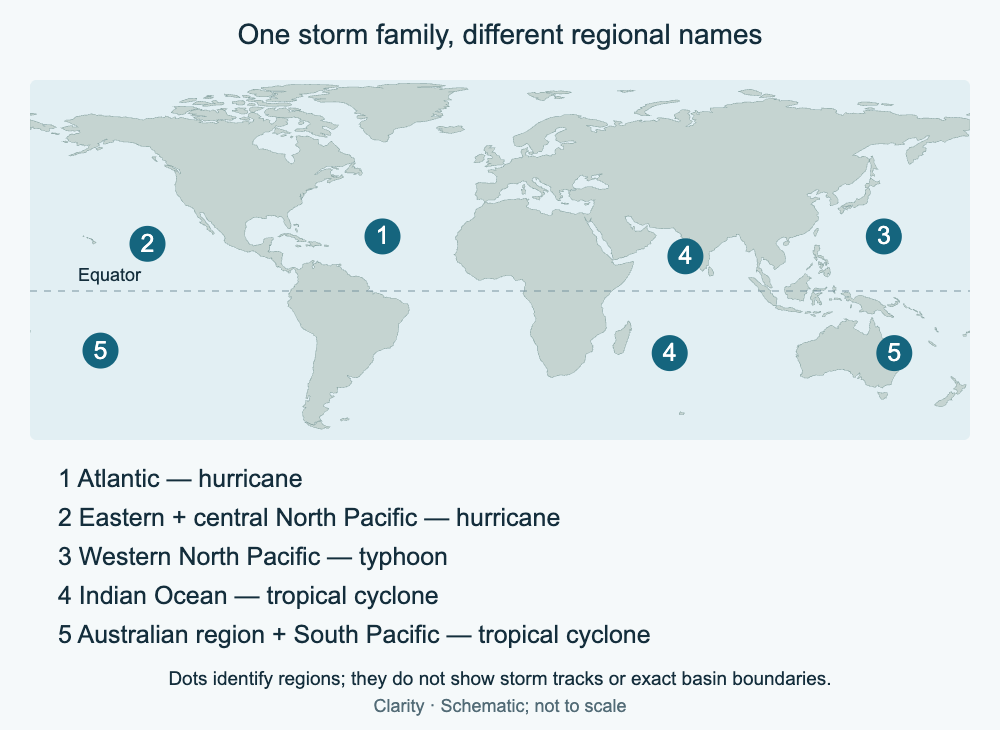
There is also a distinction between the general family of storms and a regional intensity label. For example, an Atlantic tropical storm is not yet a hurricane. Hurricane and typhoon status generally begin at 64 knots under the relevant agency’s observing convention. India begins naming a system earlier, at its cyclonic-storm threshold of 34 knots. Comparing names without checking the wind scale can therefore be misleading. The Met Office explains the regional terminology.
Where and when tropical cyclones develop
Tropical cyclones commonly develop over tropical oceans several degrees away from the equator, often within roughly 5°–30° latitude in either hemisphere. This belt brings together warm seas and enough influence from Earth’s rotation. A storm may later travel well outside the latitude where it formed. Formation zones and the full length of storm tracks are therefore different geographical features.
Warm water is widespread in the tropics, but the required atmospheric conditions are not. The western North Pacific is an active basin, while the South Atlantic and southeastern Pacific have very little tropical-cyclone activity. Unfavourable combinations of cooler water, atmospheric stability, wind shear and limited initiating disturbances help explain the contrast. Rare exceptions mean that “uncommon” is more accurate than “impossible”.
The North Indian Ocean has two main favourable periods: before the southwest monsoon, especially around April–June, and after it, broadly October–December. May and November are prominent months in long-term records. During the main summer monsoon, strong changes in wind with height often hinder the development of intense tropical cyclones. However, monsoon lows and depressions remain important and can bring extensive rain over India.
Elsewhere, the most active months generally occur during the warmer part of the year and afterwards, because oceans retain heat. The Atlantic hurricane season runs from June to November, while much Southern Hemisphere activity occurs from November to April. These calendars describe periods of greater likelihood; they do not prevent an unusual storm outside them.
Why storm tracks bend
The winds rotating around a cyclone are different from the winds that carry the whole system from place to place. A cyclone’s movement depends strongly on the surrounding flow through a deep layer of the atmosphere. These broader winds are often called steering winds. The depth and strength of the storm affect which layers influence it most.
In the tropics, trade winds and the circulation around a subtropical high often guide storms generally westward. A subtropical high is a broad area of high pressure outside the equatorial belt. If a weakness develops in it, a storm may turn towards higher latitudes. It may then encounter winds blowing from west to east and turn eastward.
This change from a broadly westward path to a poleward and then eastward path is called recurvature. In the Northern Hemisphere, the bend often leads northward and then northeastward. In the Southern Hemisphere, the corresponding bend is southward and then southeastward. Some storms remain on a westward path, stall, loop or turn differently.
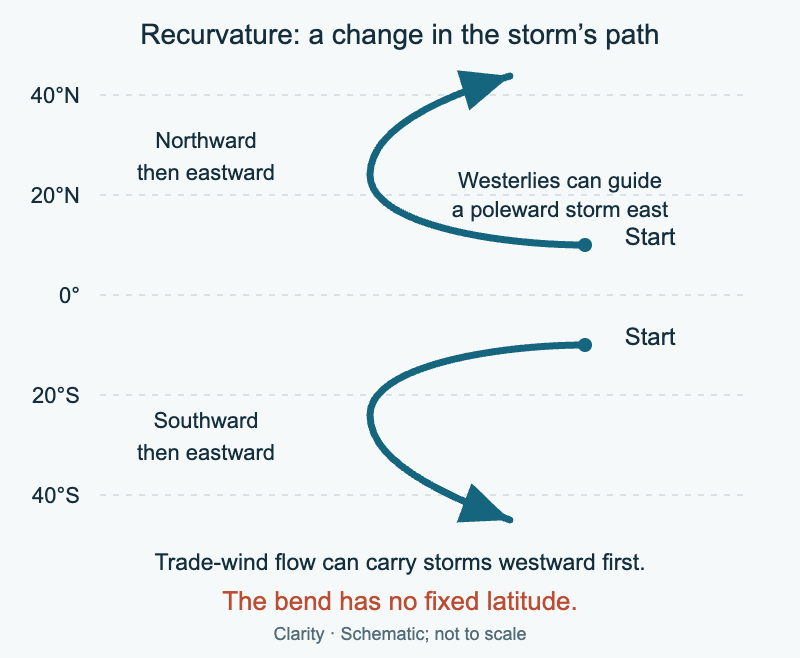
Recurvature often becomes relevant in the subtropics, around the twenties or thirties of latitude, but there is no fixed “turning latitude”. A storm can turn earlier or later depending on the position and strength of surrounding highs and troughs. A trough is an elongated area of relatively low pressure. Forecasts follow these changing weather patterns; they do not predict landfall by extending one standard curved line across a map.
Why the Bay of Bengal and Arabian Sea differ
India has cyclone-producing seas on both sides, but the Bay of Bengal has historically produced more cyclonic storms than the Arabian Sea. The difference comes from the combined behaviour of the ocean and atmosphere. It cannot be explained by saying that one sea is always warm and the other always cold.
The Bay often contains warm surface water and receives substantial rain and river runoff. Fresh water is less dense than salty water. Where a relatively fresh surface layer lies above saltier water, it can resist vertical mixing. Under suitable conditions, this layered structure helps reduce the amount of cooler subsurface water mixed upward by storm winds. The actual effect depends on the depth and temperature of the layers, not simply on low salinity itself. Research on ocean barrier layers explains this influence on cyclone intensification.
The Bay also receives disturbances associated with the monsoon circulation and weather systems moving westward from the region towards the western Pacific. These can provide the initial rotation and organised clouds from which a cyclone develops. Many do not strengthen, but the availability of these starting disturbances matters.
The Arabian Sea is also capable of supporting very intense storms. However, during the southwest monsoon, strong winds can produce substantial shear and stir or upwell cooler water, particularly in its western parts. Dry air from nearby arid regions can also interfere with storm development when it enters the circulation. Conditions change across the basin and through the seasons, so these are influences rather than permanent barriers.
Coastal impact is a separate question from storm formation. The northern Bay narrows towards low-lying deltaic coasts in India and Bangladesh. Its shallow coastal waters and densely occupied floodplains can make storm surge especially damaging. On the Arabian Sea side, Gujarat, Pakistan and Oman face serious cyclone hazards too, while storms offshore can affect the Indian west coast through waves, wind and rain.
Recent intense Arabian Sea storms show why historical frequency should not become a claim that the western coast is safe. A basin comparison must state the years studied and whether it counts all disturbances, named storms or the strongest storms. A historical ratio should not be presented as a fixed rule for every future season.
Rapid intensification and the ocean below the storm
A storm’s wind speed does not increase at a steady rate. It can strengthen slowly, remain almost unchanged, or intensify quickly when favourable conditions coincide. Rapid intensification describes a large increase in maximum sustained wind over a short period. A widely used definition is an increase of at least 30 knots in 24 hours, approximately 56 km/h. This is a rate of change, not a separate wind category. The US National Hurricane Center defines the term.
A deep reservoir of warm water can support rapid strengthening because mixing does not quickly expose cold water. Low shear, moist surrounding air and an increasingly organised inner circulation can also help. Yet favourable conditions do not guarantee rapid intensification. Small changes in the storm’s inner structure can affect what happens next.
Ocean heat content describes the amount of thermal energy within a volume or layer of seawater. It helps distinguish a thin warm surface from a much deeper warm reservoir. Two places with the same surface temperature can therefore support different storm responses. The storm itself changes the ocean: stirring and upward movement of cooler water can leave a cold wake behind it and reduce the energy available to a slow-moving or following storm. Australia’s Bureau of Meteorology explains this ocean feedback.
Very strong storms can also undergo an eyewall replacement cycle. A second ring of thunderstorms forms outside the original eyewall and may eventually replace it. Maximum winds can weaken temporarily while the wind field expands. Thus a fall in peak wind does not always mean that the area affected by strong winds is shrinking. NOAA describes how an eyewall replacement can change strength and size.
Landfall and the rain that continues inland
Landfall occurs when the centre of a cyclone crosses the coastline. It does not mark the first arrival of bad weather. Rainbands, strong winds, high waves and rising coastal water may arrive before the centre. They can also affect places that the centre never crosses.
After moving over land, a tropical cyclone loses much of its direct supply of heat and moisture from the sea. Rougher terrain disrupts the low-level circulation. Its maximum winds usually weaken, and its eye may disappear. This weakening concerns the storm’s organised wind structure; it does not mean that its clouds, moisture and circulation vanish immediately.
A weakened circulation can continue moving inland as a depression or low-pressure area. It may retain large amounts of moisture and draw in more from surrounding winds. Air still converges and rises, producing rain. Hills can force moist air upward, while slow movement can keep rainfall over the same catchment. A catchment is the area from which water drains into a river or reservoir.
This explains how a storm that made landfall on the east coast can later contribute to heavy rain in Chhattisgarh, Madhya Pradesh or farther west. The inland place is usually experiencing the weakened system and its rain-bearing circulation, rather than an ocean-strength cyclone with an intact eye. Equally, many monsoon depressions affecting central India never became named cyclones at all.
Gulab in 2021 provides a striking example of continuity and change. Its weakened circulation crossed India, and a related disturbance subsequently emerged over the Arabian Sea and developed into Shaheen. The sequence does not mean that Gulab remained a strong cyclone all the way across land. It shows that a surviving disturbance can encounter a fresh energy supply and reorganise. IMD documents the sequence in its 2021 report.
How wind and rain cause damage
The main cyclone hazards arise through different physical processes. Separating them helps explain why one town may experience destructive wind, another severe river flooding, and a coastal settlement seawater inundation during the same storm.
Strong winds exert pressure on roofs, trees, power lines and other exposed structures. Loose objects become dangerous debris. Buildings differ in their ability to resist wind because of their shape, materials, connections and maintenance. The storm’s strongest winds are usually concentrated near the eyewall, but the broader wind field can affect a much larger area.
Heavy rain causes flooding when water arrives faster than the ground, drains and rivers can absorb or carry it away. Previous rainfall matters: a catchment already saturated with water produces more runoff. Urban surfaces such as roads and roofs also send water rapidly into drains. A storm’s forward speed influences how long rain persists over a place, so a slower storm can produce large accumulations even with a lower wind category.
In steep terrain, intense rain can trigger landslides and sudden flows through valleys. Farther downstream, rivers may continue rising after local rainfall eases because water is still arriving from upstream. Cyclone impacts therefore need to be followed across the whole drainage basin, not only along the coast or directly under the centre.
Storm surge, tide and coastal flooding
A storm surge is an abnormal rise of seawater above the level expected from the astronomical tide. Strong winds blowing towards land push water towards the coast. The water cannot spread or escape equally easily in every coastal setting, so its level rises. Low atmospheric pressure also contributes to the rise, but wind is usually the main driver of a damaging surge.
The regular rise and fall caused mainly by the gravitational influence of the Moon and Sun is the tide. The water level resulting from tide together with storm surge is called the storm tide. Large waves can ride on top and run farther up a beach or structure. Storm surge, storm tide and wave run-up are connected, but they are not interchangeable terms. NOAA distinguishes surge from storm tide.
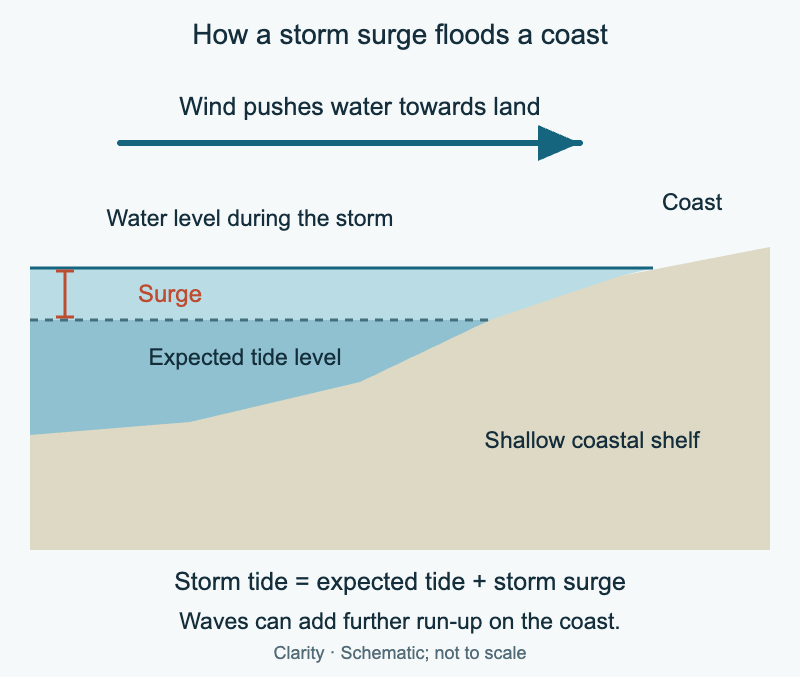
A broad, shallow continental shelf often allows a larger coastal rise than a steeply deepening seabed. Coastal shape, the direction of the wind, the storm’s size and its approach also matter. Water can be driven into bays and river mouths. At the head of the Bay of Bengal, shallow waters and low deltaic land create a particularly dangerous combination. There is no single surge height that applies to every cyclone of a given wind category. The National Hurricane Center explains these controls.
Onshore winds may be strongest on one side of the track, but the “dangerous side” cannot be reduced to a universal rule for every coastline. The coast’s orientation and the actual wind field must be considered. Surge can also hold back a river’s discharge just as heavy rain is sending more water downstream. This combination is called compound flooding.
A storm surge is different from a tsunami. A tsunami usually begins with a sudden displacement of water, commonly caused by an undersea earthquake. A cyclone surge develops through atmospheric forcing over hours. Both can flood coasts, but their origins and warning systems differ.
Why coastal shape and ecosystems matter
Coastal morphology means the shape and physical features of a coast. A rocky shore, sandy beach, river delta and tidal creek do not respond in the same way to a cyclone. Waves can remove beach sediment, cut through dunes and carry sand inland. Currents may deposit that sediment elsewhere, changing channels and shorelines.
Low-lying deltas are exposed because even a modest increase in water level can spread across a wide area. River mouths and tidal creeks can carry seawater inland. Salt water may damage freshwater supplies, crops and soils after the immediate flood recedes. Whether an embankment helps depends on its design, condition and the drainage routes around it; a breached or poorly drained enclosure can retain floodwater.
Mangroves and other coastal vegetation can reduce wave energy and slow water movement in suitable settings. Their effect depends on the width and condition of the vegetation, water depth and the force of the event. They form one part of risk reduction alongside shelters, warnings and sound land-use decisions. They cannot guarantee protection against every severe surge.
Fishing communities face hazards both at sea and ashore. Large waves can reach the coast from a distant storm before local weather looks threatening. Boats, landing centres, nets, cold storage and access roads may be damaged. Turbid runoff and disturbed coastal waters can also affect marine habitats. Restoring a harbour alone may therefore leave livelihoods disrupted if boats, markets or clean water remain unavailable.
How a cyclone is observed and forecast
Much of a cyclone’s life takes place over water where surface observations are sparse. Forecasters therefore combine several kinds of evidence. No single instrument measures every part of the storm, and each source has limits.
Satellites show the organisation of clouds, the development of deep thunderstorms and changes around the centre. Infrared measurements reveal cloud-top temperatures, helping identify very high, cold cloud tops. Some satellite instruments estimate ocean-surface winds, while buoys and ships provide measurements near the sea surface. As a storm approaches land, Doppler weather radar helps track rainbands, precipitation and winds within its coverage.
Numerical weather models use observations and the laws of atmospheric motion to calculate possible future states. An ensemble forecast runs a collection of simulations with different starting conditions or model assumptions. Agreement or disagreement between them helps forecasters assess uncertainty. Forecasts are updated as the observations and calculations change.
A forecast track shows the expected movement of the centre. An uncertainty cone represents uncertainty about that centre’s future position; it does not enclose every place that may receive strong wind, heavy rain or surge. Those hazards can extend beyond it. Similarly, an accurate track forecast does not guarantee an equally accurate prediction of intensity, especially during rapid strengthening. NOAA explains what the track cone represents.
Names, warning stages and colour codes in India
A storm’s personal name helps people distinguish it from other systems and follow its bulletins. The Regional Specialised Meteorological Centre in New Delhi, operated by IMD, names qualifying storms over the Bay of Bengal and Arabian Sea using an agreed regional list. The list adopted in 2020 contains 169 names contributed by 13 member countries. A system forming in this basin receives a name when it reaches cyclonic-storm strength, beginning at 34 knots. Its name does not announce which country will be hit. IMD describes the naming arrangement.
Warnings serve a different purpose: they communicate expected weather, places at risk and the time available for action. IMD’s four-stage cyclone warning system moves from an early watch towards more specific warnings and an inland outlook. The timing below refers to when the stages are normally issued in advance of the stated event.
The pre-cyclone watch provides an early signal that a developing disturbance may become a cyclone and affect a coastal belt. Its purpose is to start preparations while considerable uncertainty may remain. Authorities can review shelter readiness, communications and resources before the threat becomes immediate.
The cyclone alert gives more specific information about the storm and the coastal areas likely to experience adverse weather. This allows preparations to become more local: identifying vulnerable settlements, arranging transport and communicating with people at sea. An alert should be read as a prompt to prepare for the stated hazards.
The cyclone warning describes the approaching threat in greater detail, including expected landfall, wind, rain and surge. It is updated as the storm approaches. At this stage, the time needed to complete protective actions matters: a road or harbour can become unsafe before the storm’s centre arrives.
The post-landfall outlook extends attention to the interior. It describes where the circulation is likely to move after crossing the coast and where adverse weather may continue. This matters to inland districts that can face heavy rain and flooding even as the storm’s maximum wind decreases.
IMD’s four-stage cyclone warning system
| Stage | Timing | Main purpose |
|---|---|---|
| Pre-cyclone watch | About 72 hours before expected adverse weather | Draw attention to the developing threat and possible affected coastal belt. |
| Cyclone alert | At least 48 hours before expected adverse weather | Give more specific information so preparations can advance. |
| Cyclone warning | At least 24 hours before expected adverse weather | Communicate the approaching threat and the action required. |
| Post-landfall outlook | At least 12 hours before expected landfall | Describe likely movement after landfall and adverse weather inland. |
Swipe across the table to read all columns.
Despite its name, the post-landfall outlook is issued before landfall. It looks ahead to what may happen afterwards. In IMD’s general colour system, green indicates no warning, yellow calls for awareness, orange for preparedness and red for action. Within the cyclone stages, alert, warning and post-landfall outlook are associated with yellow, orange and red respectively. Always read the bulletin’s locations, hazards and instructions along with the colour. IMD sets out the four stages and their colours.
How preparedness reduces losses
A cyclone becomes a disaster when hazardous weather meets exposed people and assets that cannot withstand it. Preparedness therefore connects a forecast to practical decisions: moving people from threatened areas, securing boats and equipment, protecting essential services, and arranging safe shelter before travel becomes dangerous.
Evacuation requires more than a warning message. People need to know where to go, how to get there and whether a shelter can accommodate their needs. Transport, accessible facilities, drinking water, sanitation and help for children, older people and people with disabilities affect whether an evacuation succeeds. Fishers need warnings early enough to return before rough seas close a harbour.
Buildings and infrastructure also need protection before a storm develops. Secure roof connections reduce the chance of roof loss. Safe siting and resilient construction help protect power, water and communications. Drainage routes must remain functional, especially where rainfall flooding can occur alongside surge. Coastal ecosystems and appropriate setbacks can reduce exposure over the longer term.
After the storm, the hazards change rather than ending at once. Floodwater, damaged electrical systems, unstable structures and unsafe drinking water can delay a safe return. Local authorities’ instructions remain important during this period. India’s cyclone-management guidelines provide the broader framework for shelters, warnings and risk reduction.
What climate change can alter
A warmer climate changes several ingredients that affect cyclone risk. Warmer air can hold more water vapour, and a warmer ocean can provide more energy under suitable atmospheric conditions. Rising mean sea level also gives coastal flooding a higher starting level. These influences concern different hazards and should be examined separately.
The IPCC assesses that tropical-cyclone rainfall rates and the proportion of stronger storms are expected to increase with warming. This does not imply that the total number of tropical cyclones must rise everywhere. Global projections generally indicate a decrease or little change in total frequency, alongside an increasing proportion of intense storms. Regional patterns and changes in tracks remain more uncertain. The IPCC summarises the projected changes.
For the Arabian Sea or Bay of Bengal, an observed trend must specify the period and the measure being studied. Improved satellites have also changed our ability to observe storms. A sequence of intense cyclones is relevant evidence, but it does not by itself establish the cause of a long-term trend. Attributing the rainfall or intensity of one event to climate change requires a study designed for that question.
Rising sea level can increase coastal flood risk even without a change in a storm’s wind category. The outcome at a particular coast also depends on land subsidence, tides, coastal development and protective features. Climate change and local exposure can therefore increase losses through several interacting pathways. IPCC Chapter 11 discusses the evidence and its uncertainties.
ENSO, the IOD and the MJO
Weather over the Indian Ocean is connected to conditions elsewhere. A teleconnection is a link between weather or climate patterns in separated regions through the circulation of the atmosphere or ocean. ENSO, the Indian Ocean Dipole and the Madden–Julian Oscillation can change the background in which storms develop. None determines the track or strength of every individual cyclone.
ENSO, the El Niño–Southern Oscillation, involves changes in tropical Pacific sea temperatures and the overlying atmospheric circulation. El Niño is its warm phase in the central and eastern equatorial Pacific, while La Niña is its cool phase. Associated shifts in tropical rising and sinking air can alter rainfall, winds and wind shear far from the Pacific. Effects on Indian Ocean cyclones depend on season and location; “El Niño means more cyclones in India” is too broad to be reliable. The Bureau of Meteorology explains ENSO.
The Indian Ocean Dipole, or IOD, concerns a contrast in sea-surface temperature anomalies between the western and eastern equatorial Indian Ocean. In its positive phase, the west is relatively warmer and the east near Indonesia relatively cooler than their usual relationship. A negative phase reverses that contrast. The resulting changes in convection and winds can influence the regional atmosphere. A positive IOD does not simply mean that the whole Indian Ocean is uniformly hotter. The Bureau of Meteorology explains the IOD.
The Madden–Julian Oscillation, or MJO, is a moving tropical pattern with regions of enhanced and suppressed cloud formation and rainfall. It generally travels eastward over several weeks, often completing a cycle in roughly 30–60 days. Its active convective region can make the environment more favourable for organised thunderstorms and cyclone formation when it passes a basin. Other conditions can still prevent development. NOAA explains the MJO and its influence.
ENSO and the IOD help describe seasonal background conditions; the MJO often helps explain changes within a season. Their influences can overlap. They are best treated as factors that change probabilities, alongside the local ocean, moisture, shear and an existing disturbance.
How extratropical cyclones form
Many storms outside the tropics develop where contrasting air masses meet. A front is a boundary zone between air masses with different temperature and density. Warm air is generally less dense than cold air, so it tends to rise over colder air where the two interact.
A disturbance along a frontal zone can develop into a wave. Warm air advances on one side of the developing low, forming a warm front, while cold air advances on another side, forming a cold front. Air rises along these boundaries, producing bands of cloud and rain. The circulation draws energy mainly from the horizontal contrast between warmer and colder air. The Met Office explains fronts and their weather.
Winds higher in the atmosphere are also important. A favourable arrangement near the jet stream, a narrow band of strong upper-level winds, can help remove air from above the developing low. Surface pressure falls and the frontal circulation strengthens. Later, a cold front may catch up with a warm front, lifting the warm air away from the surface and creating an occluded front. Real storms vary, but this sequence explains the basic frontal mechanism. The Met Office describes the role of the jet stream in developing storms.
A tropical cyclone usually begins without fronts and has a comparatively compact warm core. An extratropical cyclone is commonly more asymmetric, with extensive fronts and strong horizontal temperature contrasts. It can develop over land as well as sea and does not require a tropical warm-water reservoir. Both types rotate anticlockwise in the Northern Hemisphere and clockwise in the Southern Hemisphere.
The main differences after following both formation processes
| Feature | Tropical cyclone | Extratropical cyclone |
|---|---|---|
| Main energy source | Heat and moisture exchanges with warm water, with heat released in clouds. | Contrasts between air masses and their interaction with the upper atmosphere. |
| Typical structure | Warm core; organised central thunderstorms; generally no fronts at formation. | Frontal and asymmetric structure with strong temperature contrasts. |
| Usual setting | Tropical and subtropical oceans under favourable conditions. | Mainly middle and higher latitudes, over both land and sea. |
| Weather distribution | Often concentrated around the inner core and curved rainbands. | Often spread along extensive fronts and around the low. |
Swipe across the table to read all columns.
A tropical cyclone moving poleward can interact with fronts and become extratropical. This is a change in structure and energy supply, not an assurance of harmless weather. Strong winds and heavy rain can continue after the transition. Western disturbances affecting northern India belong to the wider world of extratropical weather systems, rather than being tropical cyclones arriving from a warm ocean.
Indian examples that connect the concepts
Following a few real storms helps connect formation, changing intensity, tracks and inland impacts. The strongest category reached during a storm’s lifetime must be distinguished from its category at landfall. A storm can strengthen and weaken more than once.
Gulab and Shaheen, 2021
Gulab formed over the Bay of Bengal and crossed the east coast. Its weakened circulation moved across India, and the associated disturbance later developed over the Arabian Sea into Shaheen. This illustrates why a circulation can survive after its strongest winds have weakened, and why renewed access to warm water may allow development again. It is an unusual sequence to explain carefully, rather than a normal path expected of every Bay cyclone. IMD’s 2021 annual report records both systems.
Biparjoy, 2023
Biparjoy developed over the Arabian Sea and reached extremely severe cyclonic-storm strength during its lifetime. It later crossed the Gujarat coast near Jakhau on 15 June as a very severe cyclonic storm. The different labels refer to different times. Its track and changing intensity show why an Arabian Sea storm must be assessed from current forecasts rather than a belief that India’s main cyclone risk lies only to the east. IMD’s Biparjoy report gives the observed sequence.
Montha, 2025
Montha crossed the Andhra Pradesh coast on the night of 28 October as a severe cyclonic storm. IMD’s subsequent report traces its weakening through lower categories as it moved inland. The case connects a post-monsoon Bay storm to the continuing need for inland rainfall warnings after landfall. It also shows why the name remains useful while the intensity label changes. IMD’s report of 30 October 2025 includes the observed track.
Questions to check the connections
Use the conditions, processes and examples above to explain each situation. Try to trace the cause before reading the answer.
Why does a warm sea not guarantee a cyclone?
Warm water makes energy and moisture available, but the atmosphere must organise them into a sustained circulation. The storm also needs moist air, an initial disturbance, sufficient influence from Earth’s rotation, manageable wind shear and favourable upper-level flow. If strong shear displaces thunderstorms away from the low-level centre, their heating cannot remain concentrated over it. A warm sea beneath scattered thunderstorms can therefore remain a warm sea without producing a cyclone. Warm water is one ingredient, not a complete explanation.
Why can the lowest pressure occur where the wind is relatively light?
Wind depends strongly on the pressure gradient: how rapidly pressure changes with distance. A pressure value at one point does not tell us that gradient. In a mature cyclone, the sharp pressure change and strongest winds occur around the eyewall, while the central eye can have very low pressure and comparatively light winds. This is why “lowest pressure” and “strongest wind” need not describe the same place. The surrounding storm remains dangerous even during the eye’s temporary calm.
Does a weakening wind category mean inland flood danger has ended?
No. A wind category describes maximum sustained wind, while rainfall and runoff depend on additional conditions. A weakened circulation can retain abundant moisture, continue drawing air inward and produce prolonged rain. Saturated soil absorbs less additional water, and slow movement can keep rain over the same catchment. Rivers may also rise later as water arrives from upstream. Falling wind speed and rising floodwater can occur together. Follow the rainfall and flood outlook as well as the storm’s intensity label.
Does a cyclone always turn northeast at 25° north?
No. A cyclone is steered by the surrounding winds, including the position and strength of subtropical highs, troughs and mid-latitude westerlies. A weakness in a ridge may allow a storm to move poleward and then turn eastward, but a different arrangement can keep it moving westward or produce another track. Latitude helps describe the circulation belts it may encounter; it is not a switch that forces a turn. Recurvature is a response to changing steering winds.
Would the same storm produce the same coastal flood everywhere?
No. A shallow shelf, a coast that funnels water, onshore winds and a high tide can increase the level reached by seawater. A different coastal shape or tide can produce a different outcome even under similar storm winds. Waves act on top of the elevated water, while heavy rain and river discharge may make drainage harder. Local elevation then affects how far water spreads inland. A useful coastal-flood assessment combines the storm, the sea and the shape of the land.
Why can two equally warm sea surfaces support different changes in intensity?
The depth of the warm layer matters. A storm’s winds mix the upper ocean and may bring cooler water towards the surface. Where warmth is confined to a shallow layer, this mixing can cool the surface quickly and reduce the energy supply. A deeper warm layer can resist that cooling. A fresh surface layer may also limit mixing with colder, saltier water below. These ocean differences help explain why sea-surface temperature alone is incomplete; atmospheric moisture and shear still affect the result.
Can an unnamed depression still require serious preparation?
Yes. In the North Indian Ocean, a system forming in the basin receives a name at cyclonic-storm strength, beginning at 34 knots. Naming follows a wind threshold; it does not measure every hazard. A depression below that threshold can still produce heavy rain, rough seas and flooding. The absence of a name therefore does not mean the absence of danger. Read the forecast for the affected area, including rainfall and marine warnings, rather than waiting for a familiar storm name.
Why is the post-landfall outlook issued before landfall?
The term describes the period being forecast, not the time when the forecast is released. IMD normally issues this outlook at least 12 hours before expected landfall so inland districts can prepare for the system’s subsequent movement and adverse weather. Waiting until the centre had already crossed the coast would reduce their preparation time. This connects forecasting with preparedness: a warning is useful when it arrives early enough for people and services to act.
Frequently asked questions
These answers clarify terms that are often confused when reading cyclone reports. For India-specific definitions and warnings, IMD’s cyclone FAQs provide a useful reference.
Are hurricanes and typhoons different from tropical cyclones?
They belong to the same family of storms. Hurricane and typhoon are regional names used for sufficiently strong tropical cyclones in different ocean basins. The underlying process—an organised circulation drawing heat and moisture from a warm ocean—is similar. The name alone does not make one storm more powerful than another; compare the reported winds and hazards.
Does every tropical cyclone have a clear eye?
No. A well-defined eye is associated with an organised, usually stronger storm. A developing or weaker tropical cyclone may have no clear eye, and cloud can obscure the centre in satellite images. Forecasters assess several observations to locate and classify a system. An image without a neat circular hole does not establish that the storm is weak or harmless.
Does sudden calm mean the cyclone has passed?
Not necessarily. If the eye moves over a location, the wind may ease temporarily before the opposite eyewall arrives with strong winds from another direction. A local lull therefore cannot establish that the danger has ended. Remain in the advised shelter and follow the local authorities’ all-clear rather than judging safety from a brief improvement outdoors.
Can I directly compare an IMD category with an Atlantic hurricane category?
No. IMD uses its own named intensity classes for the North Indian Ocean; the Atlantic commonly uses the Saffir–Simpson hurricane scale. The category boundaries and wind-averaging conventions differ. Compare the actual sustained-wind values together with their measurement convention, and consult the relevant agency’s classification. Neither wind scale alone describes the full rainfall or coastal-flood threat.
Is a storm surge the same as a tsunami?
No. Storm surge is a storm-driven rise above the predicted astronomical tide, caused mainly by winds pushing seawater towards the coast. A tsunami is a series of waves caused by a sudden displacement of water, commonly during an undersea earthquake. Both can flood coasts, but their causes, warning systems and behaviour are different.
Is a place outside the forecast cone safe?
The cone describes uncertainty in the future position of the storm’s centre. It is not a boundary containing every hazard. Strong winds, rainbands, waves and coastal flooding can affect places outside it, and forecasts change as new observations arrive. Use the warnings for the particular location and hazard alongside the track graphic.
Can tropical cyclones form during India’s southwest monsoon?
Yes, although the North Indian Ocean’s main cyclone seasons are before and after the southwest monsoon. Strong vertical wind shear during much of the monsoon often limits the organisation of intense tropical cyclones. Depressions and other rain-bearing low-pressure systems are still important then. A seasonal tendency is not a rule excluding every cyclone in a monsoon month.
Is a tropical cyclone a very large tornado?
No. A tropical cyclone is a large weather system containing many thunderstorms and can last for days. A tornado is a much smaller, intensely rotating column of air associated with a thunderstorm and usually lasts much less time. Some tropical cyclones produce tornadoes within their rainbands, so one can occur inside the other without making them the same phenomenon.