

Why in news?
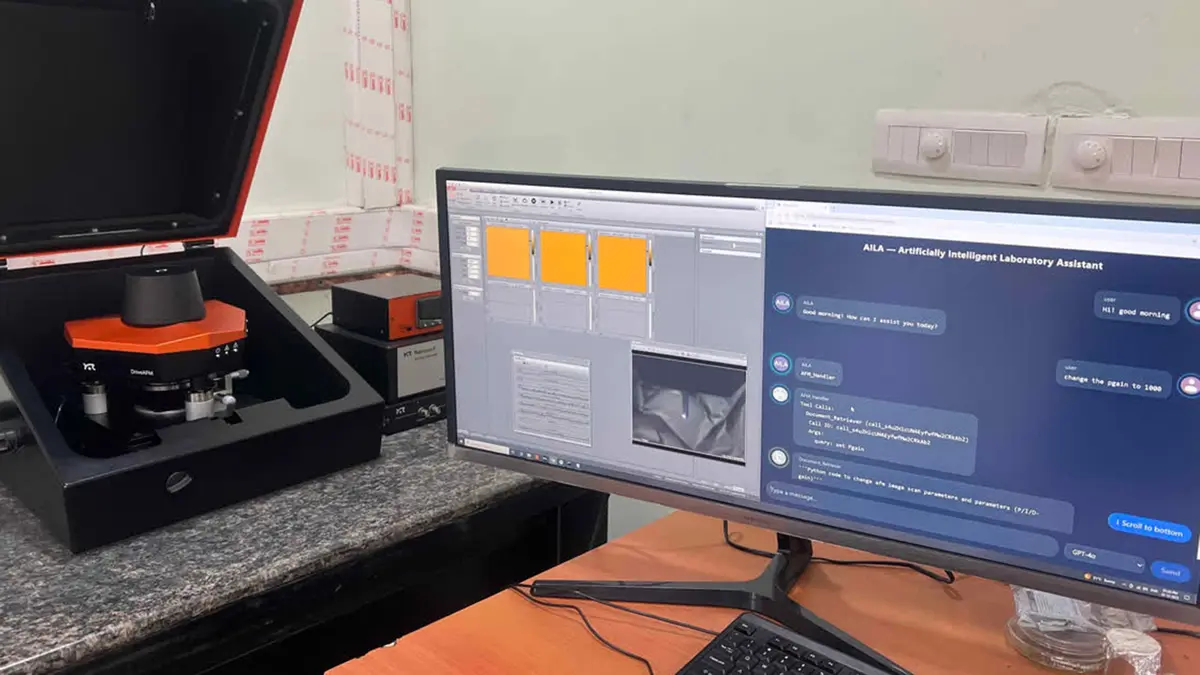
The Indian Institute of Technology (IIT) Delhi unveiled an AI agent called AILA that can design and conduct real laboratory experiments on its own. The system communicates with researchers through a chat interface, translates instructions into machine code and autonomously operates complex instruments like an atomic force microscope. It is being hailed as a breakthrough that could reduce the time and manpower needed to perform sophisticated experiments.
Background
What is AILA? AILA (Artificially Intelligent Lab Assistant) is a generative‑AI based software agent combined with robotics. It uses large language models and computer vision to understand English instructions, plan experiments, control laboratory equipment and interpret results. The project was developed by IIT Delhi researchers and published in the journal Nature Communications in 2025.
- Chat interface: Scientists communicate with AILA by typing natural language instructions. The agent converts these into code for robotic systems and laboratory instruments.
- Autonomous operation: AILA can physically operate equipment such as an atomic force microscope (AFM) to obtain high‑resolution images. It adjusts parameters like scanning speed and tip force, responds to sensor feedback and completes tasks that previously required human experts.
- Rapid optimisation: While human operators may spend a day optimising AFM settings, AILA can achieve the same quality of images in about 7–10 minutes. This dramatically reduces the time needed for research.
- Real‑time reasoning: The agent interprets experimental results, decides the next steps and learns from feedback. It can design subsequent experiments based on previous outcomes.
- Safety and oversight: Researchers note that AI agents sometimes deviate from instructions or make unsafe decisions. Therefore, AILA operates under human supervision with fail‑safe mechanisms to prevent damage to equipment.
Significance
- Efficiency: AILA can handle repetitive and time‑consuming tasks, freeing researchers to focus on creative aspects of science.
- Accessibility: By automating complex procedures, the system could democratise advanced research for smaller laboratories and educational institutions.
- Future research: The project paves the way for fully automated laboratories where AI designs, conducts and analyses experiments without human intervention. This could accelerate discoveries across physics, chemistry, biology and materials science.
Source: NOA