

Why in news?
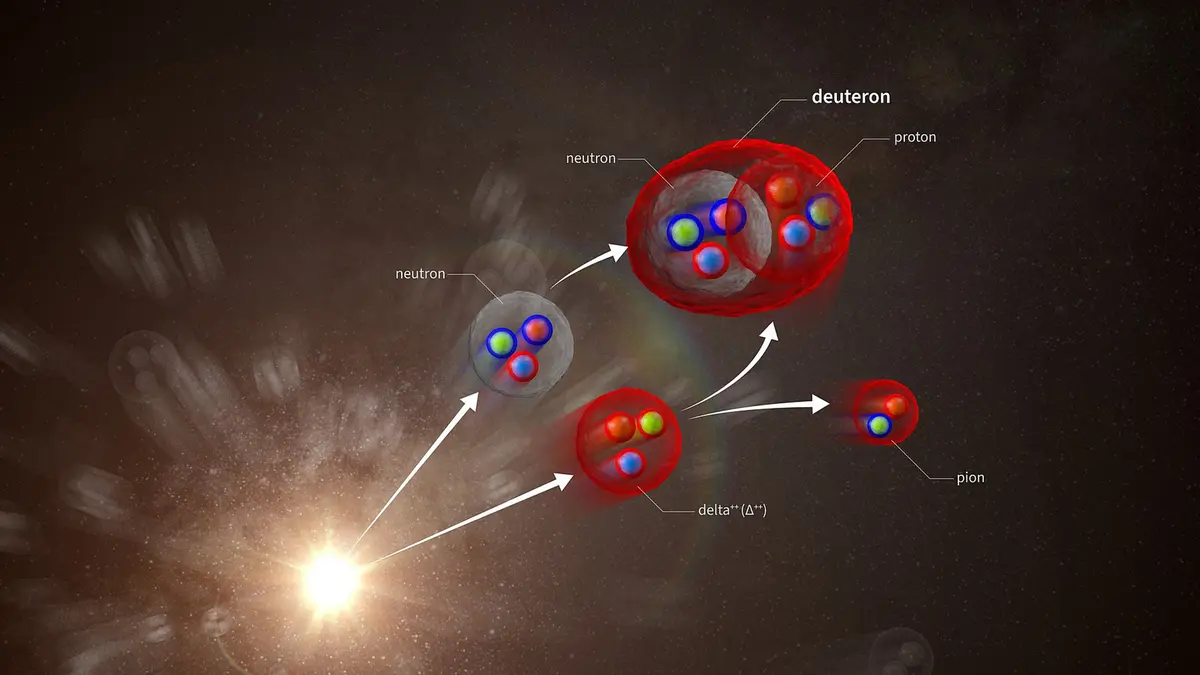
The ALICE collaboration at CERN has revealed that about 90 percent of deuterons and antideuterons produced in proton–proton collisions at the Large Hadron Collider are not born directly in the searing heat of the collision, but instead form later through a two‑step process. This discovery closes a long‑standing gap in understanding how fragile light nuclei can emerge from violent particle interactions.
Background
A deuteron is the nucleus of heavy hydrogen and consists of one proton and one neutron bound together. In everyday life deuterons form inside stars via nuclear fusion, but in the extreme energy densities of particle colliders or cosmic‑ray interactions they would be expected to break apart. Yet experiments have repeatedly observed deuterons and even antideuterons among collision debris, puzzling physicists.
The ALICE team analysed proton–proton collisions at energies of 13 tera‑electronvolts. Using sophisticated detectors they tracked how nucleons (protons and neutrons) emitted from the collision combine to make deuterons. The study found that most deuterons form when a proton or neutron produced from the decay of a short‑lived Δ (delta) resonance travels some distance away from the collision zone and then fuses with another nucleon. This sequential process occurs in a cooler region where the newly formed nucleus can survive.
Key findings
- Sequential fusion dominates: Around nine out of ten deuterons and antideuterons result from nucleons that first originate from Δ resonance decays. Only a small fraction are created directly in the collision.
- Cooled environment: Because the fusion happens away from the hot core, the binding energy of the deuteron is not overwhelmed by surrounding particles. This explains why such fragile nuclei persist in high‑energy experiments.
- Implications for astrophysics: Understanding deuteron production helps interpret cosmic‑ray data and refine searches for dark‑matter signatures, which often rely on modelling antideuterons produced when cosmic rays strike interstellar gas.
Significance
The results demonstrate that light nuclei can emerge from sequential processes rather than only from thermal coalescence. By improving theoretical models, they reduce uncertainties in estimates of deuteron yields in both accelerator experiments and cosmic rays. The work illustrates how precision measurements at the LHC can inform questions ranging from the nature of the strong force to the composition of the universe.
Sources : TH