
Why in news?
The Rajasthan High Court recently issued notices to the state government and the Amber Development and Management Authority following a public interest petition alleging illegal elephant rides near Amber Fort. Activists argued that many elephants were being transported without proper permission and kept in inadequate conditions, prompting the court to seek a response from authorities.
Background
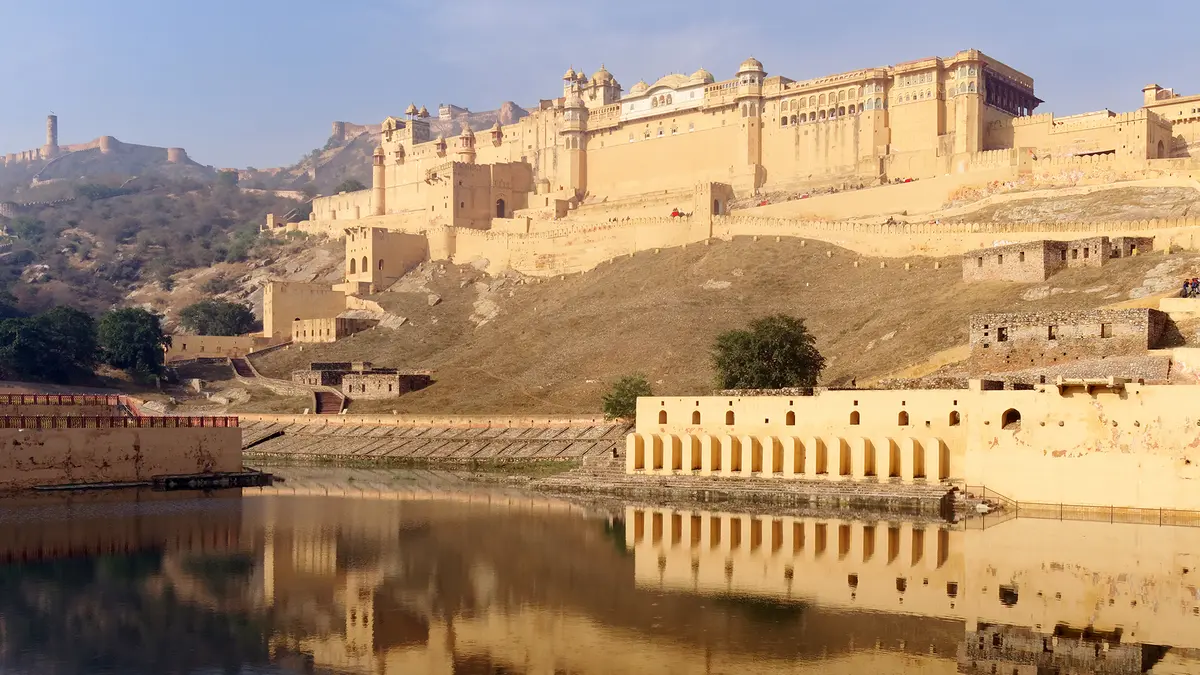
Amber Fort (also spelled Amer Fort) is a monumental palace‑fort complex built in 1592 by Raja Man Singh I on a hill overlooking Maota Lake near Jaipur. Successive rulers, particularly Mirza Raja Jai Singh I, expanded the fort in the 17th century. Constructed from red sandstone and white marble, the fort combines Rajput and Mughal architectural styles and is part of the UNESCO‑listed “Hill Forts of Rajasthan”.
Architectural highlights
- Layout: The fort is organised into four levels each with a central courtyard. The first level includes the Diwan‑e‑Aam (Hall of Public Audience) with pillared galleries.
- Sheesh Mahal: The Mirror Palace is an ornate hall adorned with thousands of tiny glass pieces that sparkle under lamp light.
- Sukh Niwas: Known as the Hall of Pleasure, this palace uses natural ventilation and water channels to keep rooms cool during Rajasthan’s scorching summers.
- Ganesh Pol and Tripolia Gate: Elaborately painted gateways lead to royal quarters and act as defensive structures.
- Connection to Jaigarh: A subterranean passage links Amber Fort to the nearby Jaigarh Fort, providing an escape route during sieges.
Significance
- Cultural heritage: Amber Fort reflects the artistic synthesis of Hindu Rajput and Mughal influences. Its frescoes, inlaid stones and latticed windows represent the zenith of 16th‑century craftsmanship.
- Tourism: The fort is one of Rajasthan’s most visited landmarks. Traditional elephant rides up the cobbled path are a popular attraction but have raised concerns about animal welfare and safety.
- Conservation challenges: Heavy footfall, vibrations from nearby traffic and pollution pose threats to the fort’s fabric. Conservationists advocate regulated visitor numbers and proper maintenance.
Conclusion
Amber Fort stands as a majestic testament to Rajasthan’s martial and artistic heritage. The court case over elephant rides invites reflection on responsible tourism that respects both heritage structures and animal welfare.
Sources: TOI

