
Why in news?
The Gauhati High Court has asked the Assam government to explain why trees were proposed to be felled inside the Amchang Wildlife Sanctuary without forest clearance for a planned ring road around Guwahati. Until a decision is reached, the court has directed the state not to finalise the tender for tree felling.
Background
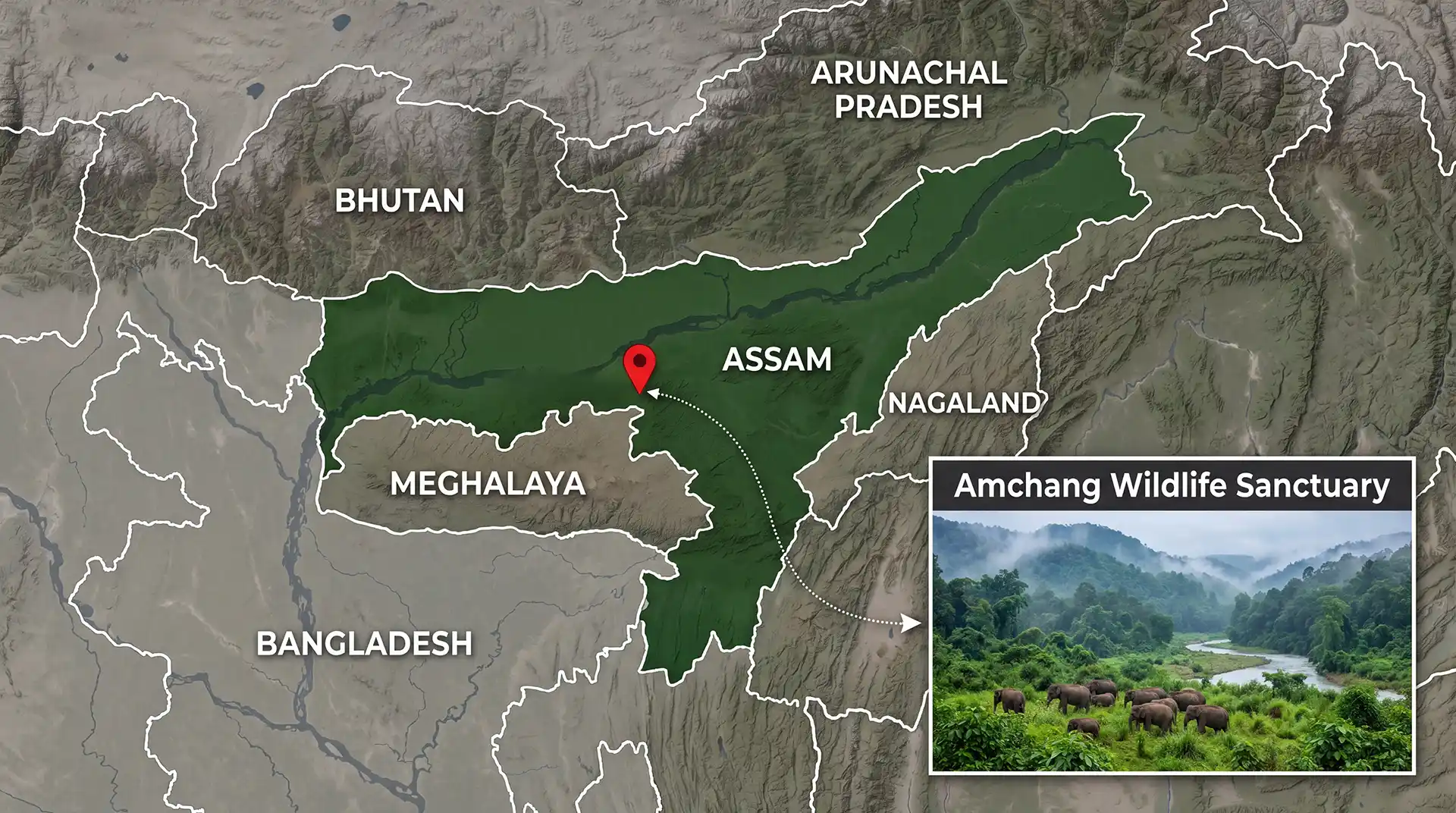
Amchang Wildlife Sanctuary lies on the eastern outskirts of Guwahati, Assam. It combines three reserve forests—Amchang, South Amchang and Khanapara—and a wetland called Khamranga Beel. Situated at altitudes of 39 to 562 m, it serves as a green belt for the city.
The sanctuary hosts rich biodiversity: Asian elephants, gaur (Indian bison), several primate species including the hoolock gibbon and slow loris, and birds such as the white‑rumped vulture and great hornbill. The forest types range from moist deciduous to semi‑evergreen, and it is an important elephant corridor.
What is the Guwahati Ring Road?
Guwahati faces heavy traffic congestion. The proposed 121 km ring road aims to divert through‑traffic away from the city centre. One segment of the route cuts through the Amchang Sanctuary to connect National Highway 37 in the south to NH 27 in the north.
Concerns and legal issues
- Forest clearance: Petitioners argued that the state floated an e‑tender to fell trees inside the sanctuary without obtaining clearance under the Forest Conservation Act 1980.
- Ecological impact: The sanctuary is home to elephants, leopards, pangolins and other species. Felling trees would fragment habitats and degrade the eco‑sensitive zone.
- Alternatives: Environmental groups suggest rerouting the road outside the sanctuary to avoid biodiversity hotspots.
The High Court’s intervention provides time for scrutiny of the proposal. The state government must now justify its plan and secure statutory clearances before proceeding.

