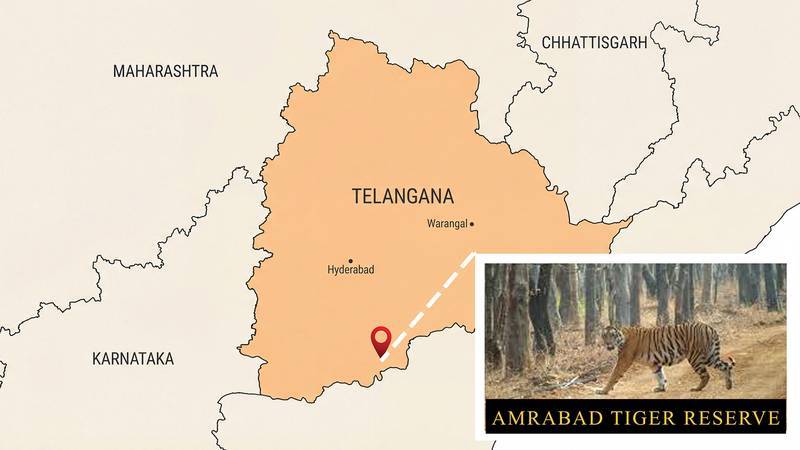
Why in news?
The government of Telangana has launched a programme to rehabilitate and relocate tribal families living inside the Amrabad Tiger Reserve (ATR). In the first phase, 417 families from four villages will either receive cash compensation of ₹15 lakh or be provided modern houses and agricultural land in a model village. The initiative aims to improve the living standards of tribal communities while restoring wildlife habitat within one of India’s largest tiger reserves.
Background
The Amrabad Tiger Reserve lies in the rugged Nallamala hills of Telangana, spanning portions of Nagarkurnool and Nalgonda districts. Originally part of the Nagarjunasagar–Srisailam Tiger Reserve, it became a separate reserve after the formation of Telangana in 2014. At about 2,600 square kilometres it is India’s second‑largest tiger reserve and forms part of the Eastern Ghats. The landscape is characterised by deep valleys, steep ridges, dry deciduous forests and perennial streams such as the Krishna River. The reserve is home to carnivores like tigers, leopards and wild dogs; herbivores such as sambar, chital and gaur; and over 300 bird species. Dense forests support medicinal plants and bamboo groves.
Indigenous peoples, particularly the Chenchu tribe, have lived in these forests for centuries. Their livelihood depends on gathering minor forest produce, shifting cultivation and small‑scale agriculture. Conservationists have long struggled to reconcile the needs of wildlife with human habitation. India’s wildlife laws prohibit permanent settlements within core tiger habitats, and the government offers voluntary relocation with compensation. Previous attempts at relocation in other reserves have often faced resistance due to inadequate support and livelihoods.
Details of the relocation programme
- Voluntary participation: Deputy Chief Minister Bhatti Vikramarka emphasised that relocation is based on the consent of affected families. Tribals can choose between a cash package of ₹15 lakh or resettlement in a new village with a house, drinking water, electricity and five acres of agricultural land.
- Financial outlay: The state has allocated about ₹62.55 crore for the first phase. Of this, ₹24 crore is earmarked for cash compensation and ₹38.55 crore for developing housing and infrastructure.
- Model village at Bacharam: The new settlement in Nagarkurnool district is designed as a model village with permanent homes, schools, healthcare centres, anganwadis (child‑care centres), digital learning facilities, drinking water supply and roads. Skill development centres and self‑help groups will support livelihoods.
- Ecological benefits: Relocation of villages will free up about 1,501 hectares of forest land for wildlife. The plan includes afforestation and measures to enhance the tiger population. Authorities believe the restored corridors will allow tigers and other species to move freely and improve genetic diversity.
Significance
- Balancing conservation and human rights: The project illustrates how wildlife protection can be aligned with tribal welfare when relocation packages are generous and participatory. By offering both cash and comprehensive rehabilitation, the government hopes to ensure that families willingly move and enjoy improved living conditions.
- Restoring habitats: Freeing core tiger habitats from human disturbance allows ecosystems to regenerate. Healthy forests help conserve soil and water, support medicinal plants and create corridors for wildlife migration.
- Socio‑economic upliftment: Modern housing, access to education and healthcare, and agricultural land can transform the lives of relocated families, breaking cycles of poverty and isolation. Skill development programmes aim to provide sustainable livelihoods beyond farming.
- Policy implications: Successful implementation could serve as a model for other reserves where human settlements intersect with critical wildlife areas. Transparent and humane relocation is essential for the credibility of conservation efforts.
Conclusion
The rehabilitation initiative at Amrabad Tiger Reserve signals a compassionate approach to conservation. By combining fair compensation with comprehensive resettlement and by ensuring participation of the Chenchu tribe, Telangana hopes to safeguard wildlife while improving human welfare. If executed well, the project will restore important tiger habitats and set a precedent for future conservation programmes across India.
Source: The Times of India