

Why in news?
Researchers at the Council of Scientific and Industrial Research (CSIR) and the Central Food Technological Research Institute (CFTRI) have developed improved methods for extracting and processing annatto seeds into natural food colourants. Their work includes a seed‑separating machine and formulations tailored for various food applications, renewing interest in this traditional dye.
Background
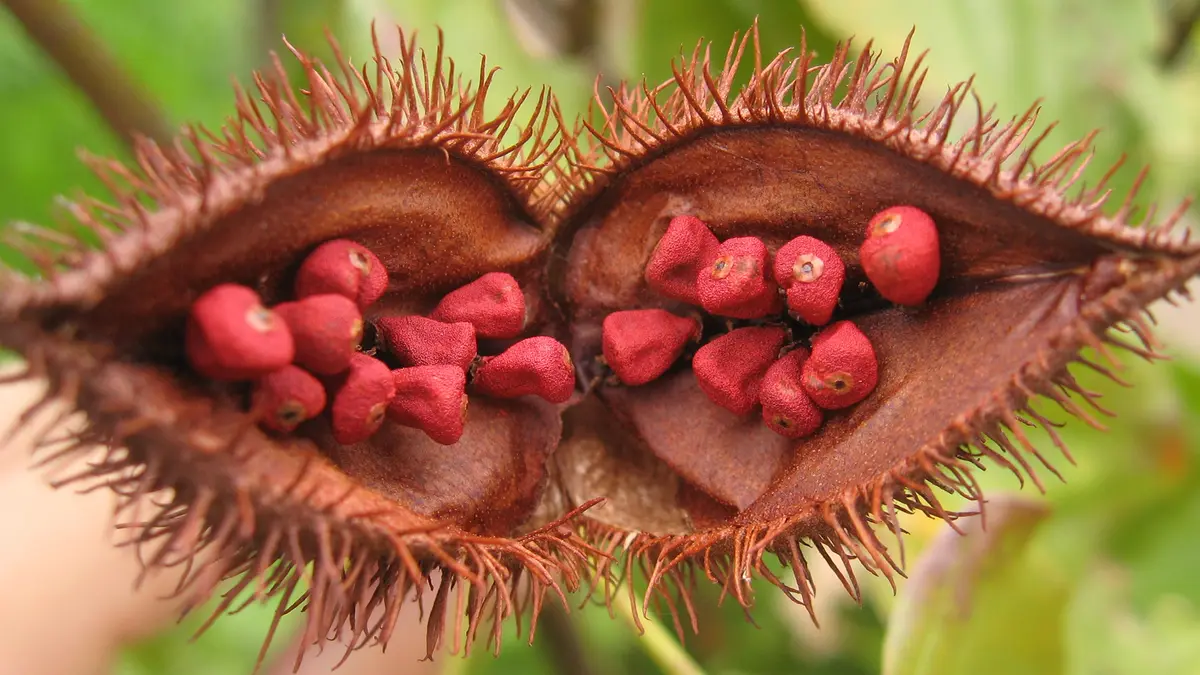
Annatto comes from the seeds of Bixa orellana, a small tree native to the tropical Americas but now cultivated in parts of India, including Karnataka, Andhra Pradesh and the North‑East. The seeds are covered in a red aril rich in carotenoid pigments such as bixin and norbixin, which yield yellow to orange colouring. Traditionally, communities used annatto to colour textiles, food and body paint. It is now valued as a natural alternative to synthetic food dyes.
CSIR–CFTRI innovations
- Efficient extraction: Scientists developed a counter‑current extraction process to obtain a crystalline dye that can be converted into water‑soluble or oil‑soluble powders. This improves stability and ease of use.
- Seed separator: A mechanical device was designed to separate seeds from fruit pods more quickly and with less labour, enhancing processing efficiency.
- Formulation development: Researchers standardised colour formulations suitable for different food sectors – water‑based beverages, propylene glycol‑based syrups and sugar‑based products such as candies and baked goods. Each formulation delivers consistent colour and flavour compatibility.
- Vitamin E‑rich oil: The project aims to extract tocotrienol‑rich oil from annatto seeds, which is high in vitamin E and has antioxidant properties.
Benefits and cultivation
- Natural food colourant: Annatto provides a plant‑derived alternative to synthetic dyes like tartrazine. It imparts yellow–orange hues to cheeses, butter, snacks and sweets without adding strong flavours.
- Nutraceutical potential: Compounds in annatto possess antioxidant and anti‑inflammatory properties. Tocotrienols may support heart health and reduce oxidative stress.
- Crop characteristics: The plant is moderately drought tolerant and grows well in warm climates with well‑drained soil. Seeds are usually sown during the monsoon, and fruiting begins in two to three years.
- Income opportunity: With rising demand for natural colours and nutraceuticals, annatto cultivation can offer farmers a diversified source of income, especially in hilly and tribal regions.
Conclusion
Annatto has long been valued for its colouring properties, and recent innovations by CSIR–CFTRI make its extraction and application more efficient and versatile. By combining traditional knowledge with modern technology, India can promote this indigenous crop as a source of natural dyes and health‑promoting ingredients.
Source: Press Information Bureau