

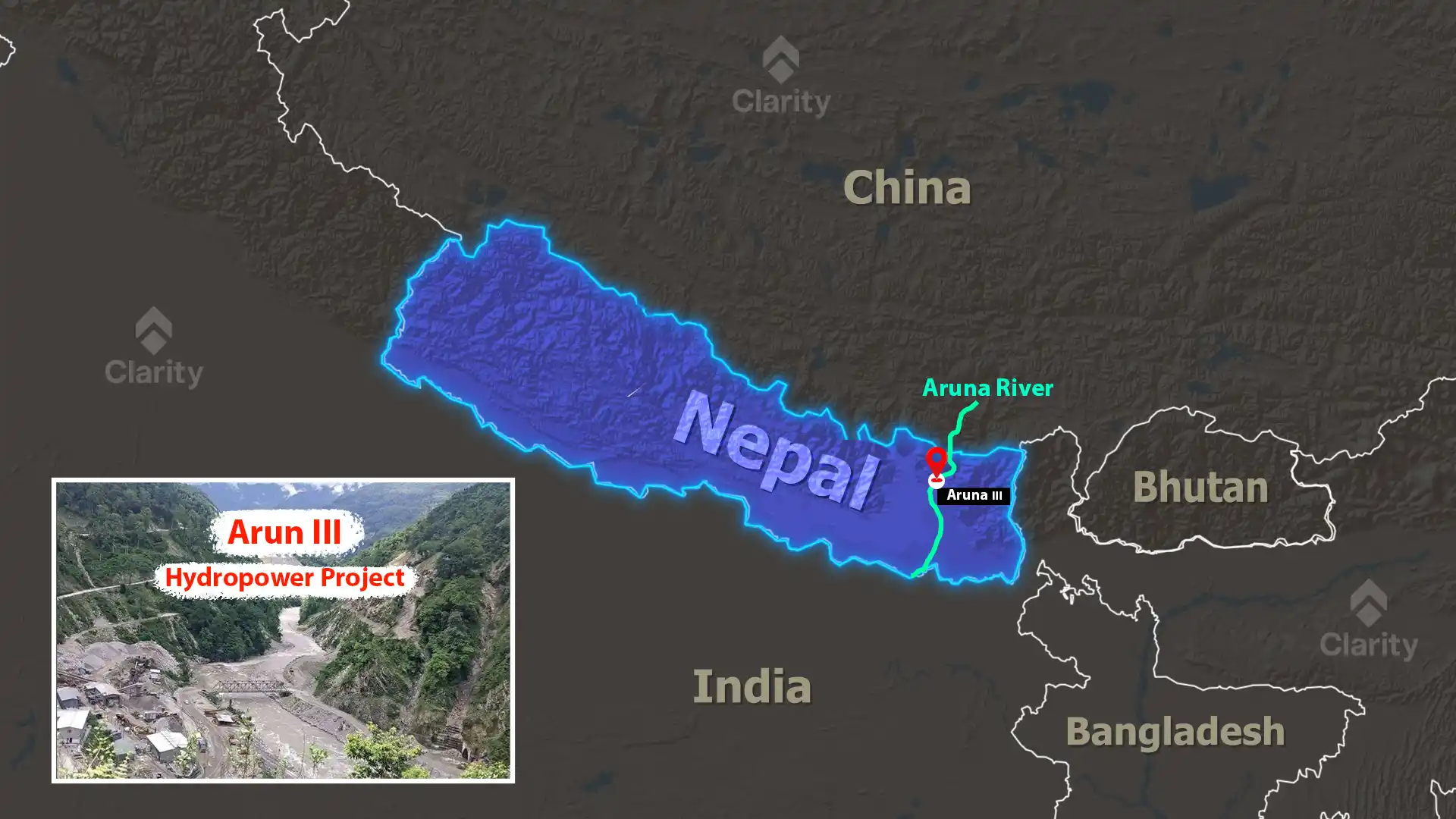
Why in news?
The 900 megawatt Arun‑3 Hydropower Project in eastern Nepal has been in the news as construction progresses under the supervision of SJVN’s Arun III Power Development Company. With transmission links nearing completion, the project is expected to begin delivering electricity in the coming years.
Background
Arun‑3 is a run‑of‑the‑river hydropower scheme on the Arun River, a tributary of the Kosi in Sankhuwasabha district of Nepal. The project is being developed by SJVN, an Indian state‑owned company, on a build‑own‑operate‑transfer (BOOT) basis for 30 years. Nepal will receive 21.9 per cent of the electricity free of cost during the concession period and will take ownership after the term ends.
Key features
- Dam and reservoir: A concrete gravity dam 59 metres high (80 metres from its deepest foundation) and 233 metres long creates a small reservoir with a submergence area of about 66 hectares. The catchment area upstream is roughly 26,747 square kilometres.
- Headrace tunnel: Water is conveyed to the power house through an 11.8 kilometre headrace tunnel of 9.5 metre diameter, ensuring continuous flow.
- Power generation: The underground power house houses four 225 MW Francis turbine units generating a total of 900 MW. Annual energy production is estimated at around 4,000 million units.
- Transmission line: A roughly 300 kilometre 400 kV transmission line will evacuate power from Sankhuwasabha to the India– Nepal border and onward to Bihar. Nepal will use part of the line to integrate its eastern grid.
- Employment and benefits: The project is expected to create about 3,000 jobs during construction. It will supply Nepal with free electricity and a share of revenues while providing India with clean, renewable power.
Significance
- Regional cooperation: Arun‑3 exemplifies win‑win collaboration between India and Nepal. Nepal gains infrastructure, revenue and electricity, while India secures a share of dependable hydroelectric power.
- Low‑carbon energy: Hydropower from run‑of‑the‑river projects helps reduce reliance on fossil fuels and supports both countries’ climate commitments.
- Economic stimulus: Construction activity and improved electricity supply stimulate local economies in Nepal’s eastern hills and strengthen cross‑border trade.
Conclusion
Once operational, the Arun‑3 hydropower project will become a cornerstone of India– Nepal energy cooperation. Continued attention to environmental safeguards, fair benefit sharing and timely completion will determine its success and serve as a model for future regional projects.
Sources: WPM