

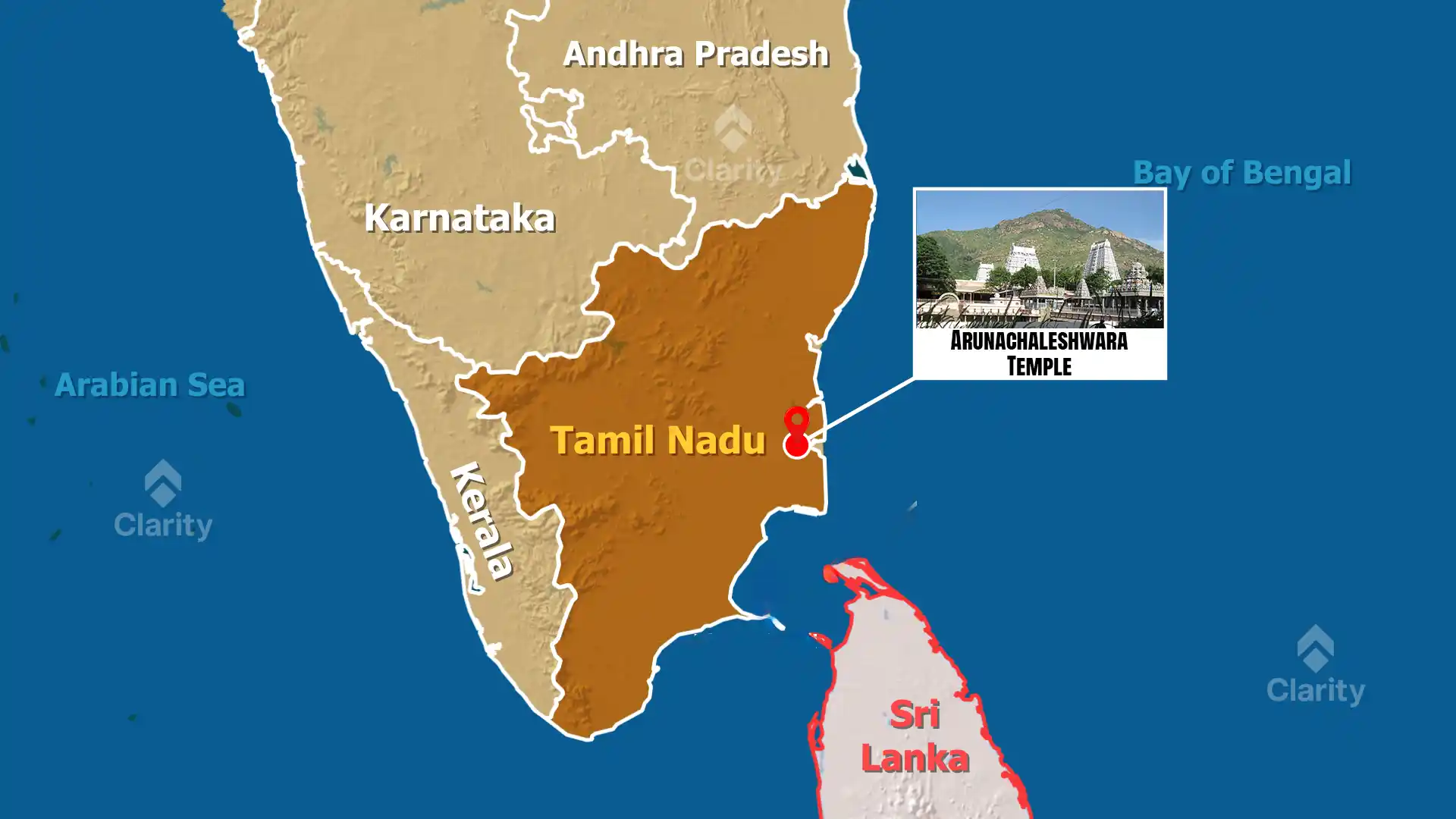
Why in news?
Authorities in Tiruvannamalai recently removed illegal shops and other encroachments around the Arunachalesvara Temple to create more space for pilgrims during the annual Karthigai Deepam festival. The cleanup aimed to ensure that lakhs of devotees can safely walk the sacred path around the hill without obstacles and fire hazards. It also highlights the heritage value of one of India’s oldest Shiva temples.
Background
The Arunachalesvara Temple, also known as the Arunachalam or Annamalaiyar Temple, stands at the foot of the sacred Annamalai hill in Tiruvannamalai, Tamil Nadu. Devotees worship Lord Shiva here as Arunachalesvara, and his consort Parvati as Unnamulai Amman. Among the five Pancha Bhoota Sthalams, the temple represents the element of fire (Agni). Mythology recounts that Shiva appeared as an endless pillar of light on this hill to teach Brahma and Vishnu humility. Architectural inscriptions indicate that the core shrine dates back to the 9th century Chola era and was later expanded by the Hoysala and Vijayanagara dynasties. It covers roughly 25 acres and boasts massive Dravidian‑style gopurams, with the eastern gateway rising about 66 metres (11 storeys). The complex houses spacious halls, ornate pillared corridors and sacred tanks such as the Agni Theertham. Annamalai hill itself is revered as a living embodiment of Shiva, and circumambulating it (Girivalam) on full‑moon nights forms an integral part of worship.
Karthigai Deepam and recent measures
- Festival of light: The Karthigai Deepam festival is celebrated in the Tamil month of Karthigai (November–December). Priests light a giant oil lamp on top of the 2,668‑foot hill to symbolise the eternal flame of Shiva, and devotees light lamps at home.
- Pilgrim influx: Millions of pilgrims throng the town during the ten‑day festival to walk the 14‑km Girivalam path barefoot. Encroaching shops and unauthorised structures had narrowed pathways, causing crowding and safety concerns.
- Encroachment removal: District officials carried out demolitions of illegal stalls and ensured that vendors were relocated. The measures widened the circumambulation path, improved lighting, and reduced fire risks ahead of the festival. Authorities also set up temporary drinking‑water taps, toilets and first‑aid stations for pilgrims.
- Heritage conservation: Local courts and heritage activists have repeatedly urged preservation of the temple’s surroundings. Removing encroachments protects archaeological structures and enhances the spiritual ambience of the site.
Significance
- Cultural heritage: The temple is a masterpiece of Dravidian architecture and a centre of Shaivite tradition. Festivals like Karthigai Deepam and Maha Shivratri draw pilgrims from across India, strengthening cultural bonds.
- Spiritual importance: Worship at Arunachalesvara is believed to cleanse ignorance and bestow enlightenment. The Girivalam pilgrimage is thought to remove obstacles and bring spiritual merit.
- Tourism and economy: Improved infrastructure and crowd management support both religious tourism and local livelihoods. Maintaining a clean and safe environment encourages visitors while preserving the sanctity of the site.
Source: TH