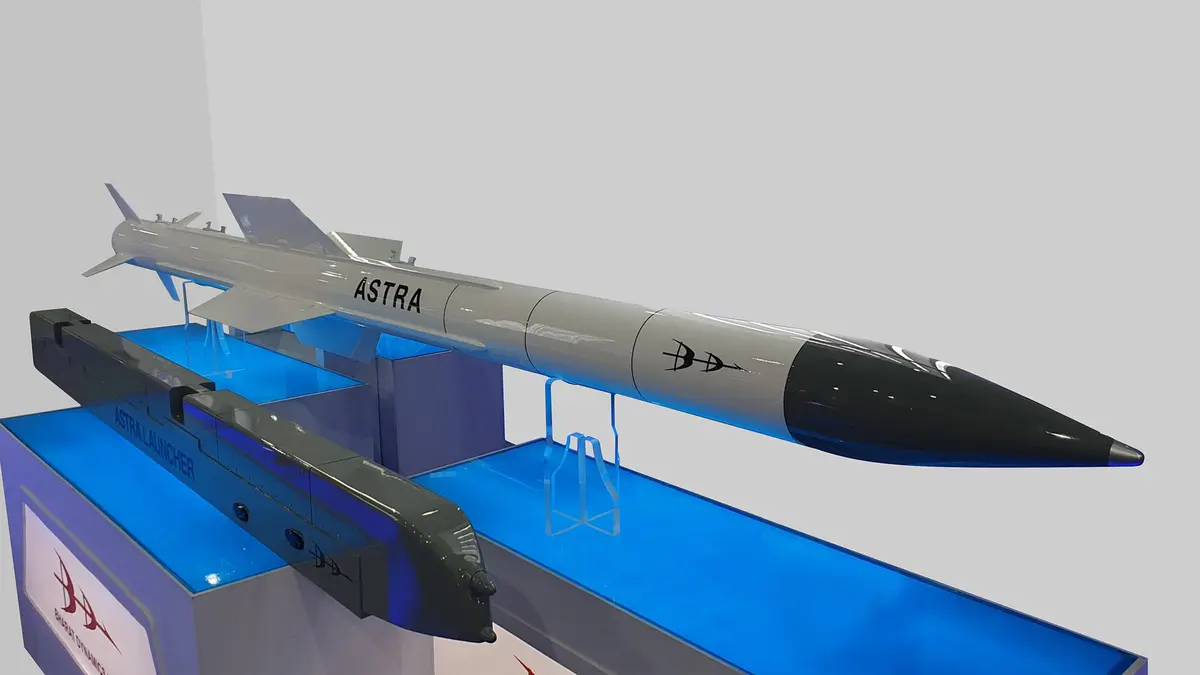
Why in news?
The Indian Air Force plans to equip its Mirage‑2000 fighter jets with the indigenous Astra Mk‑II missile. This new variant of the beyond‑visual‑range (BVR) air‑to‑air missile promises a range of over 200 kilometres, significantly extending the interception capabilities of Indian fighters. Integration of the missile is expected to enhance air‑superiority missions and reduce dependence on imported weapons.
Background
India’s Defence Research and Development Organisation (DRDO) began developing the Astra family of BVR missiles in the late 1990s to achieve self‑reliance in air‑combat technology. The first version, Astra Mk‑I, entered service in 2023 and has been integrated on Sukhoi‑30MKI and Tejas fighters. Following its success, engineers have been working on an extended‑range variant known as Astra Mk‑II. Mirage‑2000 aircraft, which currently rely on French MICA missiles, are likely to be the first platform to receive the new missile.
Key features
- Dual‑pulse propulsion: The missile uses a dual‑pulse solid rocket motor that ignites twice, allowing it to sustain high speed during the terminal phase and extend its reach to roughly 200–240 kilometres at high altitude.
- Active radar seeker: An indigenous radio‑frequency seeker developed by Bharat Electronics Limited guides the missile to its target with high accuracy while incorporating electronic counter‑counter‑measures.
- Two‑way datalink: A secure datalink enables mid‑course guidance updates and allows the launching aircraft to transmit target corrections or switch targets during flight.
- High speed: Astra Mk‑II is expected to reach speeds of around Mach 4.5, giving it the ability to engage fast‑moving targets at long distances.
- Versatility: The missile is designed for integration on multiple fighter platforms, including Mirage‑2000, Sukhoi‑30MKI, Tejas and future indigenous fighters such as the Advanced Medium Combat Aircraft.
Advantages
- Strategic autonomy: Developing BVR missiles in‑house reduces dependence on foreign suppliers and supports the government’s Atmanirbhar Bharat (self‑reliant India) initiative.
- Cost‑effectiveness: Indigenous production is expected to bring down unit costs compared with imported BVR missiles, making long‑range air‑defence more affordable.
- Enhanced deterrence: A range beyond 200 kilometres allows Indian pilots to engage hostile aircraft before the latter can launch their own weapons, improving survivability in aerial combat.
- Export potential: Success with Astra Mk‑II could pave the way for future exports to friendly countries, strengthening India’s defence diplomacy.
Conclusion
Astra Mk‑II represents a major leap in India’s missile capability. Its extended range and advanced guidance systems will give the Indian Air Force a powerful tool for air‑dominance while reinforcing the nation’s quest for self‑reliance in defence technology.