
Why in news?
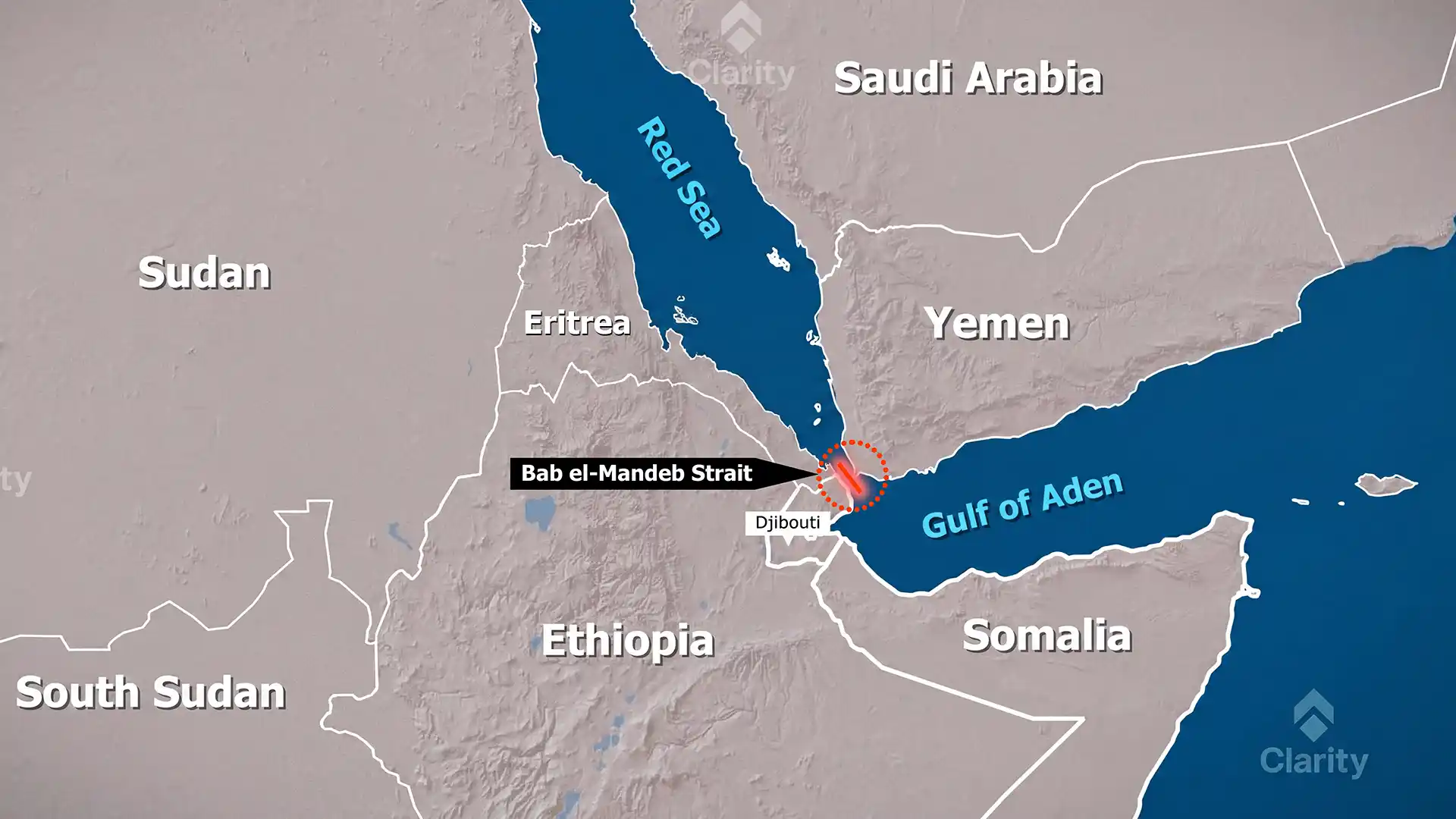
The Bab el‑Mandeb Strait has been in the headlines due to renewed threats from militant groups to close the waterway and a warning from Iranian officials that it could be targeted in response to regional conflicts. The strait is a vital link between the Red Sea and the Gulf of Aden, and any disruption has the potential to choke oil and commercial shipping routes. Recent tensions have revived concerns about the safety of vessels transiting this narrow passage.
Background
The Bab el‑Mandeb (“Gate of Tears”) is a narrow strait connecting the Red Sea to the Gulf of Aden. Situated between Yemen on the Arabian Peninsula and Djibouti and Eritrea on the Horn of Africa, the strait narrows to roughly 29 km at its tightest point. It forms two channels around the volcanic island of Perim: the eastern channel is about 3 km wide and used for south‑bound traffic, while the wider western channel is used for north‑bound traffic. Because of its narrowness, a large portion of the world’s maritime trade must funnel through these two lanes.
Strategic importance
- Global energy route: Around one‑tenth of world trade, including a significant share of crude oil and liquefied natural gas, passes through the Bab el‑Mandeb every year. Together with the Suez Canal and the Strait of Hormuz, it forms a critical corridor linking the Mediterranean Sea to the Indian Ocean.
- Dual choke points: If both the Bab el‑Mandeb and the Strait of Hormuz were blocked simultaneously, as some belligerents have threatened, almost a quarter of the world’s oil and gas supply would be cut off. Such a closure could trigger sharp price spikes and disrupt global supply chains.
- Regional tensions: In recent months, Iran‑backed Houthi rebels in Yemen have intermittently targeted ships transiting the strait, while Iranian officials have warned that they could close Bab el‑Mandeb if Israel’s military operations continue in Gaza. These threats follow previous incidents where the strait was blockaded during regional conflicts.
- Alternate routes: When the Strait of Hormuz has been threatened, exporters such as Saudi Arabia have used pipelines to ports like Yanbu on the Red Sea. However, there is no full substitute for the Bab el‑Mandeb: closing it would force vessels to circumnavigate Africa via the Cape of Good Hope, adding weeks to shipping times.
Implications for India
India relies heavily on imported crude oil and gas, much of which travels through the Red Sea. A closure of the Bab el‑Mandeb would increase freight costs and insurance premiums, affecting energy prices at home. Indian warships have occasionally escorted merchant vessels through the region to deter piracy and ensure safe passage. Maintaining stability in this strategic chokepoint is therefore essential for India’s energy security and maritime trade.

