

Why in news?
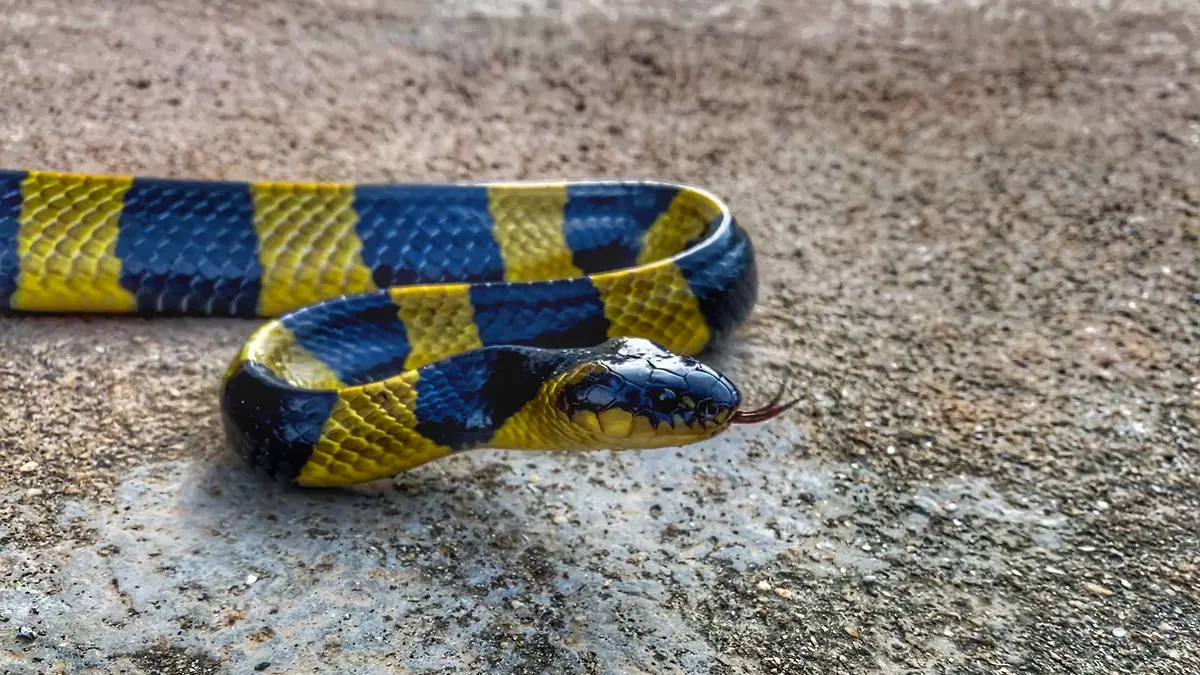
A video shared by Indian Forest Service officer Parveen Kaswan in late December 2025 went viral on social media. While on night patrol, the officer filmed a banded krait calmly gliding through a shallow stream. Viewers marvelled at the snake’s alternating yellow‑and‑black bands and discussed how its striking colours warn predators to stay away.
Background
The banded krait (Bungarus fasciatus) is a highly venomous snake native to South and Southeast Asia. It inhabits forests, wetlands, agricultural fields and villages across the Indo‑Chinese region, the Malay Peninsula and Indonesian archipelago. In India its range extends from central and eastern states to the north‑east. The species is largely nocturnal and secretive, hiding in termite mounds, rodent burrows or vegetation during the day.
Key facts
- Distinctive appearance: Adults typically measure 1.5–2 metres long. They have broad heads, smooth scales and alternating yellow and black bands along the body and tail, an example of aposematism (warning colouration).
- Behaviour: Banded kraits are shy and avoid confrontation. When threatened they hide their heads under their coils. They are more active at night when they hunt.
- Diet: Unlike many other snakes, banded kraits prey mainly on other snakes, including rat snakes and small vipers. They also eat fish, frogs and lizards.
- Venom: Their neurotoxic venom can cause vomiting, abdominal pain, dizziness and, in severe cases, respiratory failure. Bites are rare because the snakes seldom interact with humans, but antivenom is available.
- Conservation status: The International Union for Conservation of Nature (IUCN) lists the banded krait as “Least Concern”. Populations are considered stable, and the species helps control rodent populations near settlements.
Conclusion
The viral video of the banded krait serves as a reminder of the rich biodiversity that exists alongside humans. Respecting wildlife and maintaining safe distances ensure that both people and animals can coexist without harm.
Source: India Today