

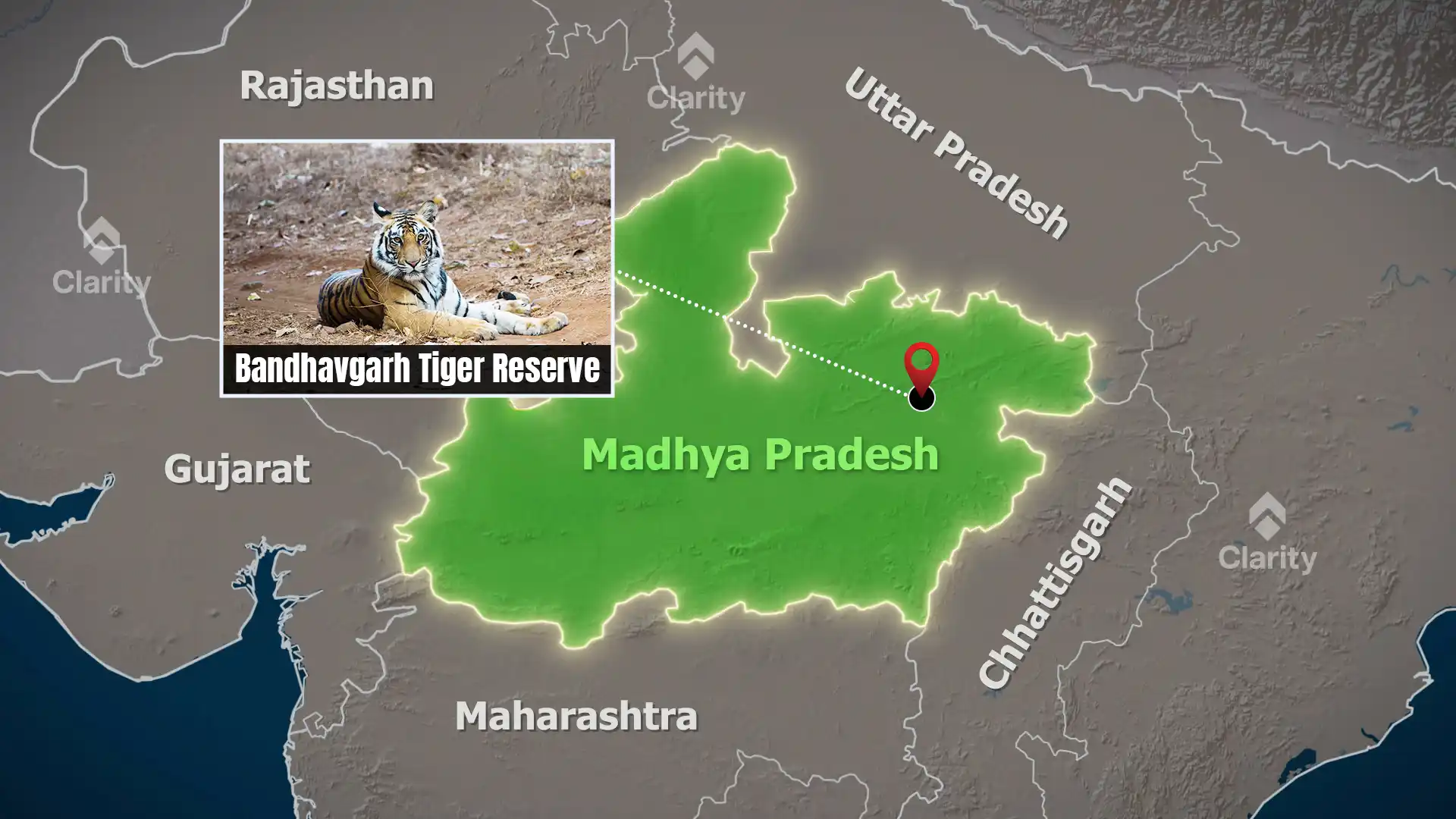
Why in news?
The Madhya Pradesh High Court has directed the Field Director of Bandhavgarh Tiger Reserve to explain a series of recent tiger deaths. Wildlife activists reported that ten tigers have died in the state since January 2026, many due to electrocution and other human‑related causes. The court’s intervention has drawn national attention to the urgent need for better conservation measures.
Background
Bandhavgarh Tiger Reserve lies in the Umaria district of Madhya Pradesh and spans roughly 1,600 square kilometres of forested hills and grasslands. The name “Bandhavgarh” means “fort of the brother” and refers to a hilltop fort believed to have been built by Lord Rama for his brother Lakshmana. The reserve became a protected area in 1968 and was designated a national park in 1982. Its varied terrain and dense forests make it a vital habitat for Bengal tigers and other wildlife.
Geography and biodiversity
- Landscape: Bandhavgarh sits on the Vindhya Range and features steep ridges, plateaus, meadows and rivers. The topography creates diverse micro‑habitats for animals and plants.
- Flora: Dominant tree species include sal, bamboo, mahua, tendu and dhaora. Lush grasslands in meadows provide grazing for herbivores.
- Fauna: The reserve supports tigers, leopards, wild boar, sambar deer, chital (spotted deer), gaur (Indian bison), sloth bears and more than 250 bird species.
The issue of unnatural deaths
Recent reports show an alarming rise in unnatural tiger deaths in Madhya Pradesh. Many animals have died due to:
- Electrocution: Poachers or farmers sometimes set up illegal electric fences around fields or poaching traps. When tigers or other wildlife contact the live wires, they suffer fatal shocks.
- Poaching and poisoning: Demand for body parts can drive poaching. In some cases farmers poison carcasses to kill predators that threaten livestock.
- Inadequate monitoring: Overextended forest staff and limited resources make it difficult to patrol all areas, leaving tigers vulnerable.
High Court’s direction
The High Court has asked for a detailed report on the deaths and the steps taken to prevent further incidents. Wildlife activists hope this legal scrutiny will lead to stricter enforcement against poaching, improved electrification safety protocols and better coordination between forest and power departments. Protecting Bandhavgarh’s tigers is vital because Madhya Pradesh hosts one of India’s largest tiger populations.
Source: The Indian Express