

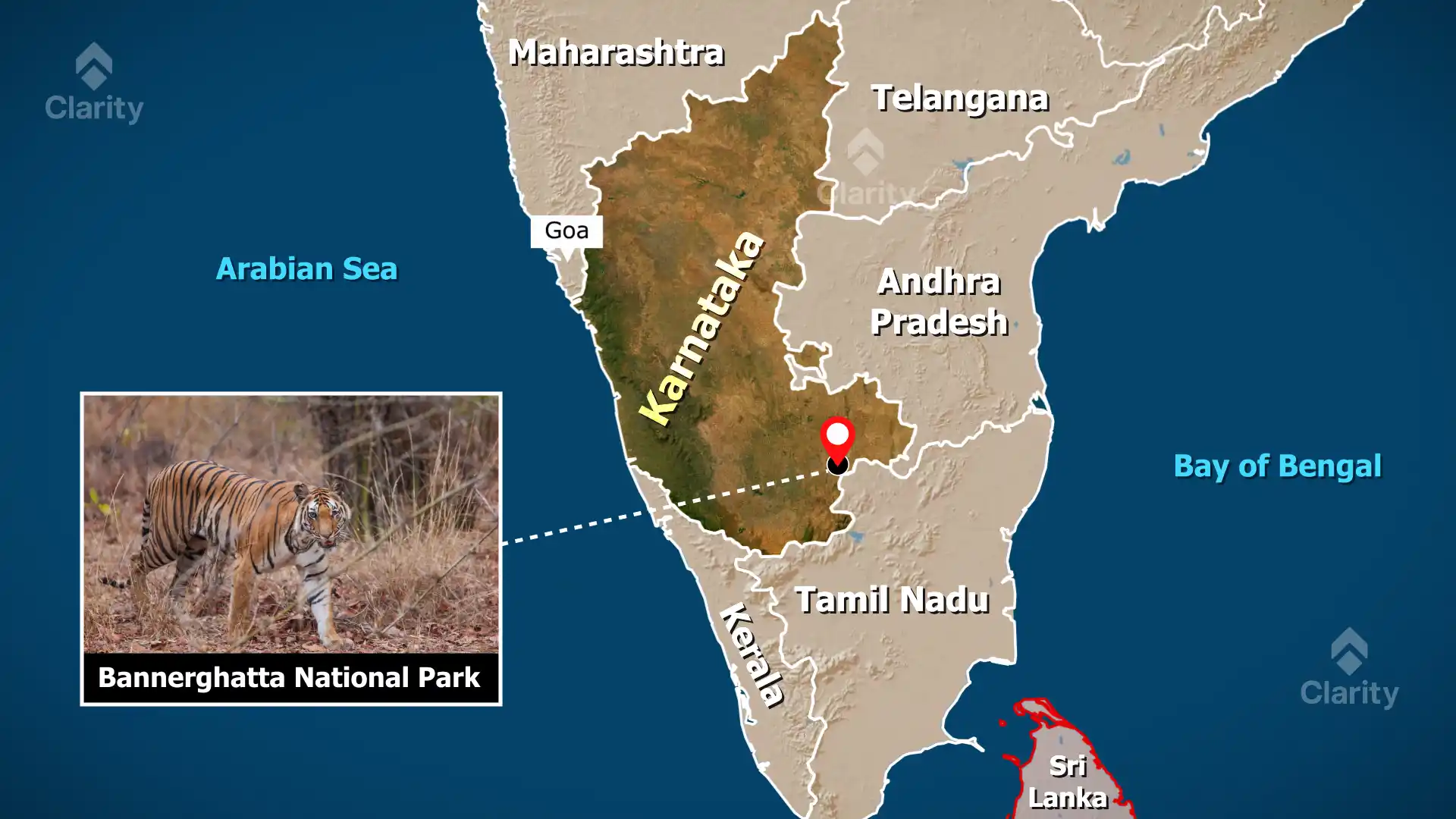
Why in news?
The Central Empowered Committee (CEC) appointed by the Supreme Court has recommended restoring the Ecologically Sensitive Zone (ESZ) around Bengaluru’s Bannerghatta National Park (BNP) to its original 2016 extent. The ESZ was reduced in 2020, triggering legal challenges from conservationists.
About Bannerghatta National Park
Bannerghatta National Park lies in the Anekal hill range near Bengaluru, Karnataka. Established as a national park in 1974, it covers forested hills and valleys where the Suvarnamukhi stream provides water for wildlife. The park hosts India’s first butterfly enclosure (opened in 2006) and diverse vegetation types—including dry deciduous scrub, southern tropical dry deciduous forests and moist mixed forests. Flora include species such as sandalwood, neem, tamarind and bamboo, while fauna comprise endangered Asian elephants, tigers, leopards, gaurs, sambar, spotted deer, sloth bears and wild dogs.
Ecologically Sensitive Zones
Eco‑Sensitive Zones are buffer areas around protected forests, notified under the Environment (Protection) Act 1986. They function as “shock absorbers” to minimise negative impacts of development on fragile ecosystems. Activities in ESZs are regulated to balance conservation with local livelihoods.
The ESZ dispute
- 2016 draft notification: The Ministry of Environment, Forest and Climate Change proposed an ESZ of 268.9 sq km around BNP. This draft lapsed after the Karnataka government did not submit its views.
- 2018 and 2020 notifications: A new draft in 2018 and a final notification in 2020 reduced the ESZ to about 168.6 sq km, excluding elephant corridors and ecologically important patches. Environmentalists argued that the reduction favoured real‑estate and mining interests.
- Legal challenge: Activists petitioned the Supreme Court, pointing out that the shrinkage increased human–wildlife conflict and threatened biodiversity. The CEC was asked to examine the matter.
- CEC recommendations: In January 2026, the committee recommended withdrawing the 2020 notification and reinstating the 2016 boundaries. It said alterations should be allowed only where irreversible urban development exists and should not compromise wildlife corridors or buffer functions. The report emphasised communicating to local communities that ESZs protect forests without hindering legitimate livelihoods.
Significance
- Conservation of wildlife corridors: Restoring the larger ESZ would safeguard elephant migration routes between Bannerghatta and neighbouring reserves, reducing human–animal conflicts.
- Urban planning: Bengaluru’s rapid expansion has put pressure on adjoining forests. A robust ESZ ensures that development is planned responsibly, preserving ecological integrity.
- Legal precedent: The case highlights the role of judicial committees in balancing development and conservation and may influence ESZ determinations for other protected areas.
Conclusion
The Central Empowered Committee’s call to restore Bannerghatta’s ESZ underscores the importance of buffer zones in protecting biodiversity amid urban growth. Implementing its recommendations will require cooperation between state authorities, conservationists and local communities.
Source: The Indian Express