

Why in news?
In a pioneering study, researchers fitted a bar‑headed goose named “Gagan” with a GSM‑GPS transmitter to trace its migratory path. The device revealed that the goose flew across the Himalayas to Tibet and back to Bihar’s Nagi Bird Sanctuary in December 2025, covering roughly 780 kilometres and reaching altitudes of more than 5,000 metres. Such tracking studies are helping scientists understand migration routes and conservation needs.
Background
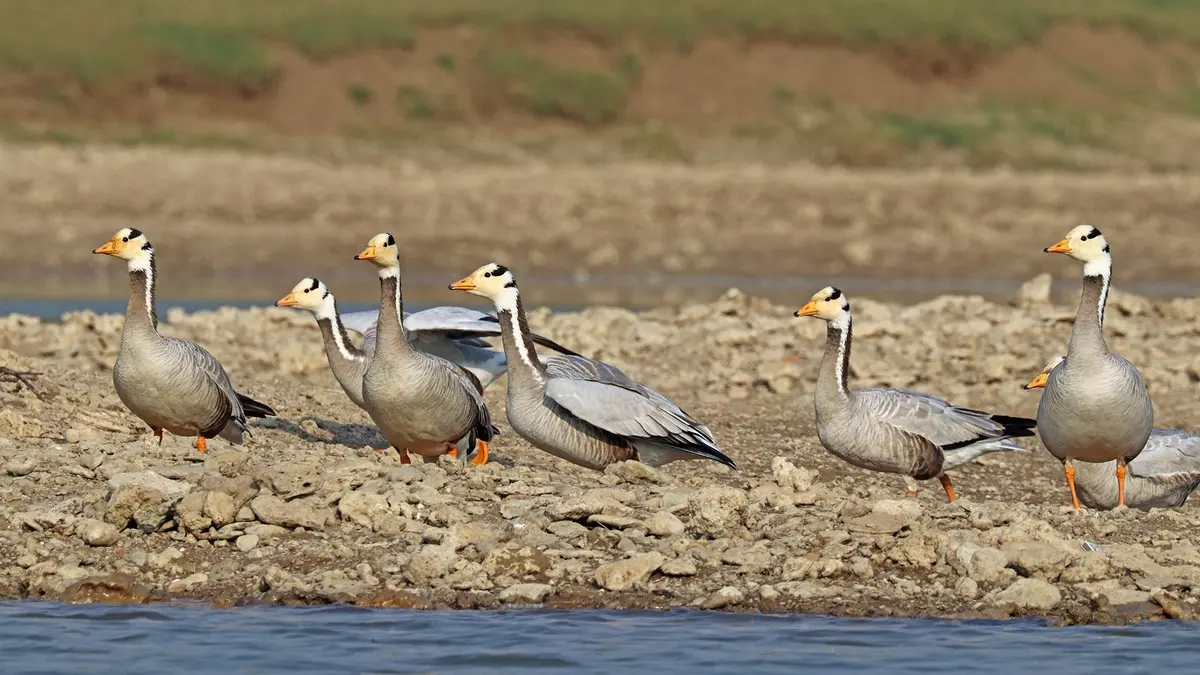
The bar‑headed goose (Anser indicus) is famous for its ability to fly over the Himalayas—one of the highest flights of any bird. It breeds in high‑altitude wetlands of Central Asia and winters in South Asia, including parts of India, Pakistan and Nepal. These geese are medium‑sized waterfowl with pale grey plumage and two distinctive dark bars across the head that give the species its name.
Characteristics
- Size: Adults measure about 71–76 centimetres in length and weigh between 1.8 and 3.2 kilograms. Males are slightly larger than females.
- Breeding and habitat: They nest on grassy islands or lakeshores in high‑altitude wetlands of Mongolia, Tibet and surrounding regions. During winter they migrate to lower‑elevation lakes, rivers and agricultural fields in India and other South Asian countries.
- High‑altitude flight: Bar‑headed geese are physiologically adapted to fly at extreme heights—often over 5,000 metres and sometimes exceeding 6,400 metres—where oxygen levels are low. Efficient lungs, specialised haemoglobin and powerful flight muscles enable them to cross the Himalayan range.
- Social behaviour: These geese form monogamous pairs and migrate in flocks. They feed on grasses, grains and aquatic plants.
- Conservation status: The species is listed as “Least Concern” by the IUCN, but monitoring is important because habitat loss and hunting can affect local populations. Recent counts in Karnataka, for example, showed a notable decline in winter arrivals.
Significance of tracking studies
- Mapping migration routes: By following individual geese like Gagan, scientists can identify important stopover sites and feeding grounds that need protection.
- Understanding flight physiology: Data on altitude and speed reveal how these birds manage to survive and thrive in low‑oxygen environments.
- Guiding conservation: Tracking helps target conservation measures along migration corridors and informs policies on wetland protection and hunting regulation.
Conclusion
The bar‑headed goose is a remarkable migrant that conquers some of the world’s highest mountains. Ongoing tracking projects not only uncover the secrets of its epic journeys but also highlight the importance of preserving wetlands and safe passage routes across Asia.
Source: Down To Earth