Why in news?
Conservationists reported in April 2026 that the blackbuck reintroduction programme at Barnawapara Wildlife Sanctuary in Chhattisgarh has yielded encouraging results. The population of blackbucks in the sanctuary has grown steadily, prompting plans to replicate the model in other protected areas.
Background
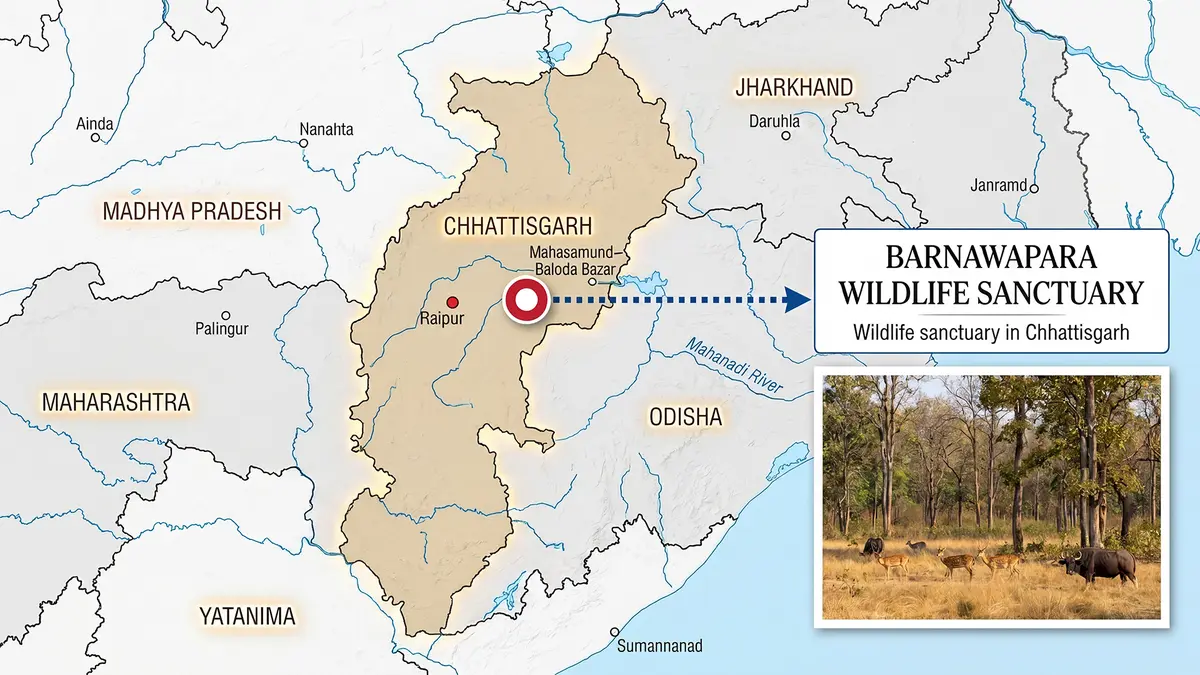
Barnawapara Wildlife Sanctuary lies in the Mahasamund district of Chhattisgarh and spans about 245 km². Established in 1976, it is named after the twin villages of Bar and Nawapara. The sanctuary is bounded by the Balamdehi River to the west and the Jonk River to the north‑east. Its terrain consists of low and high hillocks covered with tropical dry deciduous forest, featuring teak, sal, bamboo, mahua and other species. Fauna include tigers, leopards, sloth bears, chital, nilgai, gaur and numerous bird species.
The blackbuck story
- Local extinction: Blackbucks (Antilope cervicapra) were once common in central India but became extinct in Chhattisgarh by the 1970s due to poaching and habitat loss.
- Reintroduction plan: In 2018, the state launched a five‑year revival plan. Seventy‑seven blackbucks were translocated from zoos and reserves in New Delhi and Bilaspur and placed in large enclosures at Barnawapara. After acclimatisation, they were gradually released into the wild.
- Conservation measures: Early setbacks, such as a pneumonia outbreak, prompted improvements in enclosure management: sand layering to reduce moisture, proper drainage, removal of invasive weeds and establishment of watchtowers and patrolling teams to prevent poaching.
- Population growth: By 2025 the blackbuck population had reached around 190, indicating a successful adaptation to the sanctuary’s grasslands. Officials now plan to replicate the programme in other sanctuaries such as Gomardha.
Significance
- Ecosystem restoration: Blackbucks are grazers that help maintain open grasslands. Their return restores ecological balance and benefits other species.
- Community involvement: Local communities and forest staff have been involved in monitoring and protecting the animals, fostering a sense of stewardship.
- Model for other states: The success at Barnawapara shows that well‑planned reintroduction, combined with habitat management, can revive locally extinct species.
Conclusion
Barnawapara’s blackbuck revival demonstrates how science‑based translocation and habitat management can recover lost wildlife populations. Continued vigilance and habitat protection will be key to ensuring their long‑term survival.
Source: The Indian Express · Wikipedia