
Why in news?
The Union government has approved a project costing more than ₹117 crore to modernise the historic double‑leaf bascule bridge at Syama Prasad Mookerjee Port in Kolkata. Built over sixty years ago to allow ships to enter docks, the bridge now suffers from frequent breakdowns and slow operation. Renovation will upgrade its structure and electro‑mechanical systems to ensure smoother movement of road traffic and maritime traffic alike.
Background
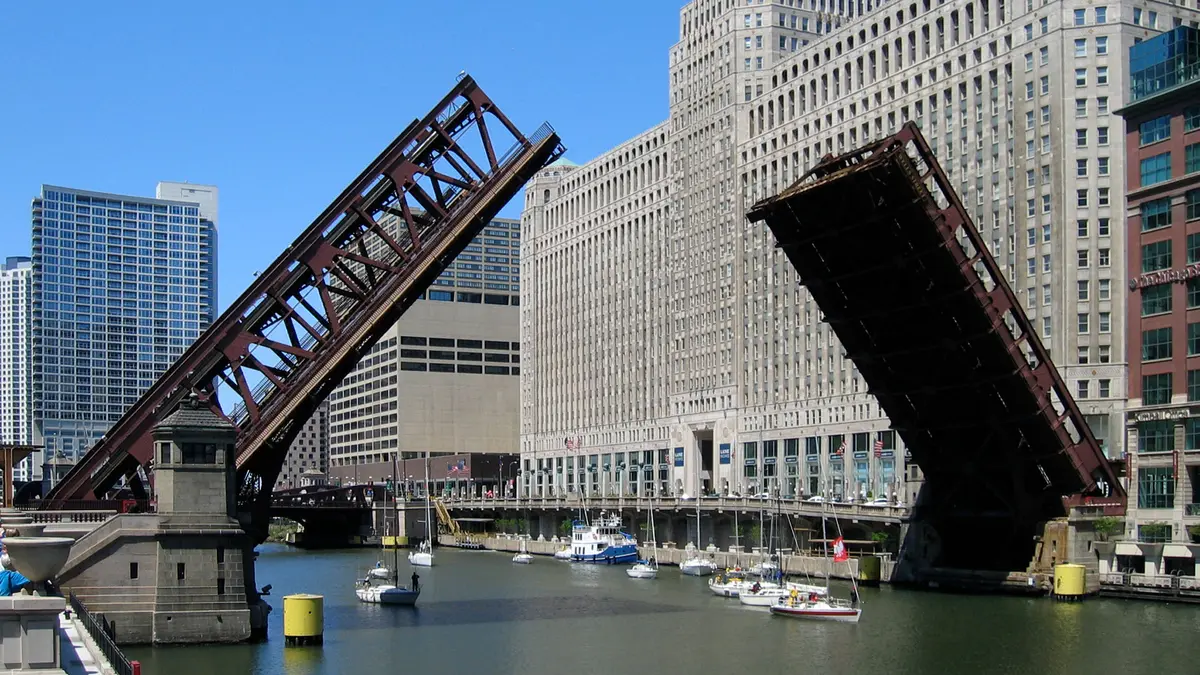
A bascule bridge is a type of moveable bridge that can be raised to allow watercraft to pass underneath. The name comes from the French word bascule, meaning “seesaw.” It uses a counterweight heavier than the span (the leaf) so that only modest energy is needed to lift the road deck. The earliest bascule bridges were constructed in mediaeval Europe as part of castle defences, and modern versions often use steel trusses and electric motors. A single bridge may have one leaf or two; a double‑leaf design meets in the middle and splits symmetrically when raised.
The bascule bridge at Kolkata’s Syama Prasad Mookerjee Port (formerly Kidderpore Dock) was commissioned in the 1960s to connect Kolkata city with the port’s docks over the Khidderpore Dock basin. It has two leaves that swing upwards, balanced by counterweights through chains and pulleys. Decades of heavy use and exposure to the marine environment have corroded steel and worn out gears, leading to delays in opening and closing. The renovation, to be executed by Rail Vikas Nigam Limited, will replace worn parts, install new hydraulic mechanisms and strengthen the bridge’s steelwork.
Key features of bascule bridges
- Counterweight system: A bascule bridge uses a heavy counterweight connected by cables or chains to the moving span. When the counterweight descends, the span rises, much like a seesaw.
- Single or double leaves: Smaller bascules have a single leaf pivoting from one bank, while larger crossings use two leaves meeting at the centre. The Broadway Bridge in Portland, USA is one of the longest double‑leaf bascule bridges in the world.
- Mechanised operation: Modern bascule bridges employ electric or hydraulic motors, gears and brakes to control the lifting and lowering of the spans, ensuring safe and efficient operation.
- Reduced energy demand: Because the counterweight balances the span, relatively little power is needed to operate the bridge. This makes bascule bridges economical to run even with large spans.
Significance of the renovation
- Improved safety and efficiency: Upgrading the bridge’s mechanical systems will reduce the risk of sudden failures, enabling smoother traffic flow for both vehicles and ships.
- Boost to trade: Faster turnaround times for opening and closing the bridge will shorten delays for cargo ships entering and leaving the port, supporting the region’s economy.
- Heritage conservation: Refurbishing this engineering landmark preserves an important piece of Kolkata’s industrial history while adapting it for contemporary needs.
- Sagarmala support: A portion of the funding comes from the central government’s Sagarmala Programme, which aims to modernise India’s ports and improve coastal logistics.
Conclusion
The bascule bridge at Syama Prasad Mookerjee Port is both a functional necessity and a symbol of Kolkata’s maritime heritage. By modernising the bridge, the government ensures that it continues to serve as a reliable link between the city and its docks, while safeguarding navigational access for ships. The project demonstrates how careful engineering and investment can extend the life of ageing infrastructure.
Sources: Devdiscourse

