Why in news?
A census conducted in April 2025 (results reported in 2026) at Assam’s Manas National Park recorded around 76 Bengal Floricans, offering hope for the survival of this critically endangered bird. However, fewer than 400 individuals remain in the Indian subcontinent, and global numbers are thought to be under 800.
Background
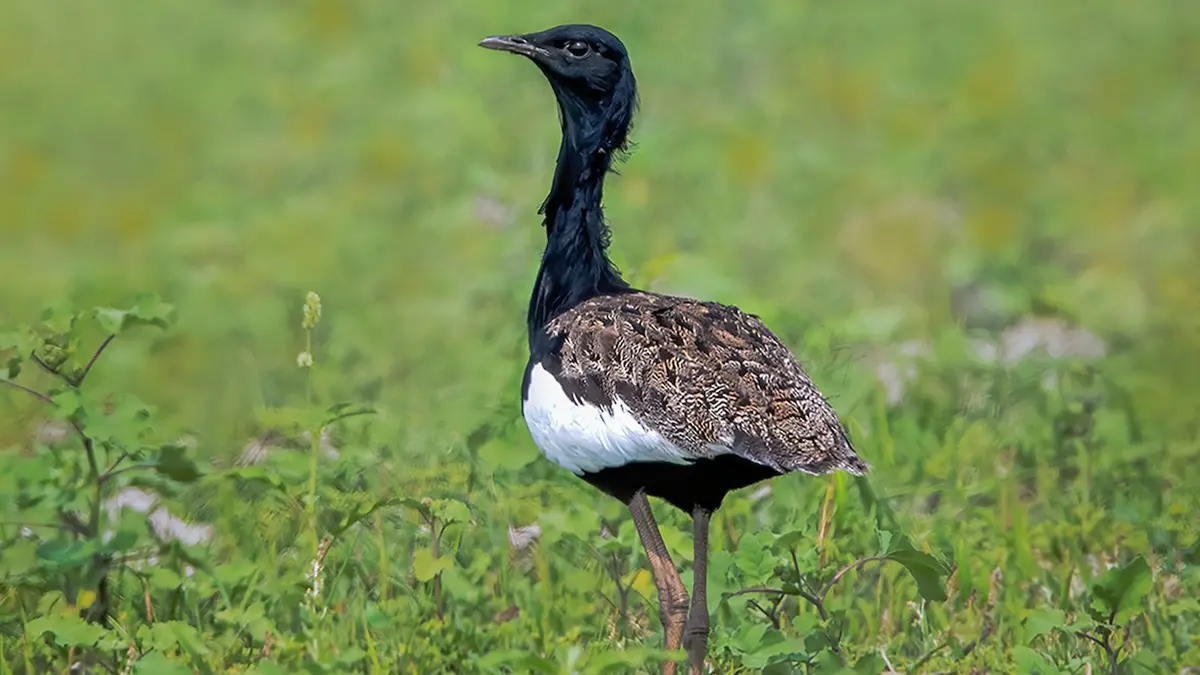
The Bengal Florican (Houbaropsis bengalensis) is a medium‑sized bustard and one of three bustard species native to India. It inhabits open grasslands and floodplains in the Indo‑Gangetic and Brahmaputra plains from Uttar Pradesh to Arunachal Pradesh, and patchily through Nepal to Cambodia. The species is sexually dimorphic: males have striking black plumage with white wings, while females are brown with barred patterns. During the breeding season males perform dramatic leaps and wing flaps to attract mates.
Population and distribution
- Global estimates: Conservation bodies estimate the global population at about 1,500 individuals. India supports roughly 350–400 birds.
- Key habitats in India: The bird survives mainly in a few protected pockets such as Manas, Kaziranga, Orang, Sonai–Rupai and Dibru–Saikhowa in Assam; D’Ering sanctuary in Arunachal Pradesh; Jaldapara and Gorumara in West Bengal; and Dudhwa in Uttar Pradesh.
- Manas survey results: The 2025 synchronised survey observed 38 displaying males and 2 females at Manas. New sightings in areas like Kuklung and Kahitama suggest possible range expansion, while absence in older strongholds indicates habitat degradation.
Threats
- Habitat loss and degradation: Conversion of grasslands to agriculture, invasion by non‑native plants (e.g., Chromolaena odorata, Mikania micrantha) and encroachment by woody species reduce suitable breeding areas. Shrinking grasslands also affect other specialists like the pygmy hog and hispid hare.
- Hunting and disturbance: Although protected by law, occasional hunting and disturbance in unprotected buffer areas pose risks. The species is sensitive to human activities, including uncontrolled grazing and vehicular movement during the breeding season.
- Male‑biased sex ratio: Studies suggest a male‑biased sex ratio, meaning fewer breeding females than males, which hinders population growth.
Conservation efforts
- Protected areas: Dedicated conservation areas and national parks provide core habitats. Seasonal controlled burning helps maintain grasslands by preventing woody encroachment.
- Aaranyak’s conservation project: The non‑profit organisation Aaranyak has been researching and monitoring Bengal Floricans since the 1990s. Its programme surveys potential grasslands, assesses threats, builds local capacity and advocates for community‑based conservation. Collaborating with the Assam Forest Department and Bodoland Territorial Council, the project encourages villagers to participate in protecting the bird.
- Landscape‑level planning: Conservationists emphasise that agro‑pastoral landscapes, if managed with low‑intensity farming during the breeding season, can function as buffer zones. Inclusion of agricultural farms like Kokilabari within conservation frameworks is recommended.
Conclusion
The Bengal Florican’s future depends on protecting and restoring natural grasslands, controlling invasive species, and working with local communities. The encouraging numbers from Manas show that with targeted conservation actions, it is possible to stabilise and even increase populations of this rare bird.