

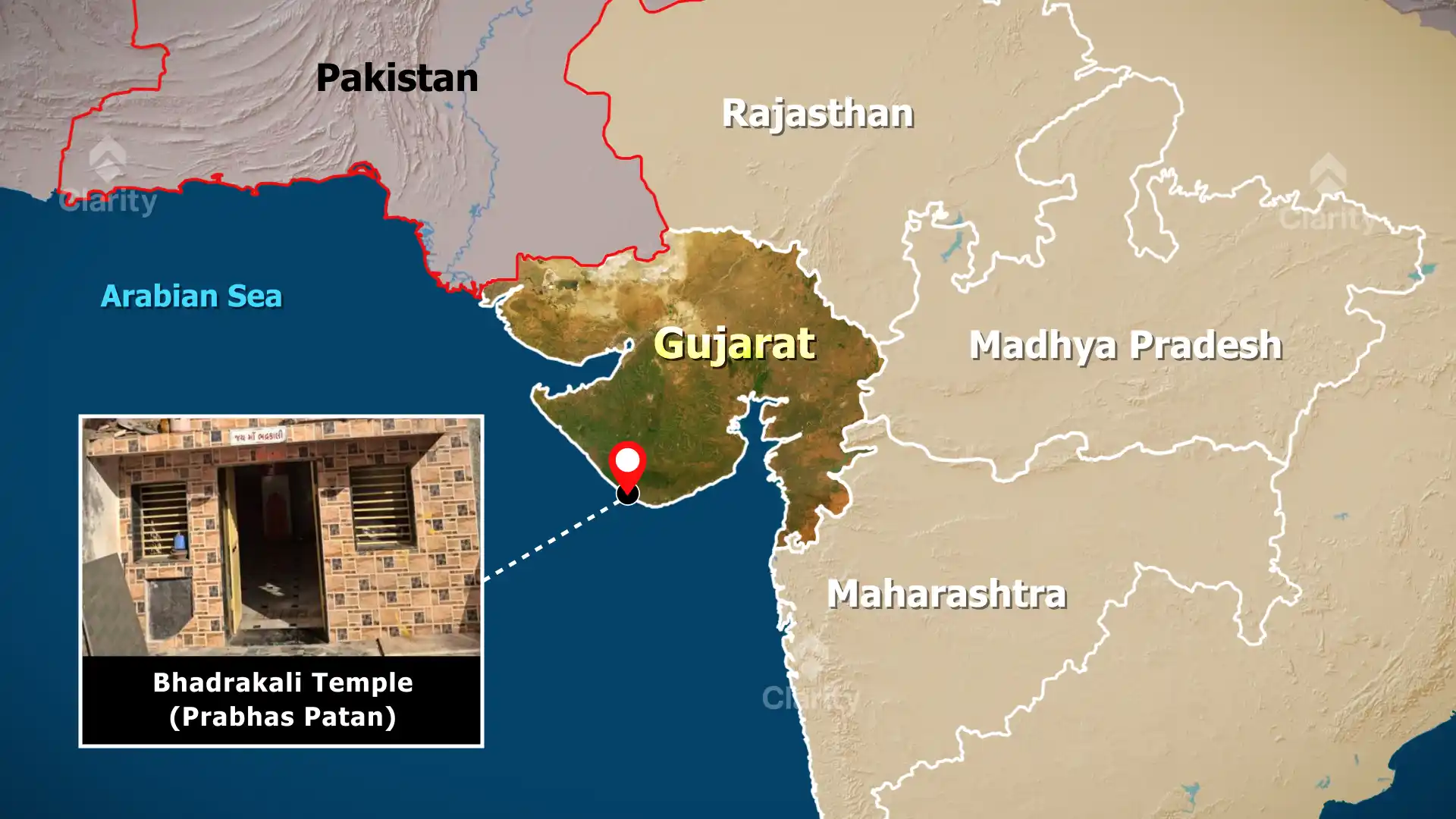
Why in news?
The Bhadrakali inscription has drawn renewed attention after the Archaeological Survey of India highlighted its rich historical content. This twelfth‑century inscription from Gujarat offers a rare chronological record of the Somnath Temple and the patronage of the Solanki rulers. Preservation efforts and recent scholarly work have brought it back into public focus.
Background
The inscription is carved on a wall of the Bhadrakali Temple at Prabhas Patan in Gujarat. It dates to 1169 CE and was commissioned under the patronage of Kumarapala, a powerful king of the Solanki dynasty. The text eulogises Param Pashupata Acharya Shriman Bhavabrihaspati, the spiritual preceptor of the king, and it records the royal support given to the Somnath Temple after repeated invasions.
Historical details
- Four yugas and the temple: The inscription recounts that the Somnath Temple was built with different materials in each mythological era. It claims that the moon‑god Chandra constructed a golden temple in the Satya Yuga, Ravana built a silver one in the Treta Yuga, Lord Krishna erected a wooden temple during the Dvapara Yuga, and in the present Kali Yuga the Solanki king Bhimdev I built a stone temple.
- Solanki patronage: The inscription praises Kumarapala’s guru Bhavabrihaspati and celebrates the piety of the Solanki rulers, who invested wealth and artistry in restoring Somnath after earlier desecrations.
- Cultural importance: Apart from its religious narrative, the inscription is one of the earliest known documents providing a continuous historical account of Somnath. It helps historians reconstruct the chronology of events and the lineage of patrons associated with the temple.
Significance
- Historical record: Inscriptions like this are vital primary sources that corroborate literary and oral traditions about temples and dynasties. They provide names, dates and events that help historians chart regional history.
- Architectural insight: The reference to construction in different eras hints at how temple architecture evolved—from wood to stone—reflecting changes in technology and resources.
- Heritage preservation: Renewed attention to the Bhadrakali inscription has spurred conservation efforts at the temple and underscores the importance of preserving epigraphic heritage.
Conclusion
The Bhadrakali inscription illustrates how a single stone carving can illuminate centuries of history and mythology. By recounting the rebuilding of Somnath across yugas and praising the devotion of the Solanki rulers, it enriches our understanding of Gujarat’s medieval past.
Source: Press Information Bureau