

Why in news?
The Bonda tribe came into focus in 2025 after the government announced housing assistance for Particularly Vulnerable Tribal Groups (PVTGs) under the PM JANMAN scheme and because a young woman from the community cleared the Odisha civil services exam. These developments drew attention to one of India’s oldest and most secluded tribes.
Background
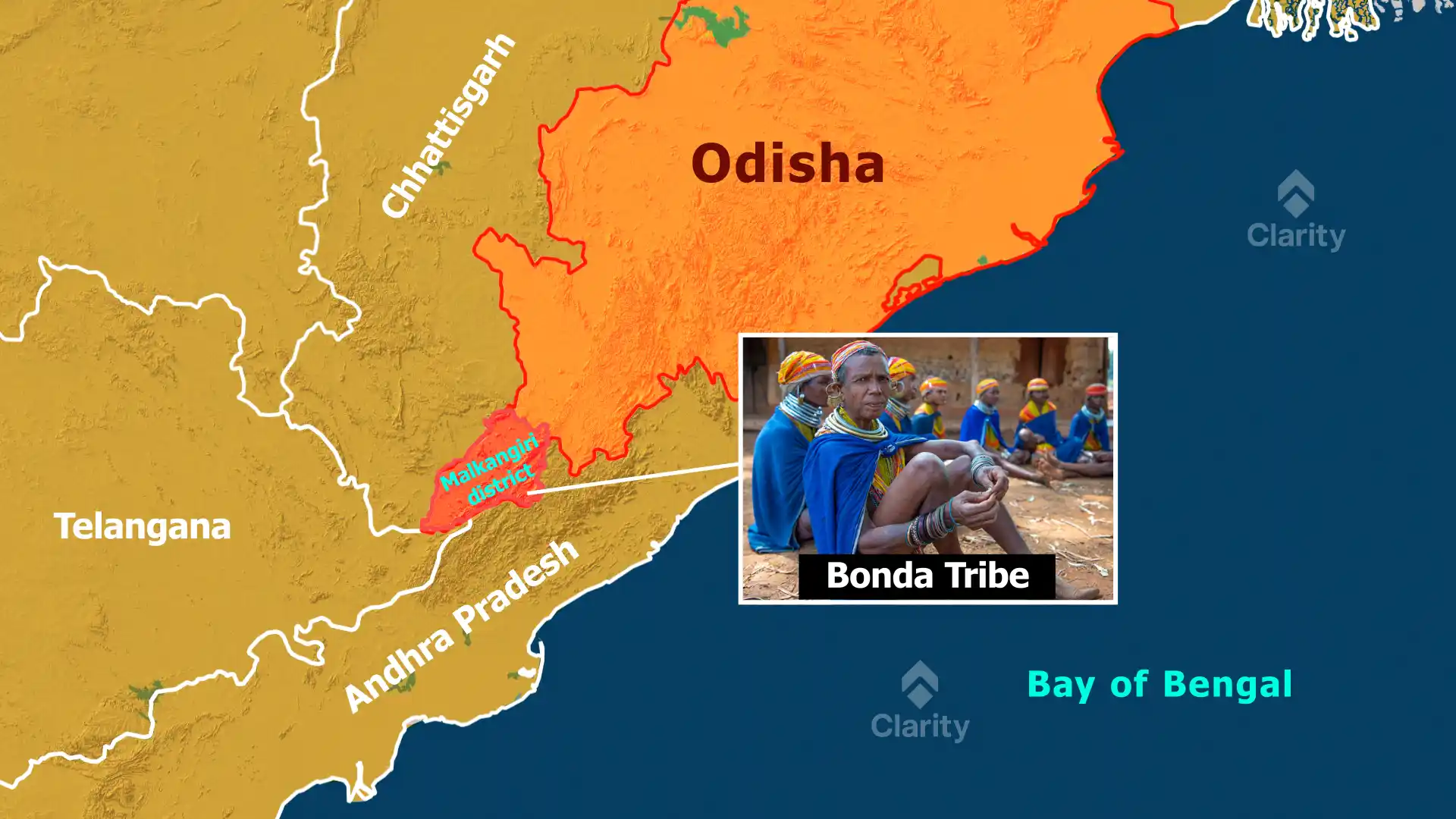
The Bondas, who call themselves Remo meaning “humans,” are a munda‑speaking people living in the remote hilltops of the Malkangiri district in southwestern Odisha. Anthropologists believe that their ancestors were part of the earliest human migrations from Africa around 60,000 years ago. Today the community numbers about 12,000 people spread across 32 hill villages known collectively as the Bonda Ghati.
The tribe is divided into three groups: Upper Bondas living at altitudes of 900–1,200 metres who remain largely isolated from mainstream society; Lower Bondas who reside on foothills and interact more with outsiders; and Gadaba‑Bondas who live alongside the Gadaba tribe. They practice shifting cultivation and collect forest produce such as bamboo shoots, fruits and medicinal plants. Men hunt small game and fish in mountain streams.
Distinctive culture
- Matriarchal traits: Women play a dominant economic role. They cultivate fields, sell produce at weekly markets and make most household decisions. Bonda women often marry men who are 5–10 years younger, ensuring that their husbands can care for them as they age.
- Traditional dress: Women shave their heads and wear dozens of layers of colourful bead necklaces and metal ornaments. Their only clothing is a short, handwoven cloth called ringa or nadi, which barely reaches the thighs. A legend recounts that the goddess Sita cursed the Bondas to dress this way after they laughed at her while she bathed.
- Language and names: They speak Remo, an Austroasiatic language. Children are often named after the day of the week on which they were born.
- Social customs: Marriages involve payment of bride‑price in the form of livestock and rice beer. The community practises dormitory living for youth and maintains strict taboos on inter‑clan marriages.
Challenges
- Isolation and poverty: The steep terrain isolates the Bondas from health care, education and markets. Many households live in thatched huts vulnerable to storms.
- Low literacy: Only a small fraction of Bondas are literate. Efforts by the Bonda Development Agency to establish schools face logistical difficulties and cultural barriers.
- Malnutrition and health issues: Limited access to diversified food and health services leads to high rates of malnutrition, malaria and diarrhoea.
- Migration pressures: Deforestation and declining forest produce compel some Bondas, especially women, to migrate to nearby towns for labour, exposing them to exploitation.
Government initiatives
- PVTG development programmes: The Bondas are one of 13 PVTGs in Odisha. The Bonda Development Agency, set up in the 1970s, implements schemes on housing, health care and livelihoods.
- PM JANMAN scheme: In 2025 the Union government sanctioned funds to build permanent houses for over 1,100 Bonda families. This aims to replace fragile thatched huts with pucca structures.
- Education and empowerment: Scholarship programmes and residential schools encourage Bonda children, especially girls, to pursue education. Success stories like that of Bini Muduli, who joined the civil services, inspire others.
Conclusion
The Bondas’ unique culture and resilience are part of India’s rich tribal heritage. While development initiatives are slowly improving living conditions, it is vital that such programmes respect traditional knowledge and empower the community rather than eroding their identity. Balancing modernisation with cultural preservation will determine the future of this ancient tribe.
Source: DC