

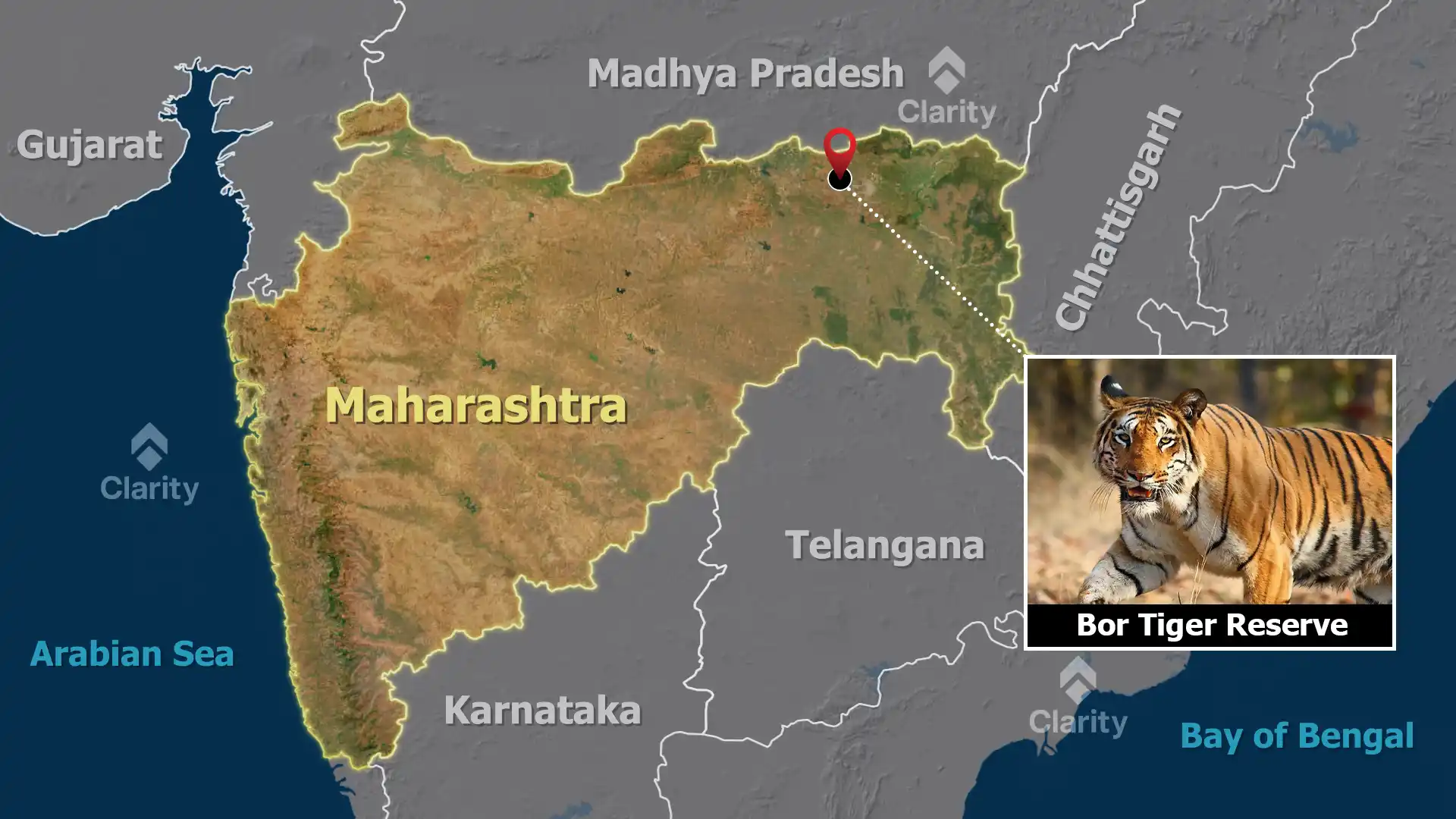
Why in news?
The Bor Tiger Reserve in Maharashtra has sought around ₹1 crore to develop wildlife safari facilities in its newly added Bangdapur and Hingni ranges. The funds will be used to build roads, entry gates, signboards, ticket counters and other tourist amenities. Since the reserve came under unified control in July 2023, its area has expanded from 138 square kilometres to 816 square kilometres with the addition of Bangdapur, Hingni and Kawdas ranges.
Background
Originally notified as Bor Wildlife Sanctuary in 1970, the area was declared India’s 47th tiger reserve in July 2014. Located near Hingani in Wardha district, about 65 km from Nagpur, it encircles the Bor Dam on the Bor River. Its landscape comprises dry deciduous forests, grasslands and riverine ecosystems. The Bor Reservoir divides the forest between Wardha and Nagpur districts, creating habitat diversity that supports a wide array of species.
Ecology and wildlife
- Flora: Teak, ain (Terminalia elliptica), tendu (Diospyros melanoxylon) and bamboo dominate the canopy. Medicinal plants such as gokhru and velatri enrich the understory.
- Fauna: The reserve shelters Bengal tigers, Indian leopards, gaurs, blue bulls (nilgai), sambar deer, chital, barking deer, sloth bears, wild boars and wild dogs. Over 160 bird species, including migratory visitors, and more than 26 species of reptiles (Indian cobra, Russell’s viper, Indian rock python, monitor lizard) have been recorded.
- Conservation efforts: Since 2005 the Maharashtra Forest Department has partnered with NGOs to implement water conservation, habitat mapping and tiger cub rehabilitation programmes. These efforts have made Bor a breeding ground for tigers.
Recent developments
- The reserve’s unified control in 2023 integrated Bangdapur, Hingni and Kawdas ranges, expanding the area to about 816 sq km.
- Officials plan to start wildlife safaris in Bangdapur and Hingni. About 35 km of routes have been identified, and around 30 vehicles will be permitted from each gate. Tourism is currently limited to the Bordharan and Adegaon gates.
- Funds from the Compensatory Afforestation Fund Management and Planning Authority (CAMPA) and district planning bodies will finance roads, signboards, ticket counters, souvenir shops and other facilities. Eco‑tourism is expected to generate employment for local communities.
- The local advisory committee has instructed resort owners to use renewable energy and to ban plastic. Plans include a nature interpretation centre to educate visitors about the reserve’s biodiversity and heritage and the removal of encroachments in wildlife corridors.
Understanding tiger reserves
A tiger reserve is a special category of protected area dedicated to conserving tigers and their habitats. Introduced under the Wildlife Protection Act of 1972 and launched with Project Tiger in 1973, each tiger reserve has a strictly protected core area free from human activity and a surrounding buffer zone where limited and sustainable activities such as eco‑tourism and agriculture may occur. Tiger reserves are managed according to guidelines of the National Tiger Conservation Authority. In contrast, national parks and wildlife sanctuaries protect broader ecosystems or particular species and may not have this core–buffer zoning.
Sources: Times of India