

Why in news?
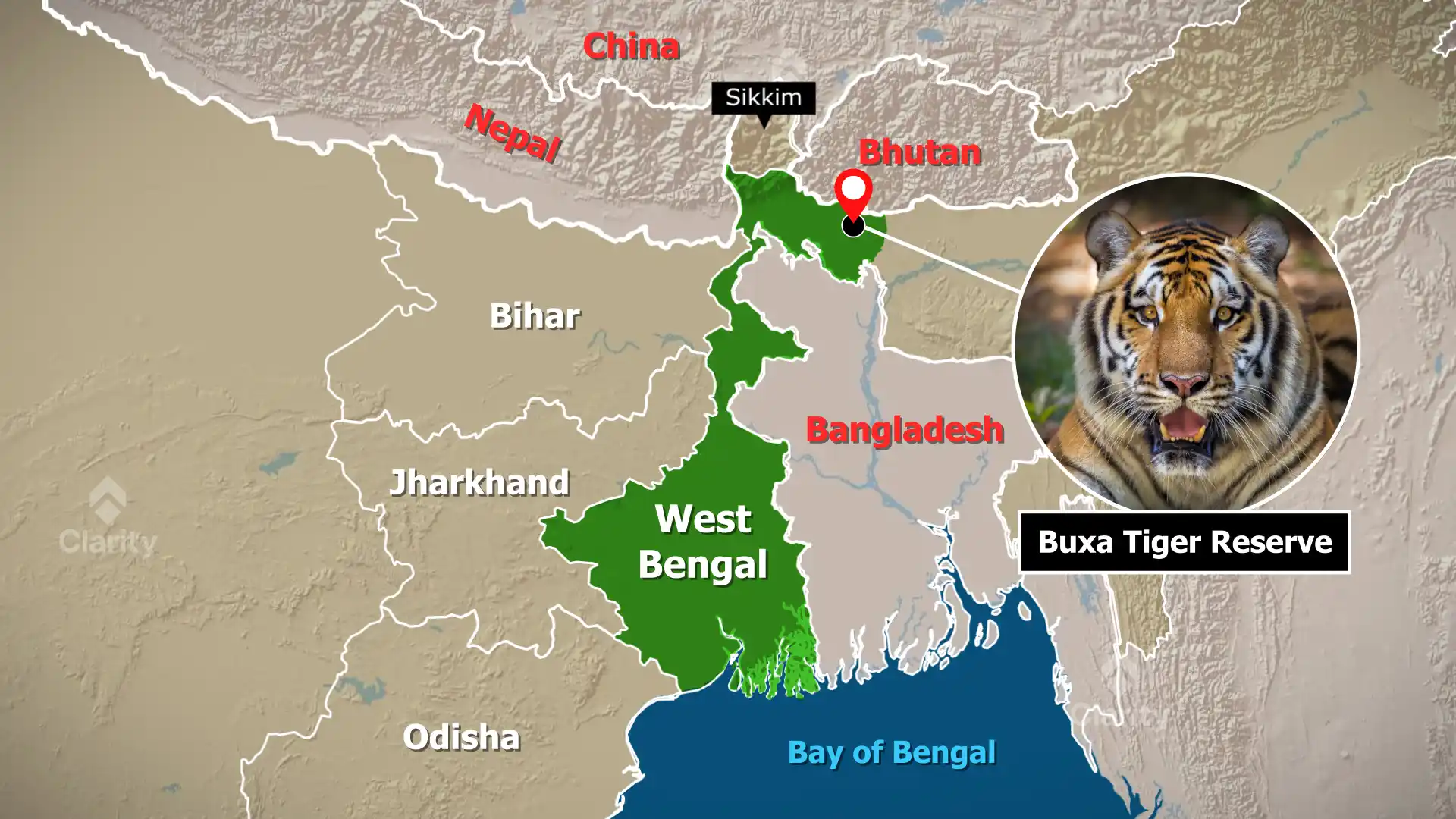
The West Bengal Forest Department launched a four‑month wildlife survey in the Buxa Tiger Reserve in late 2025. About 450 camera traps were installed across the reserve’s 760 square kilometres to document tigers and other wildlife. The survey aims to map species distribution and assess habitat use in line with guidelines of the National Tiger Conservation Authority.
Background
Buxa Tiger Reserve is located in the foothills of the eastern Himalayas in Alipurduar district, West Bengal. Established in 1983 and covering diverse landscapes from riverine grasslands to dense evergreen forests, it forms part of the larger Terai–Dooars ecosystem and adjoins Bhutan’s Phibsoo Wildlife Sanctuary. The reserve derives its name from the historic Buxa Fort, a trade route watchpost during the British era.
Geography and biodiversity
- Terrain: The reserve stretches from the foothills of the Himalayas down to the plains, with elevations ranging from 60 metres to about 1,750 metres. Important rivers such as the Jayanti and Raidak flow through, creating fertile floodplains.
- Flora: Vegetation includes tropical evergreen and semi‑evergreen forests, moist deciduous sal forests, bamboo groves and savannah grasslands. The diverse habitats support rich flora.
- Fauna: Besides tigers, the reserve hosts Asian elephants, Indian bison (gaur), leopards, clouded leopards, sloth bears and more than 300 bird species such as hornbills and flycatchers.
Purpose of the 2025 survey
- To confirm tiger presence and estimate population size using photographic evidence from camera traps.
- To map movement patterns of other large carnivores and herbivores and identify critical corridors connecting with Bhutan.
- To evaluate habitat quality and guide future conservation interventions, including habitat restoration and anti‑poaching strategies.
Source: Millennium Post