

Why in news?
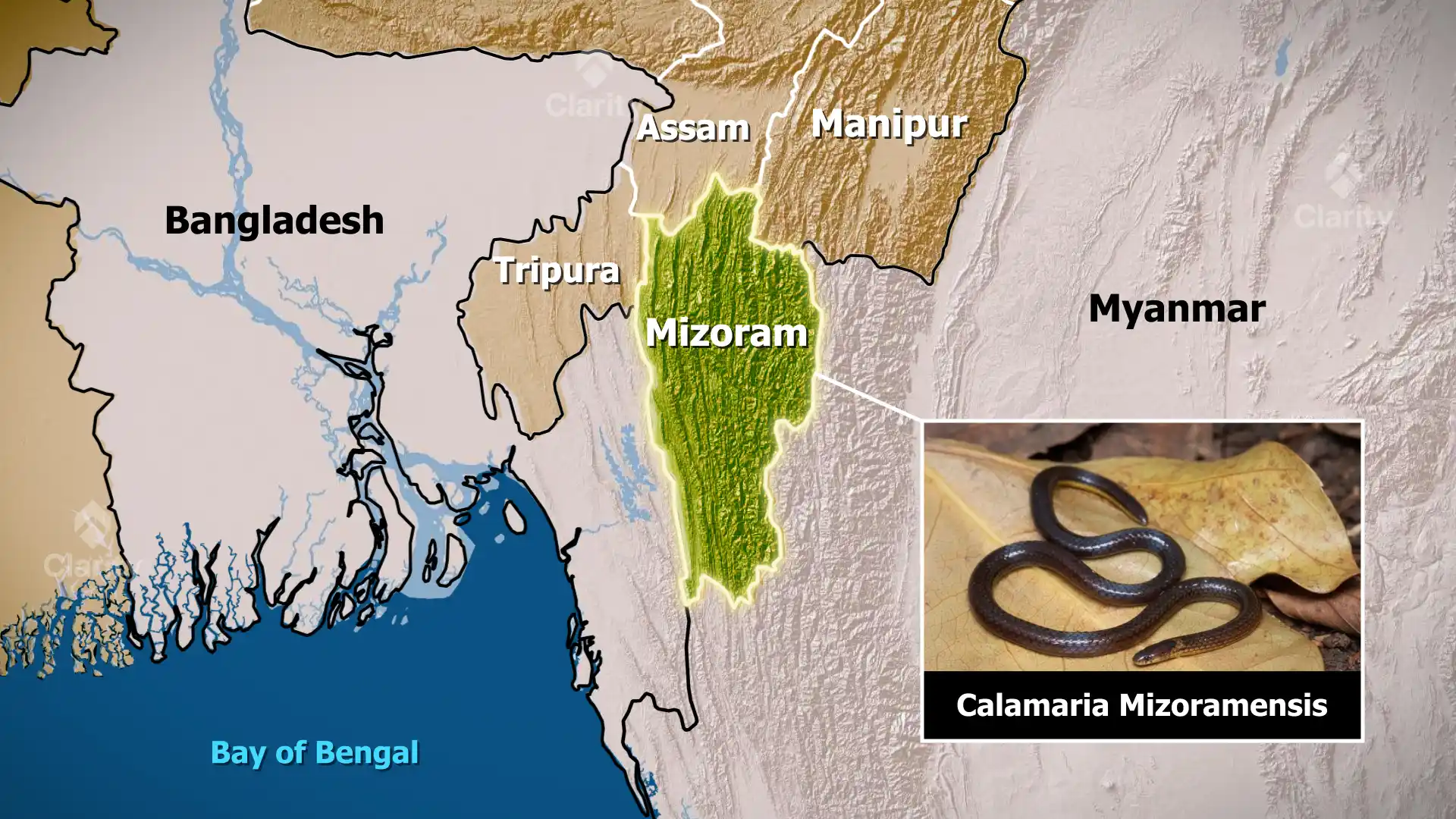
Herpetologists from Mizoram University have identified a new species of non‑venomous reed snake in India’s northeast. Previously misidentified as a Southeast Asian species, the snake has been named Calamaria Mizoramensis after the state where it was found. The discovery was published in the journal Zootaxa and highlights the region’s rich but under‑explored biodiversity.
Background
Reed snakes belong to the genus Calamaria, which comprises small, slender, burrowing snakes distributed across Southeast Asia. They are secretive, rarely seen, and feed primarily on earthworms and soft‑bodied insects. In India, reed snakes are poorly studied, and species identification has relied mainly on morphological traits. The newly described species was collected from humid evergreen forests in Mizoram over several years and mislabelled until genetic analysis was performed.
Discovery and description
- Genetic divergence: DNA sequencing showed that the Mizoram specimens differ by more than 15 percent from their closest relatives, confirming they represent a distinct species. The researchers compared mitochondrial genes with those of related reed snakes to establish this divergence.
- Distinct features: Calamaria Mizoramensis has a dark brown to reddish‑brown body with faint, narrow bands. Its head is slightly pointed with small eyes adapted for nocturnal life. The tail accounts for about 10 percent of its total length, and the scales on the underside of the tail (subcaudals) are paired.
- Behaviour and habitat: The species is nocturnal and semi‑fossorial, spending much of its time in leaf litter or under logs. It inhabits hill slopes between 670 and 1,295 metres in Mizoram and may also occur in neighbouring states such as Manipur, Nagaland and Assam, as well as across the border in Bangladesh.
Significance
- Biogeographical insights: The discovery adds to the growing evidence that northeastern India harbours unique lineages of reptiles and amphibians. Understanding these species helps scientists trace evolutionary histories and biogeographic connections between South and Southeast Asia.
- Conservation awareness: Because reed snakes are often overlooked, their habitats may be at risk from deforestation and human activities. Identifying new species draws attention to the need for habitat protection and further ecological studies.
- Taxonomic refinement: The study underscores the importance of combining morphological observation with DNA analysis to correctly identify cryptic species. Such integrative taxonomy is vital for accurate biodiversity inventories.
Conclusion
The recognition of Calamaria Mizoramensis reminds us that even well‑explored regions can yield surprises when scientists look closely. Continued fieldwork and genetic analysis will likely reveal more hidden species and contribute to better conservation planning in India’s northeastern hills.
Source: Hindustan Times