
Why in news?
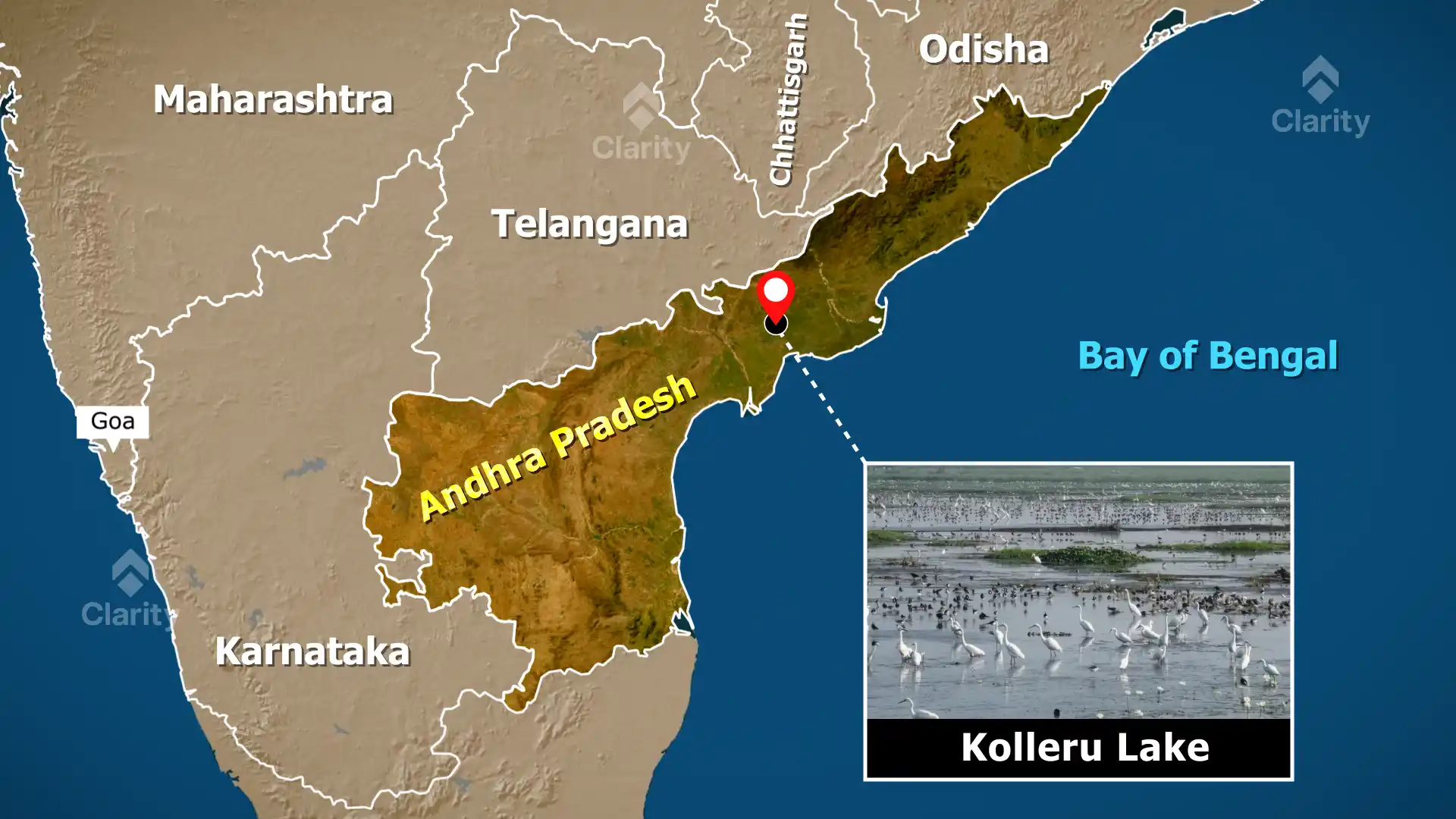
Environmental activists and researchers sounded an alarm in March 2026 over the shrinking of Kolleru Lake, one of India’s largest freshwater wetlands in Andhra Pradesh. They warned that expansive fish and shrimp farms have occupied much of the lakebed, leaving little open water and threatening migratory birds and local livelihoods. Appeals were made for stronger enforcement against encroachment and for restoration of the lake’s natural hydrology.
Background
Kolleru Lake lies between the deltas of the Krishna and Godavari rivers. Historically covering about 90,100 hectares (222,600 acres), it acts as a natural flood reservoir, receiving inflows from the Budameru and Tammileru rivers and draining to the Bay of Bengal through the Upputeru channel. In 1999 it was declared a wildlife sanctuary and in 2002 a Ramsar wetland of international importance. The lake hosts migratory birds such as spot‑billed pelicans, Asian openbills and flamingos.
Decline of the lake
- Aquaculture boom: Since the late 1980s, thousands of carp and shrimp ponds have been dug in and around the lake, often illegally. Activists estimate that around 128,000 acres of lakebed are now under aquaculture, drastically reducing open water.
- Encroachment and pollution: In addition to fish farms, paddy fields, roads and settlements encroach on the wetland. Nutrient‑rich effluents from ponds and fertiliser run‑off cause eutrophication, algal blooms and fish kills.
- Operation Kolleru: In 2006 the Andhra Pradesh government launched a campaign to demolish illegal fish ponds, but many were rebuilt. Enforcement has been sporadic, and conflicts between conservation and livelihoods persist.
- Hydrological changes: Narrowing and blockage of natural channels and bunds have impeded water flow. The lake now exists only during the monsoon months; it dries up in summer, depriving birds of habitat.
Why Kolleru matters
- Biodiversity hotspot: The lake is a vital stopover for migratory waterbirds on the Central Asian Flyway. Its decline threatens species that depend on it for feeding and breeding.
- Natural flood buffer: By absorbing floodwaters from the Krishna and Godavari systems, Kolleru reduces the risk of downstream flooding. Shrinking wetland area undermines this protective function.
- Livelihoods: Traditional fishers and farmers around the lake depend on its resources. Degradation benefits a few large aquaculture operators while harming small‑scale livelihoods.
Conclusion
Calls to save Kolleru Lake emphasise that wetland conservation must balance ecological health and human needs. Restoring water flows, removing encroachments and enforcing pollution controls are essential to revive this once‑vast lake for birds, people and climate resilience.
Source: The Hindu

