

Why in news?
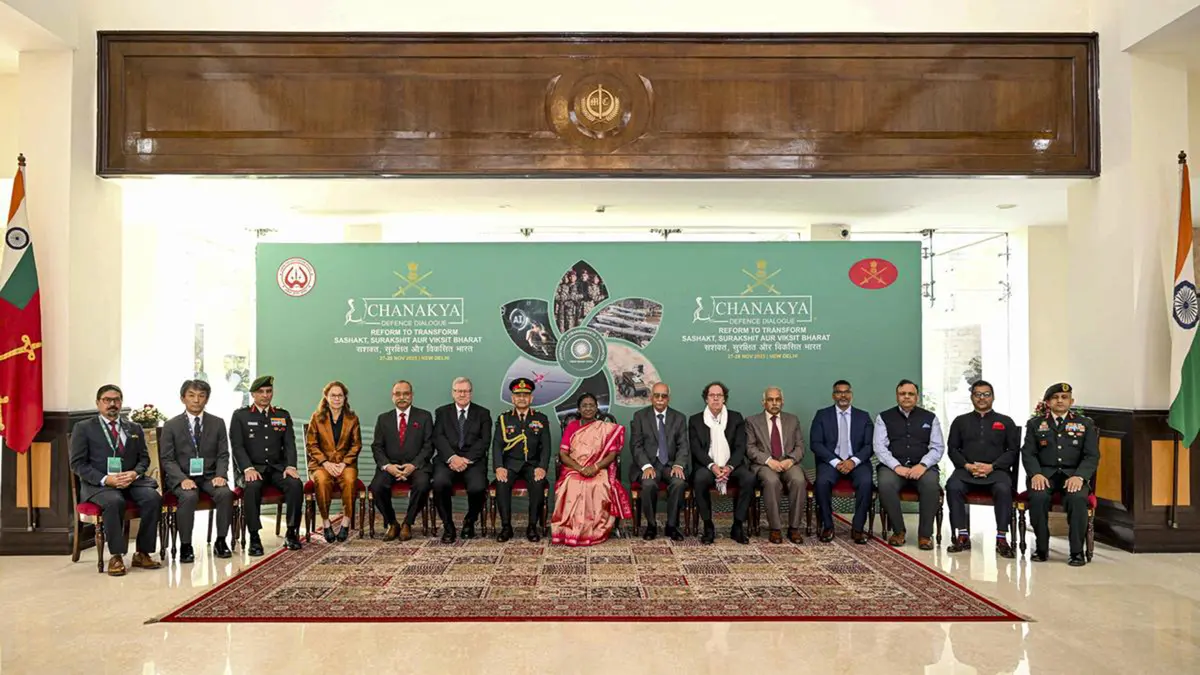
The Indian Army, in partnership with the Centre for Land Warfare Studies (CLAWS), organised the third edition of the Chanakya Defence Dialogue 2025 in New Delhi on 27–28 November 2025. The high‑level conclave, themed “Reform to Transform: Sashakt, Surakshit aur Viksit Bharat,” brought + together military leaders, policymakers, scholars and industry experts to discuss national security + challenges and defence reforms.
Background
The Chanakya Defence Dialogue began in 2023 as an annual platform to chart India’s journey towards Viksit Bharat @ 2047, a vision of a strong, secure and developed nation by the hundredth anniversary of independence. The dialogue seeks to synthesise perspectives from the military, government, industry and academia on issues such as emerging technologies, civil–military fusion, jointness among the armed services and defence industrial reforms. The 2025 edition was preceded by a Youth Leaders Forum on 31 October focusing on the role of young people in national security.
Highlights of the 2025 dialogue
- Inaugural session: President Droupadi Murmu commended the Indian Army’s role in safeguarding borders and contributing to development in remote areas. She emphasised the importance of preparing for new domains such as cyber, space and cognitive warfare and appreciated reforms that expand opportunities for youth and women.
- Army’s transformation roadmap: Chief of the Army Staff General Upendra Dwivedi laid out a three‑phase transformation plan: HOP 2032 for accelerated transition, STEP 2037 for consolidation and JUMP 2047 for a fully integrated, next‑generation force. He identified four drivers for the next leap—deepening self‑reliance, accelerating innovation in critical technologies, adapting organisational structures and strengthening military‑industry‑academia fusion.
- Policy perspectives: Defence Secretary Rajesh Kumar Singh declared 2025 the Ministry of Defence’s “Year of Reforms” and noted that 75 percent of capital procurement is earmarked for domestic industry. NITI Aayog CEO B.V.R. Subrahmanyam discussed global demographic and technological shifts and urged India to leverage its demographic dividend while investing in self‑reliant technologies.
- Technological vision: Former Principal Scientific Adviser K. Vijay Raghavan called for simultaneous investments in short‑term agility through start‑ups and AI, medium‑term control of value chains and long‑term basic science. He proposed a Defence Technology Council to coordinate mission‑driven innovation.
- Defence Minister’s announcements: On the second day, Raksha Mantri Rajnath Singh
highlighted India’s principled foreign policy and launched several initiatives:
- Project EKAM – an AI‑as‑a‑service platform deploying indigenous AI models for military use with data security.
- Prakshepan – a climatology system for predicting landslides, floods and avalanches to aid both military operations and civilian disaster response.
- An AI Handbook for Military Leaders and a publication titled Digitalisation 3.0, showcasing the Army’s adoption of 100 digital applications.
- A Green Hydrogen Microgrid Project to power high‑altitude Army posts in Ladakh, reducing reliance on diesel generators.
- Thematic sessions: Throughout the two days, participants debated topics such as Operation Sindoor, defence reforms to vitalise change, civil–military fusion, battlefield equalisers like AI, autonomous systems, hypersonic weapons and cyber capabilities, and transforming the Army into an integrated, agile and modern force.
- Focus on self‑reliance and jointness: Speakers emphasised that strategic autonomy requires a resilient defence‑industrial base, secure technology supply chains and integrated tri‑service structures. The dialogue aimed to generate actionable recommendations for policymakers.
Significance
- Strategic roadmap: The dialogue provides clarity on how India plans to adapt its defence apparatus to emerging threats and technologies while aiming for a developed nation by 2047.
- Inclusive approach: By bringing together government, military, industry, academia and youth, the event fosters a whole‑of‑nation perspective on security and development.
- Innovation showcase: Launching AI, climate and green‑energy initiatives during the dialogue underscores India’s commitment to leveraging technology for national security and sustainability.
Conclusion
The Chanakya Defence Dialogue 2025 highlighted the complex interplay between reforms, technology and strategic autonomy. By combining high‑level policy announcements with practical discussions on jointness and innovation, the event aims to guide India’s transformation into a secure, prosperous and resilient nation.
Source: TH