

Why in news?
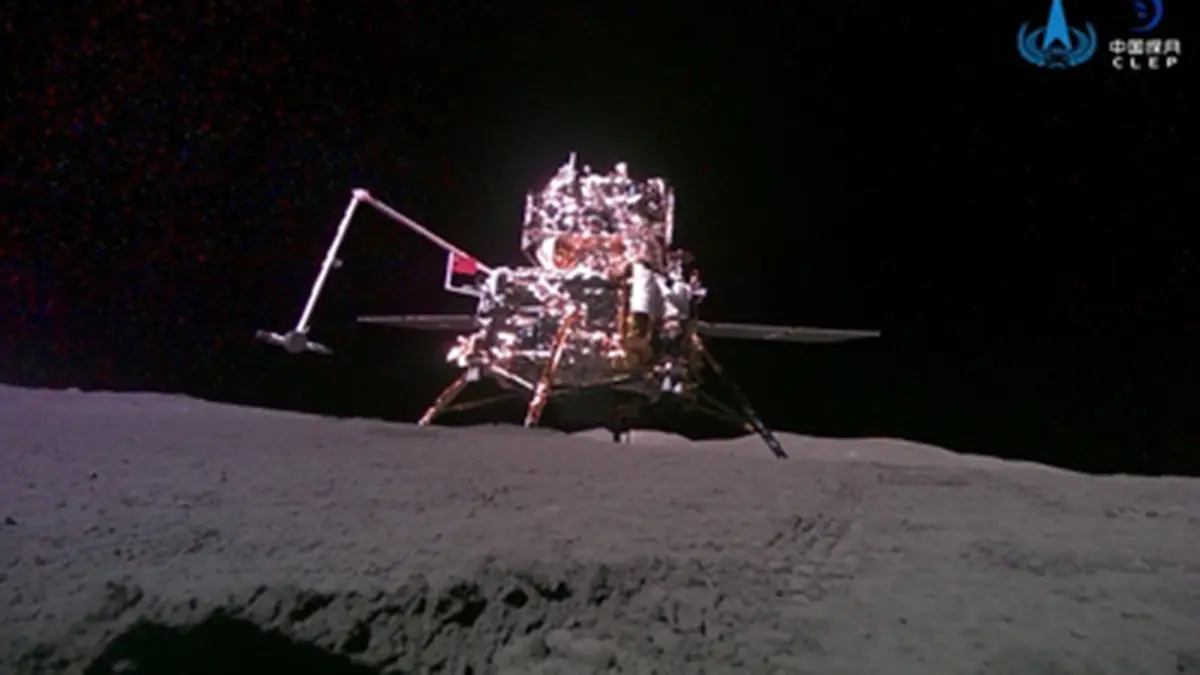
The Chang’e‑6 mission returned the first soil and rock samples from the Moon’s far side in 2024. Recently, scientists announced that these samples contain isotopic clues suggesting that the South Pole–Aitken (SPA) basin on the Moon was formed by a giant impact about 4.25 billion years ago. They also found evidence of ancient volcanic activity and a once‑present magnetic field. These findings help explain why the far side looks so different from the near side.
Background
Chang’e‑6 is part of China’s lunar exploration programme. It landed in the SPA basin in June 2024, collected 1,935 grams of regolith and rock, and returned them to Earth. The SPA basin is the largest and oldest known impact crater on the Moon. Until Chang’e‑6, all lunar samples came from the near side, so scientists had limited information about the far side’s geology. By analysing potassium isotopes and other elements, researchers can infer the conditions under which the rocks formed.
Key findings
- Evidence of a giant impact: High‑precision measurements of potassium isotopes show that the SPA basin was formed by a massive collision. The impact heated deep lunar material and caused the loss of moderately volatile elements. This explains why rocks from the far side differ from those collected during the Apollo missions.
- Ancient volcanic activity: Basalts in the samples reveal two episodes of volcanic eruptions, around 4.2 billion and 2.8 billion years ago. These eruptions brought molten rock to the surface, but volcanic activity on the far side slowed earlier than on the near side.
- Magnetic field traces: Mineral grains preserve signatures of a magnetic field that existed billions of years ago. This suggests that the Moon’s core generated a magnetosphere in its early history.
- Water content differences: The samples have lower water content than those from the near side, indicating that the far‑side mantle was drier.
Significance
- Understanding lunar evolution: The results show that the far side of the Moon developed differently because of the SPA impact. This helps scientists refine models of how the Moon and Earth formed and evolved.
- Planning future missions: Knowledge of volcanic activity, water content and magnetic history guides site selection for future landers and potential human exploration.
- International collaboration: The Chang’e‑6 mission involved cooperation between China and international partners. Sharing sample data fosters global scientific progress.
Conclusion
The Chang’e‑6 samples are rewriting our understanding of the Moon. By showing that a colossal collision created the SPA basin and shaped the far side’s geology, scientists gain insights into early solar‑system history. Continued study of these samples will reveal more about the Moon’s formation and volcanic past.
Sources: MSC