
Why in news?
On 17 April 2026, members of the Chenchu tribe living in Telangana’s Amrabad Tiger Reserve submitted a petition to the state’s Planning Board opposing any attempt to relocate them from their forest homes. They argued that relocation would destroy their way of life and insisted that they wish to remain within the forest at all costs. Officials assured the community that no families would be evicted and promised discussions with forest authorities.
Background
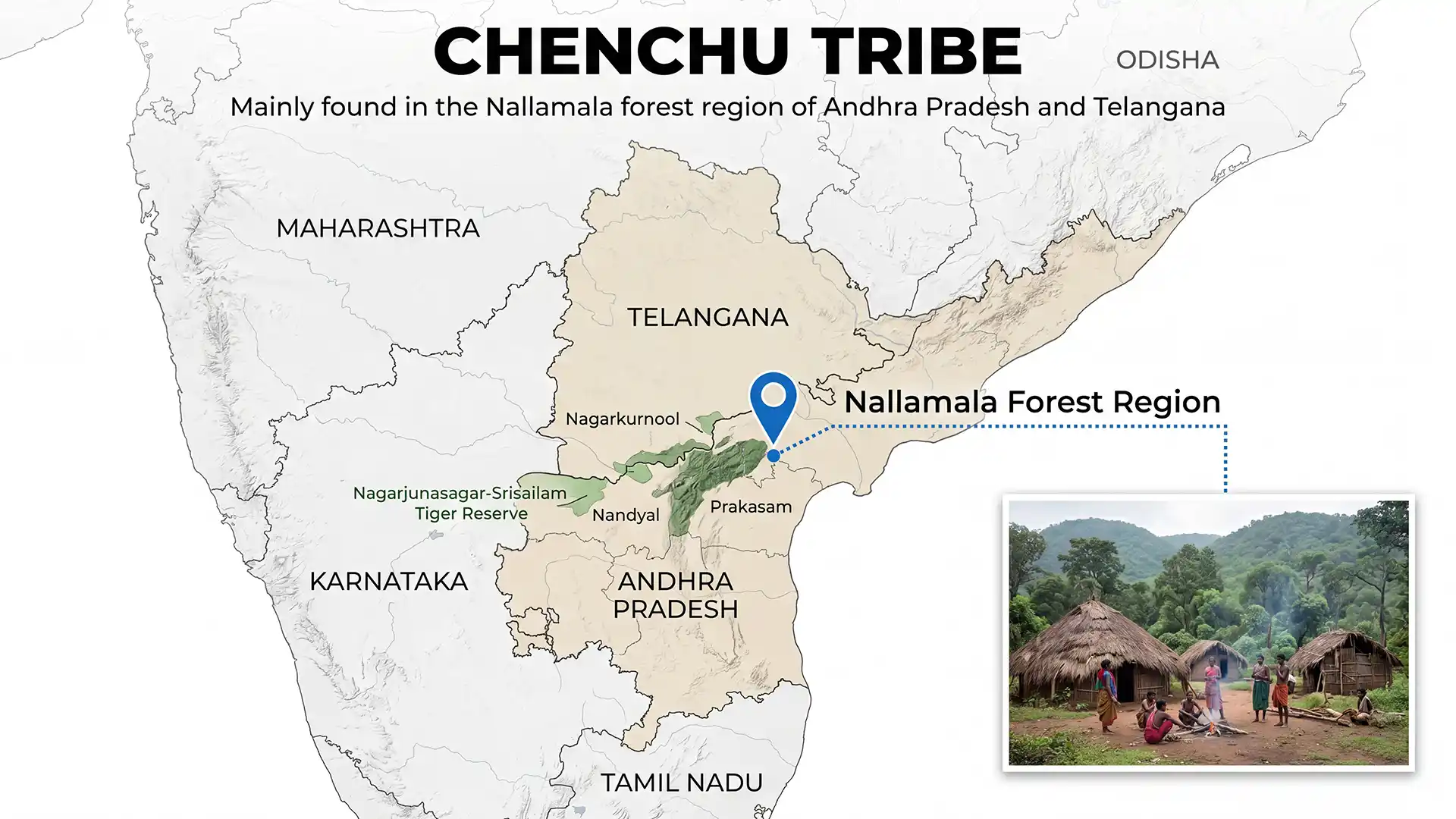
The Chenchus are one of the Particularly Vulnerable Tribal Groups (PVTGs) of India. Traditionally, they have lived as hunter‑gatherers in the Nallamala forests, which stretch across Andhra Pradesh and Telangana. Their name is derived from the Telugu word chettu, meaning “tree,” reflecting their deep connection to the forest. Ethnographers have described them as a nomadic people with egalitarian social relations and a high degree of gender equality. Since 1975 the government has recognised the Chenchus as a PVTG owing to their isolation, low literacy and dependence on the forest. Various development schemes, including a special project under the Mahatma Gandhi National Rural Employment Guarantee Scheme (MGNREGS), have sought to provide livelihood support and basic infrastructure to Chenchu settlements.
Way of life
- Forest dependence: Chenchus collect wild roots, fruits, honey and medicinal plants, and hunt small animals. They avoid killing pregnant animals and ensure that roots are harvested sustainably to allow regeneration.
- Housing and mobility: Many families live in small hamlets deep within the forest. Homes are usually simple huts made of wood and thatch, and people move seasonally depending on resource availability.
- Gender and community: Chenchu society is relatively egalitarian, with women participating in decision‑making and having control over their earnings. Community disputes are settled by elders through consensus.
- Threats: Conservation projects such as tiger reserves often seek to relocate forest‑dependent communities in the name of wildlife protection, leading to conflict. Many Chenchus fear that relocation will result in loss of livelihood, cultural erosion and inadequate compensation.
Significance of the protest
- The Chenchus’ resistance highlights the tension between wildlife conservation and indigenous rights. It raises questions about how to balance ecological protection with the rights of those who have historically stewarded these forests.
- Keeping the community within the forest may support conservation goals since the Chenchus’ traditional knowledge often helps preserve biodiversity.
- The government’s assurance that no eviction will take place underscores the importance of free, prior and informed consent when dealing with tribal communities.
Conclusion
The stand taken by the Chenchus draws attention to the need for inclusive conservation policies. Protecting both biodiversity and indigenous cultures requires recognising the deep connections that communities like the Chenchus have with their ancestral lands.

