

Why in news?
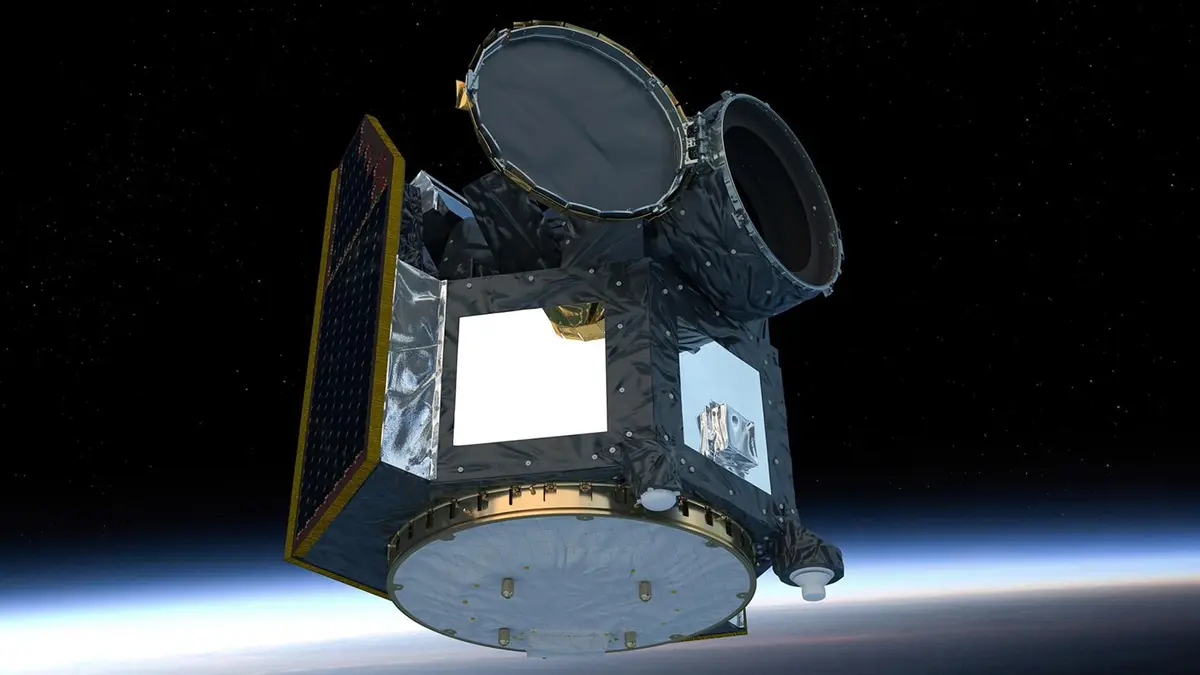
Astronomers using the European Space Agency’s CHEOPS satellite have discovered a remarkable four‑planet system around a red dwarf star called LHS 1903. The outermost planet, designated LHS 1903e, is rocky despite orbiting farther from its star than its neighbours. This finding challenges traditional ideas that outer planets in such systems are usually gas giants.
Background
CHEOPS (Characterising ExOPlanets Satellite) was launched in 2019 to study known exoplanets in detail. By measuring tiny dips in a star’s brightness as planets pass in front, the mission accurately determines planetary sizes and densities. These measurements help scientists infer whether a planet is gaseous or rocky and understand how planetary systems form.
The new planetary system
- Star LHS 1903: A red dwarf located about 54 light‑years from Earth. Red dwarfs are smaller and cooler than the Sun.
- Four planets: CHEOPS confirmed the presence of four planets orbiting the star. The innermost planets are closer to the star and complete an orbit in a few days. The outer planet, LHS 1903e, orbits farther away but still within the star’s habitable zone.
- Surprising composition: LHS 1903e has a rocky composition instead of a thick gaseous envelope. Its estimated radius and mass point to a dense, terrestrial planet.
Implications for planet formation
- Formation timing: Scientists previously believed that outer planets form early, collecting large amounts of gas. The rocky nature of LHS 1903e suggests it formed after the protoplanetary gas had largely dissipated.
- Alternative scenarios: One explanation is that gas giants might have lost their atmospheres through collisions, but data from CHEOPS indicate that LHS 1903e did not undergo significant collisions. Instead, the planet likely formed as a rocky body in a gas‑poor environment.
- Further observations: The CHEOPS mission continues to study other planetary systems to learn whether rocky outer planets are common or rare.
Source: India Today