
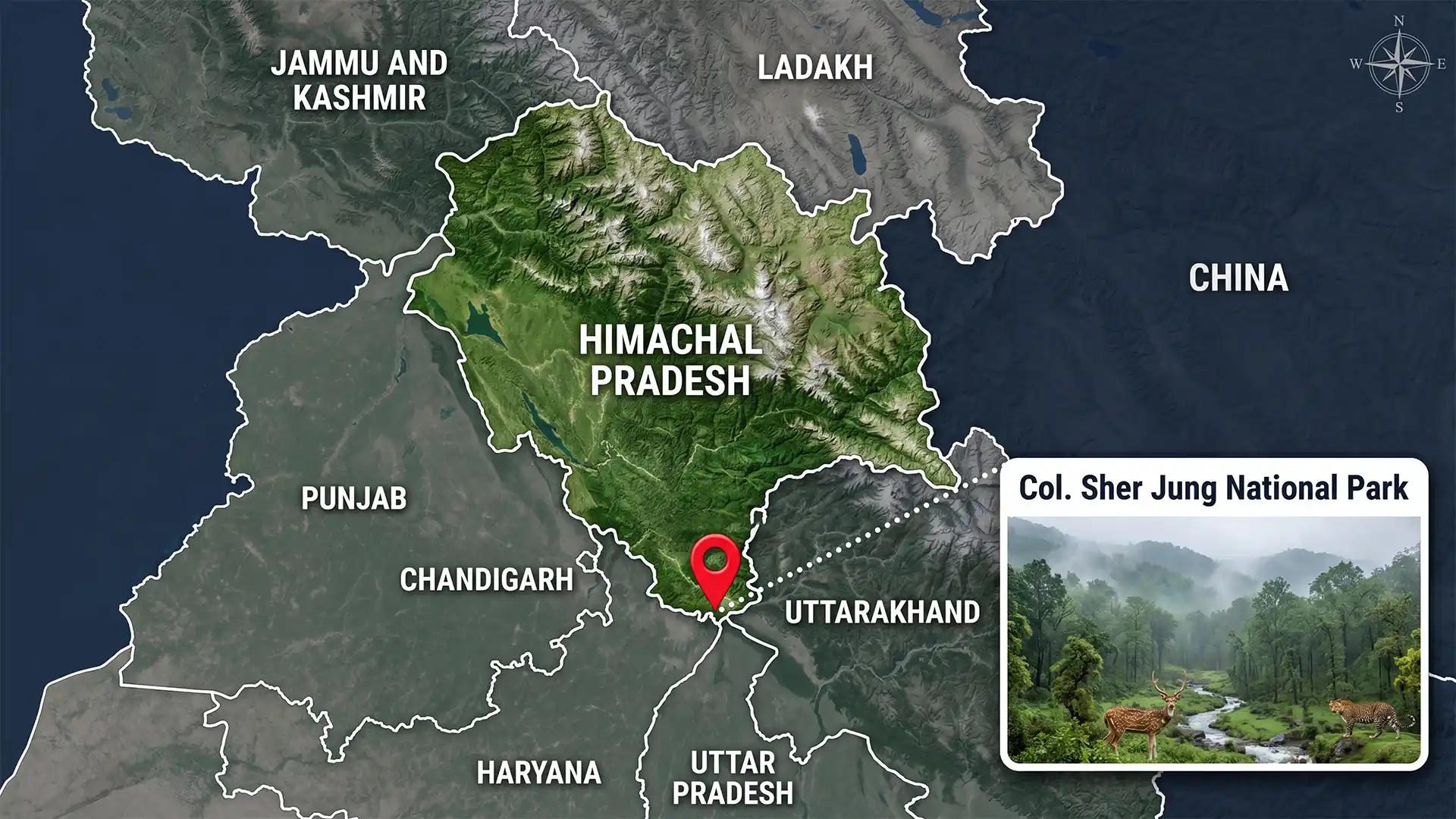
Why in news?
The Himachal Pradesh High Court recently quashed a state government notification that had designated panchayat lands around Col. Sher Jung National Park (also known as Simbalbara) as an eco‑sensitive zone. Locals had complained that the process bypassed public consultation and restricted their rights to use community forests. The decision underscores the delicate balance between conservation and the livelihoods of nearby villagers.
Background
Simbalbara is a small national park in the Shiwalik foothills of Sirmaur district, Himachal Pradesh, adjoining Haryana’s Kalesar National Park. The area was declared a wildlife sanctuary in 1958 and upgraded to a national park in 2010. Covering about 28 square kilometres, the park is named after Colonel Sher Jung, a freedom fighter and conservationist. Its moist deciduous forests dominated by Sal trees form part of an important wildlife corridor linking Rajaji National Park in Uttarakhand with Kalesar in Haryana.
Features of the park
- Vegetation: The park’s dense forests are dominated by Sal (Shorea robusta) and Terminalia species, with patches of Jamun and Eucalyptus along streams. Open grassy glades provide grazing for herbivores.
- Wildlife: Simbalbara supports Nilgai (blue bull), sambar and spotted deer, goral, barking deer, wild boar, porcupine and rhesus macaque. Occasional sightings of tigers and leopards highlight its role as a corridor.
- Birdlife: Avian residents include Indian roller, dollar bird, various kingfishers and hornbills, along with raptors like the crested serpent eagle and Brahminy kite.
- Hydrology: A perennial stream cuts through the park, maintaining moist conditions that support rich understorey vegetation. Gentle hills and shallow valleys make the terrain accessible for wildlife and tourists.
Significance
- Wildlife corridor: Simbalbara links the Rajaji–Kalesar landscape, allowing elephants, leopards and other animals to move between larger reserves.
- Ecotourism: The park offers serene walking trails through Sal forests and is popular for birdwatching. Responsible tourism can support local livelihoods.
- Community dependence: Villagers around the park rely on forest produce and grazing. Eco‑sensitive zoning must balance ecological protection with customary rights.
Conclusion
The quashing of the eco‑sensitive zone notification does not diminish the ecological importance of Col. Sher Jung National Park. Instead it highlights the need for inclusive conservation policies that respect local communities while preserving wildlife corridors in the fragile Shiwalik landscape.
Sources: Indian Express

