

Why in news?
Record‑breaking rainfall during autumn 2025 filled parts of California’s Death Valley with water, causing the temporary reappearance of Lake Manly in the Badwater Basin. Storms from September through November delivered about 2.4 inches of rain—more than the area’s usual annual total—creating a shallow lake that attracted visitors and raised hopes of a wildflower “superbloom” in the coming spring.
Background
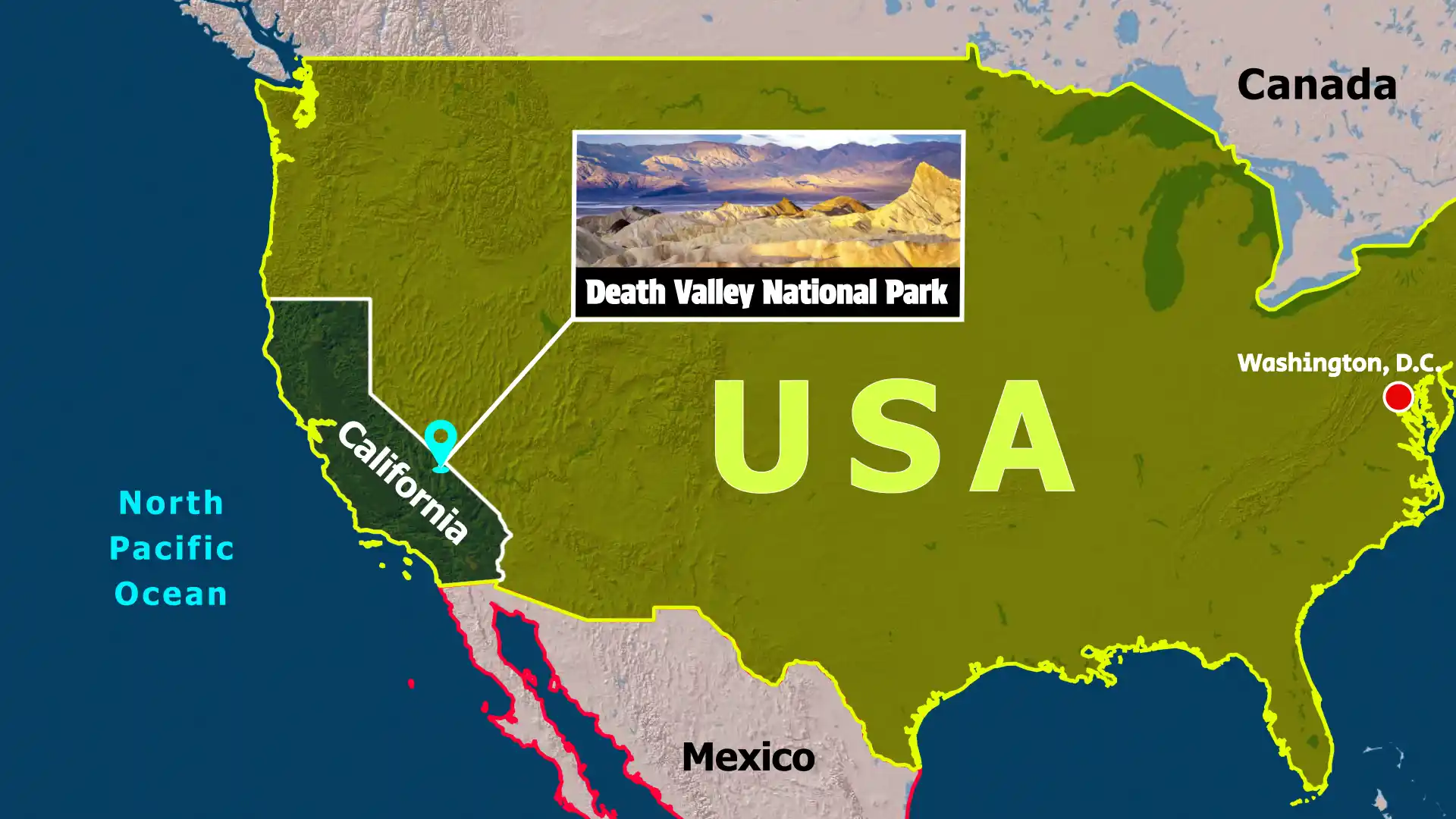
Death Valley National Park is a stark desert valley located in southeastern California, straddling the border with Nevada. It holds several climatic extremes: it is the hottest, driest and lowest place in North America. Furnace Creek in the park recorded a world‑record air temperature of 134 °F (56.7 °C) in July 1913. Average annual rainfall is less than two inches, and much of this water evaporates quickly due to intense heat and low humidity.
Geography and climate
- Lowest point: Badwater Basin, a salt flat at 282 feet (86 metres) below sea level, is the lowest elevation in North America. Normally dry, it occasionally fills with water after heavy rain.
- Highest point: Telescope Peak towers 11,049 feet (3,368 metres) above sea level, providing a dramatic contrast within the park.
- Rift valley: Death Valley is a graben—a block of land that has sunk between parallel faults. It lies in the northern Mojave Desert east of the Sierra Nevada Mountains.
- Ancient Lake Manly: During the Pleistocene epoch, a much larger lake filled the valley. The current shallow pond is a remnant of this ancient body of water and forms only during rare wet periods.
Recent events
- Rainfall totals: The National Park Service reported 2.41 inches of rain over three months, with 1.76 inches falling in November 2025 alone. This is exceptional for an area that typically sees less than two inches a year.
- Temporary lake: Water pooled in Badwater Basin, reaching about ankle‑deep in spots. Since the valley has no outlet, the lake will evaporate over weeks or months.
- Wildflower prospects: Heavy rains could trigger a “superbloom” of desert wildflowers in spring 2026, similar to blooms witnessed after wet winters in 2016 and 2019.
- Safety and closures: Some park roads were closed due to flooding and muddy conditions. Visitors were advised to check for updates and carry plenty of water and supplies.
Conclusion
Death Valley’s fleeting lake serves as a reminder that even the driest landscapes can transform under unusual weather. These rare events provide scientists with data on desert hydrology and give visitors a chance to witness an ancient phenomenon come to life.
Source: TG