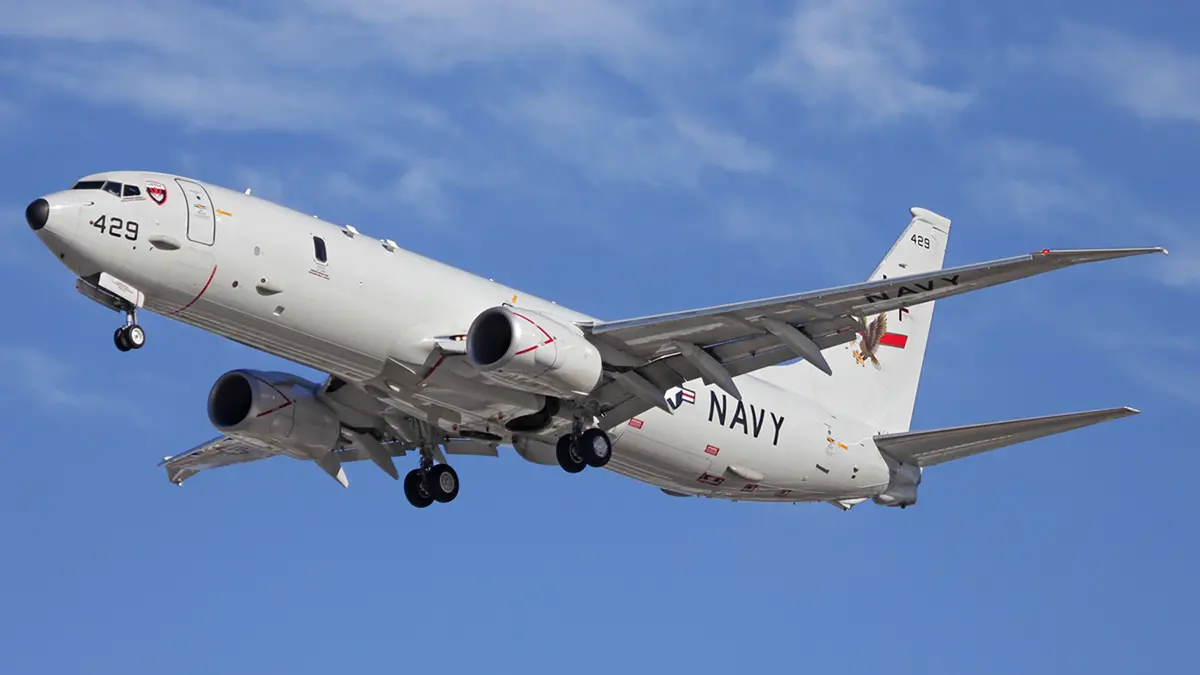
Why in news?
On 27 March 2026 the Ministry of Defence signed a ₹413 crore contract with a domestic firm to perform depot‑level inspections on the Indian Navy’s P‑8I long‑range maritime patrol aircraft. The agreement includes 100 percent indigenous work share and will allow heavy maintenance to be carried out within India, supporting the Aatmanirbhar Bharat initiative.
Background
The P‑8 Poseidon is a multi‑mission maritime patrol aircraft developed by Boeing. It excels in anti‑submarine warfare (ASW), anti‑surface warfare, intelligence, surveillance and reconnaissance (ISR), search and rescue and maritime domain awareness. Key characteristics include:
- Performance: The aircraft has a top speed of about 490 knots (905 km/h), a service ceiling of 41,000 feet and a range exceeding 1,200 nautical miles with more than four hours on station.
- Sensors: A multi‑mode AN/APY‑10 radar can perform synthetic aperture and inverse synthetic aperture imaging to detect ships and submarines. Electro‑optical/infrared (EO/IR) cameras, sonobuoy processing systems and an acoustic sensor suite enhance detection of underwater targets.
- Weapons: The P‑8 can carry torpedoes, depth charges, anti‑ship missiles (such as AGM‑84 Harpoons) and mines. A rotary sonobuoy launcher and under‑wing hardpoints allow flexible mission configurations.
The Indian Navy operates a customised variant called the P‑8I. Modifications include a Telephonics APS‑143 OceanEye aft radar for 360° coverage, a Magnetic Anomaly Detector (MAD) to spot submerged submarines and several Indian‑made systems:
- BEL Data Link II and Identification Friend or Foe (IFF): Enable secure tactical data exchange among Indian Navy ships, aircraft and shore stations.
- Satellite communications: Avantel’s SATCOM system provides beyond‑line‑of‑sight connectivity.
- ECIL speech secrecy devices: Ensure secure voice communications.
Why depot‑level maintenance matters
- Long service life: Aircraft undergo various levels of maintenance. Depot‑level inspections involve extensive disassembly, structural checks and system overhauls that cannot be performed at frontline bases.
- Cost and capability: Performing heavy maintenance in‑country saves foreign exchange and builds domestic capabilities in aircraft servicing and repair.
- Operational readiness: Timely inspections ensure that the fleet remains airworthy and mission ready, which is especially important given increasing naval activity in the Indian Ocean.
Conclusion
The new contract signals India’s growing self‑reliance in maintaining complex defence platforms. By building expertise in heavy aircraft maintenance at home, the Navy can ensure the P‑8I fleet remains a potent tool for securing India’s maritime interests.
Source: Press Information Bureau