
Why in news?
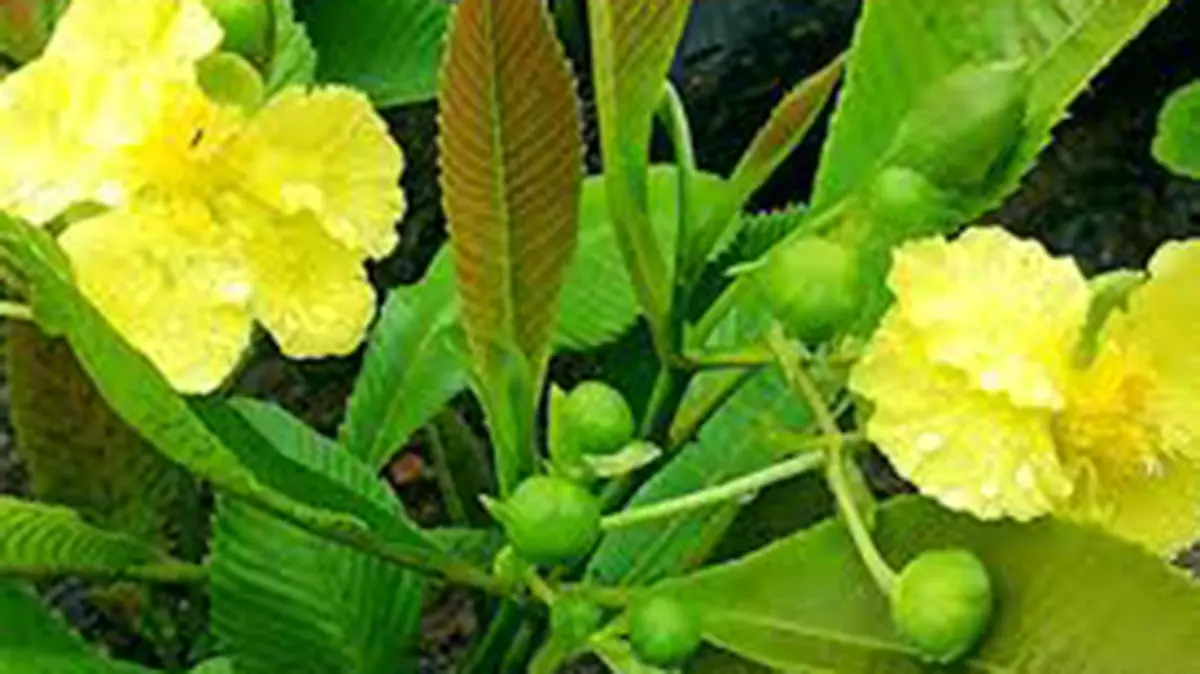
Botanists have described a new flowering plant species, Dillenia nagalim, found in Manipur’s Kamjong district. The shrub, which bears striking yellow blossoms, is known from a single location and may already be at risk of extinction. Its discovery underscores the rich but fragile biodiversity of Northeast India.
Background
The genus Dillenia includes about 60 species of trees and shrubs native to tropical Asia. During botanical surveys in 2024 and 2025, researchers from the CSIR‑National Botanical Research Institute and the University of Science and Technology, Meghalaya, encountered an unusual plant on the border of Manipur and Myanmar. Careful morphological studies and DNA sequencing (using the rbcL gene) confirmed that it was a previously unknown species, which they named Dillenia nagalim. The name honours the Naga people and their homeland.
Distinctive traits
- Growth habit: The plant is a shrub reaching about 1.2 metres in height. It has thick, dark green leaves with double‑serrated edges and prominent veins.
- Flowers and fruits: Large yellow flowers up to 6 centimetres across bloom in May and June. They have many petals, numerous stamens and multiple carpels. The fruits are capsule‑like, and local communities consume the tender leaves and immature fruits as vegetables.
- Habitat: Dillenia nagalim grows in open tropical deciduous forests at altitudes of about 250–350 metres. It is currently known only from a small area of Kamjong district, making its distribution extremely restricted.
Conservation concerns
- Limited population: Fewer than 250 mature individuals were observed, leading scientists to provisionally classify the species as Critically Endangered.
- Habitat threats: Slash‑and‑burn cultivation, logging and road construction in the Indo‑Burma biodiversity hotspot threaten the plant’s forest home.
- Need for protection: Researchers recommend establishing community reserves and educating locals about the plant’s rarity to prevent unsustainable harvesting.
Significance
- Highlighting biodiversity: The discovery demonstrates that the forests of Northeast India still harbour undescribed species that need scientific attention and conservation.
- Ethnobotanical value: The edible leaves and fruits show how new species can contribute to local livelihoods if harvested sustainably.
- Urgency of conservation: Early identification allows authorities to monitor the population and integrate the species into conservation planning.
Conclusion
Dillenia nagalim is a botanical treasure that points to the extraordinary diversity of the Indo‑Burma region. Safeguarding its habitat and involving local communities in conservation will help ensure that this species does not vanish shortly after being discovered.
Source: NorthEast Now

