
Why in news?
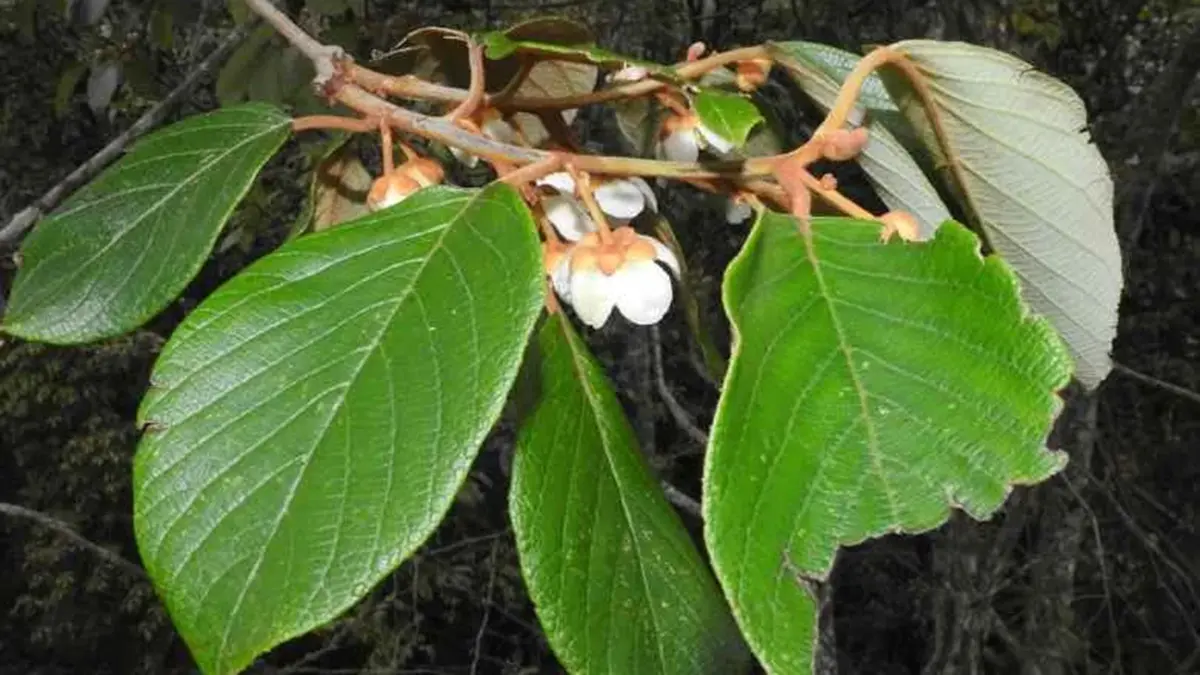
Botanists from the Botanical Survey of India (BSI) discovered a new species of wild kiwi, Actinidia indica, during fieldwork in Arunachal Pradesh’s Ziro Valley. The plant adds to India’s rich botanical diversity.
Background
The genus Actinidia comprises woody climbers native to temperate and subtropical regions of Asia, best known for the cultivated kiwifruit (Actinidia deliciosa). The discovery of A. indica brings the total number of known species in the genus to 56. BSI scientists documented the plant in 2022 while surveying the transition zone between temperate and subtropical forests near Ziro Valley in Arunachal Pradesh’s Lower Subansiri district.
Key characteristics
- Growth habit: A. indica is a perennial climbing shrub reaching 2–4 metres. Its branches are covered with fine hairs, and the leaves are ovate with a dense covering of hair on the underside.
- Flowers and fruits: The plant bears large, showy flowers measuring 4–6 centimetres across, followed by round, slightly hairy fruits 2.5–4 centimetres in diameter. The fruit surface displays a network of linear lenticels (tiny corky pores).
- Habitat and distribution: Currently, A. indica is known only from a narrow stretch near Ziro Valley at around 1,725 metres elevation. It grows in a transitional zone between temperate and subtropical forests, indicating a specific ecological niche.
- Conservation status: Because the species is restricted to a small area and little is known about its population size, researchers have listed it as “Data Deficient.” Its limited distribution raises concerns about potential threats from habitat disturbance and climate change.
Conclusion
The discovery of Actinidia indica underscores the botanical richness of Northeast India and the need for continued exploration. Conservation measures will be vital to protect this unique wild kiwi and other endemic species that may yet be found in the region.
Source: NET

