

Why in news?
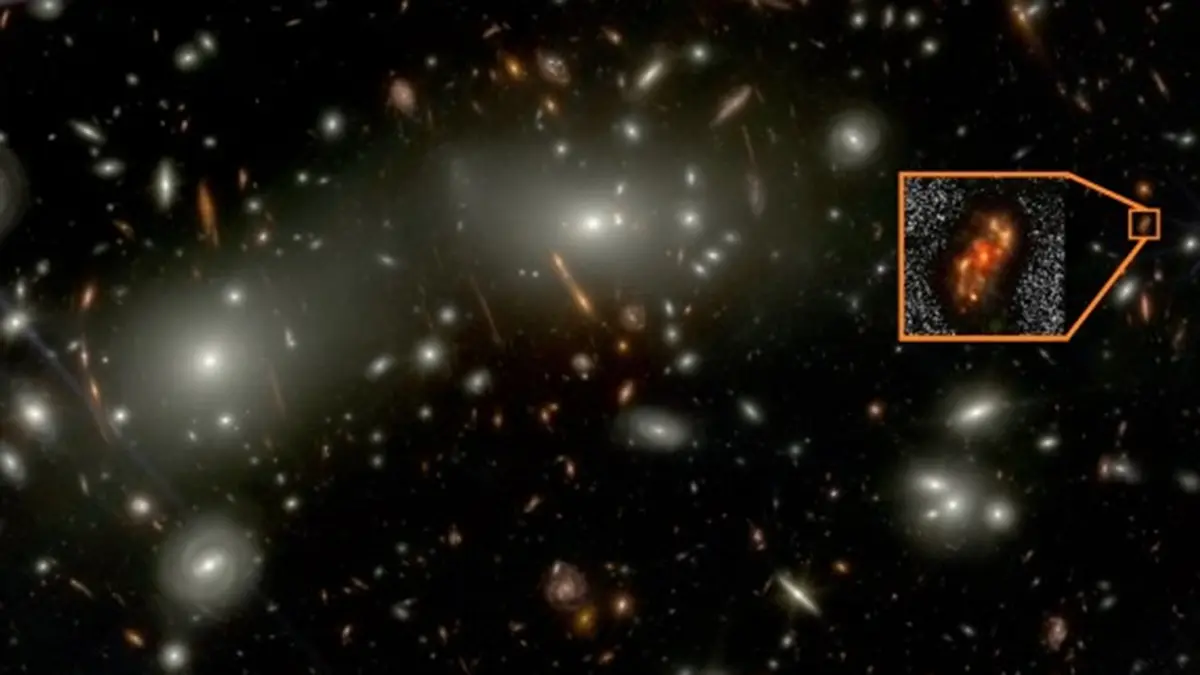
Astronomers using the James Webb Space Telescope (JWST) have discovered a remarkably mature spiral galaxy nicknamed Alaknanda. The galaxy lies about 12 billion light‑years away and dates to a time when the universe was just 1.5 billion years old. Its well‑formed spiral arms challenge theories that early galaxies were chaotic and irregular.
Background
Galaxies come in different shapes. Spiral galaxies, like our Milky Way, have a rotating disk with graceful arms of stars and gas winding around a bright central bulge. They generally form in the later stages of cosmic history as gravity and angular momentum organise gas into disks. Finding such a mature structure so soon after the Big Bang suggests that galaxy formation was more rapid and efficient than previously thought.
Researchers at Pune’s Inter‑University Centre for Astronomy and Astrophysics and the University of California used JWST’s high‑resolution imaging and the natural magnification of a foreground galaxy cluster (a technique called gravitational lensing) to observe Alaknanda. The galaxy’s light has been stretched by the expansion of the universe, allowing astronomers to look back in time.
Key characteristics of Alaknanda
- Grand‑design spiral: Alaknanda exhibits two sweeping spiral arms and a bright central bulge, similar to mature galaxies like the Milky Way. The arms span roughly 30,000 light‑years across.
- Rapid star formation: The galaxy is forming stars at an estimated 60 solar masses per year – dozens of times faster than the Milky Way’s current rate. This intense activity explains its brightness despite its great distance.
- Early maturity: Its organised structure at 1.5 billion years after the Big Bang suggests that massive disks can assemble quickly. Most theories predicted that galaxies at this epoch should be clumpy and irregular.
Implications
Alaknanda’s discovery implies that conditions in the early universe allowed some galaxies to cool and settle into disks much sooner than expected. The finding will prompt astronomers to refine models of galaxy formation and investigate whether such mature spirals are rare exceptions or part of a broader population. It also showcases JWST’s power to reveal the universe’s infancy with unprecedented detail.
Source: Indian Express