
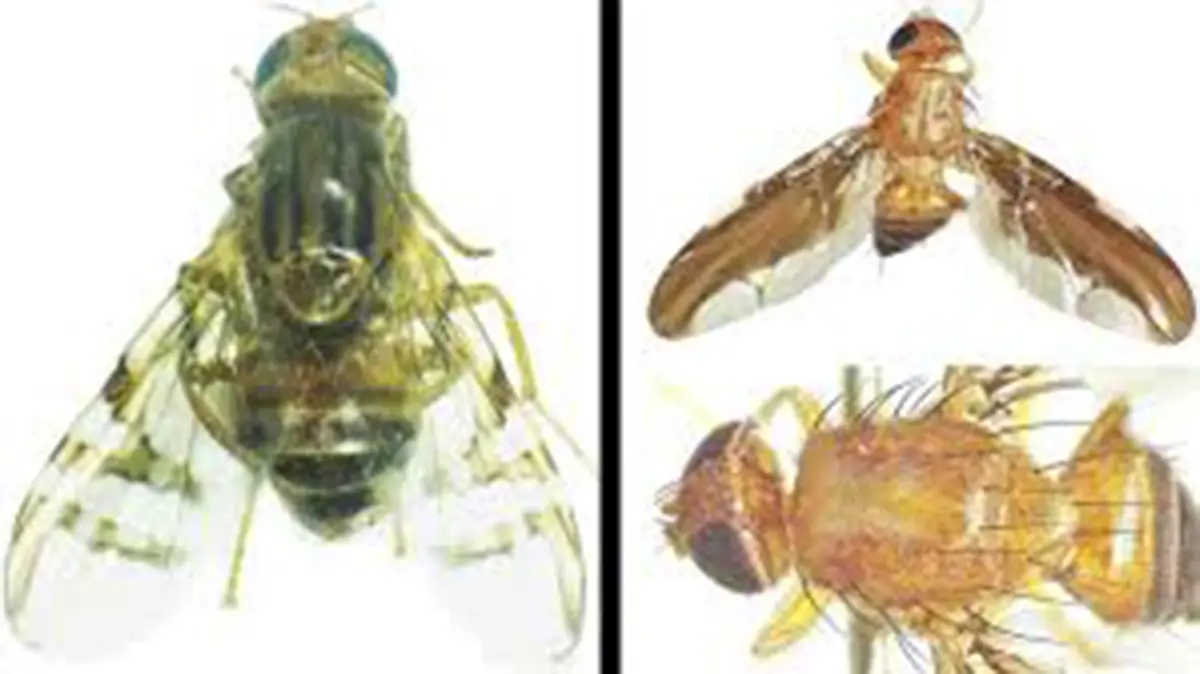
Why in News? Indian entomologists have identified two new species of fruit flies—Acidoxantha paratotoflava and Hemilea suneriae—in the Solan region of Himachal Pradesh. The discoveries were published in a recent research paper and highlight the rich insect diversity of the Himalaya.
Background
Fruit flies (family Tephritidae) include many species that are agricultural pests, but they also play roles in ecosystems as pollinators and decomposers. Scientists survey insect populations to understand biodiversity and to monitor the arrival of invasive species. India’s mountain regions are home to many endemic insects yet to be formally described.
Details of the discovery
- Innovative trapping: Researchers used a locally developed “Solan Bait” trap, which combines fermented fruit and synthetic attractants, to lure rare species into collection jars.
- Acidoxantha paratotoflava: This medium‑sized fly has a greenish‑yellow body with four black stripes on the thorax and distinctive hook‑like structures on the male’s abdomen. It was named because of its similarity to another species, A. totoflava.
- Hemilea suneriae: A reddish‑brown fly with small black dots and wings that display a single clear window. The species was named in memory of the first author’s late mother.
- Other findings: The study reported the genus Rhagoletis in India for the first time and documented the male of Euphranta nigripeda, a species previously known only from female specimens.
These discoveries underscore the need for continued biodiversity surveys in the Himalaya. Documenting new species helps inform conservation and pest‑management strategies.

