

Why in news?
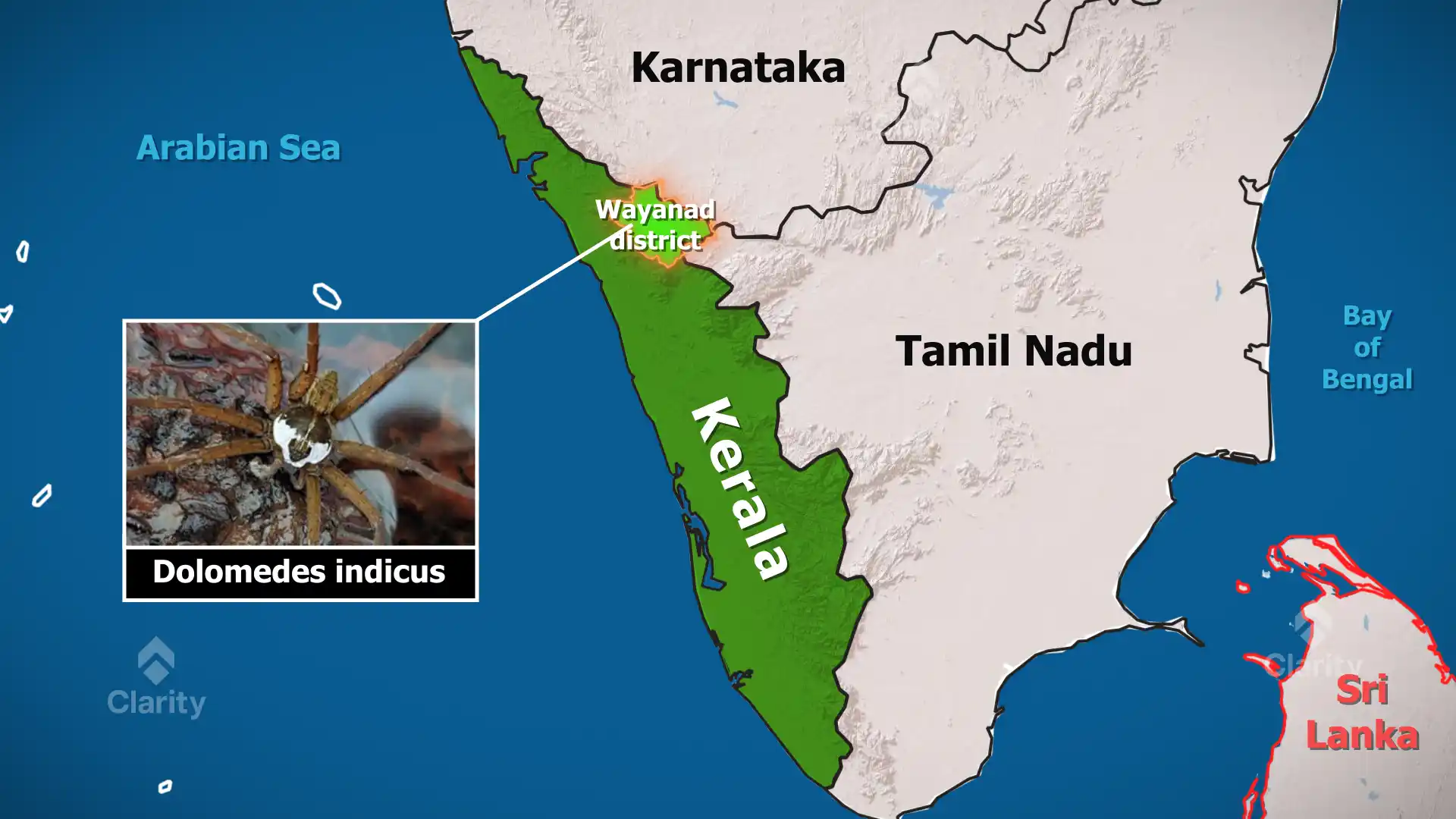
Researchers working in the rainforests of the Western Ghats recently announced the discovery of Dolomedes indicus, a new spider species belonging to the genus of raft or fishing spiders. This species, found in Wayanad district of Kerala, marks the first time a Dolomedes spider has been recorded in India. The discovery has generated excitement among biologists because such spiders are indicators of pristine freshwater ecosystems.
Background
The genus Dolomedes comprises semi‑aquatic spiders commonly called raft or fishing spiders. Unlike typical web‑spinning spiders, they hunt actively on the surface of water. They sense vibrations with their legs, dash across the water to catch insects or small fish and can dive under the surface when threatened. The new species Dolomedes indicus was identified through both morphological characteristics and DNA analysis by scientists at the Kerala Forest Research Institute.
Notable characteristics
- Appearance: Males have a striking snow‑white stripe running down their dark bodies, while females are larger and greenish‑brown to blend with mossy rocks along streams.
- Behaviour: The spiders rest their legs on the water to detect ripples from struggling prey, then sprint across the surface to capture insects or tiny fish. They are also capable swimmers and divers; one observed female remained submerged for over an hour thanks to a layer of hydrophobic hairs that trap air.
- Habitat: The species thrives in cool, forested streams with clean water under dense canopy. Its sensitivity to pollution makes it a useful indicator of freshwater health.
Significance
- Biodiversity value: The discovery adds to the rich biodiversity of the Western Ghats, a global hotspot. Documenting new species helps scientists understand ecosystem health and evolutionary relationships.
- Conservation indicator: Because Dolomedes indicus depends on undisturbed streams, its presence can signal that a habitat remains intact. Conversely, its absence may warn of water pollution or habitat degradation.
- Scientific insight: Observing such spiders offers insights into adaptations for semi‑aquatic life and may inspire biomimetic designs in engineering.
Conclusion
Dolomedes indicus reminds us that India’s forests still hold secrets waiting to be uncovered. Protecting the Western Ghats and their waterways is essential not only for preserving charismatic species but also for safeguarding the ecological services these ecosystems provide, such as clean water and climate regulation.
Source: Research Matters