
Why in news?
Bird watchers in Uttarakhand recently spotted a pair of dusky eagle owls in the Phato tourism zone of the Terai West forest division. The last confirmed sighting of this elusive species near the Corbett Tiger Reserve was about fifteen years ago. Officials say the rare sighting underscores the importance of protecting the old trees and riverside forests that these owls depend on.
Background
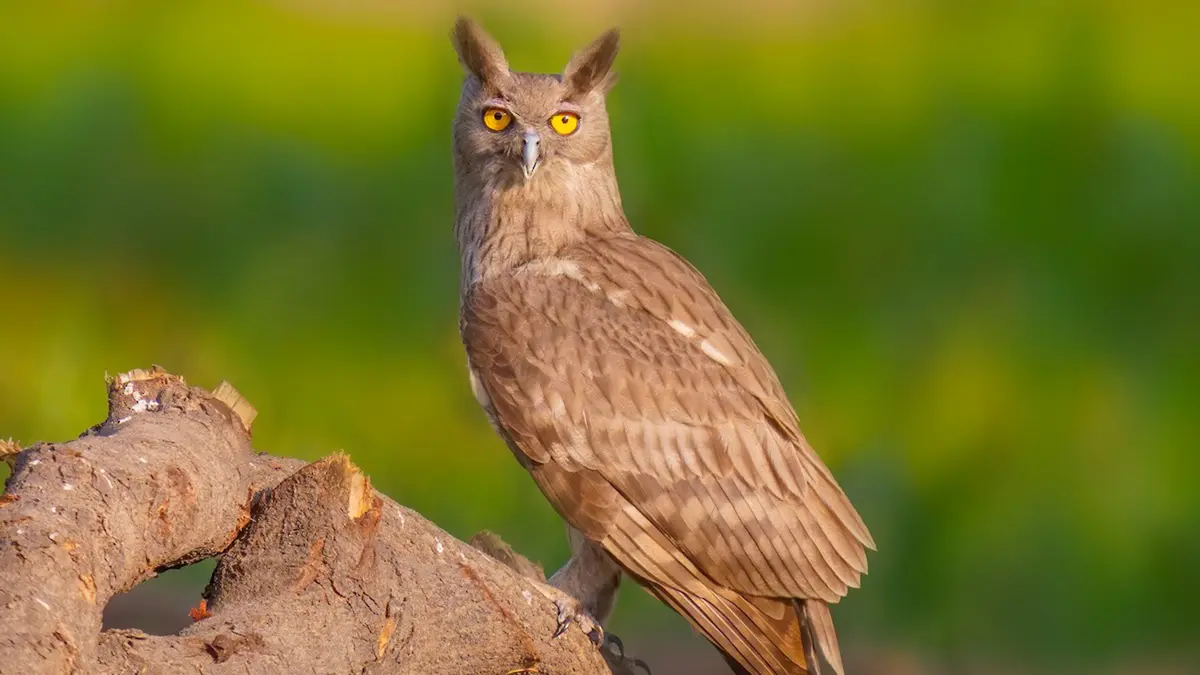
The dusky eagle owl (Bubo coromandus) is a large greyish‑brown owl found across the Indian subcontinent and parts of Southeast Asia. It prefers thick riverside woods, old orchards and groves where large, mature trees provide shelter during the day. The bird is generally nocturnal; during daylight it sits quietly in dense foliage and becomes active around sunset. Its plumage is mottled brown and grey with prominent ear tufts and striking yellow eyes. Female birds are typically larger than males.
Unlike many other owls, the dusky eagle owl does not build its own nest. Instead, it lays eggs in abandoned nests of other large birds such as kites, vultures or crows. Its diet consists mainly of rodents, reptiles and other small birds. The species ranges from Pakistan through India, Nepal and Bangladesh into Myanmar, Thailand and southern China; some populations migrate south into Malaysia during winter months. Although it is listed as “Least Concern” on the IUCN Red List, the bird is rarely seen because of its secretive habits and specialised habitat requirements.
Key details
- Habitat and behaviour: Prefers thick riverside forests and mature trees; roosts by day and hunts small mammals and birds from dusk onwards.
- Physical features: Large size (around 50 cm tall), greyish‑brown plumage, dark wings with whitish streaks, prominent ear tufts and bright yellow eyes.
- Nesting: Uses old stick nests of other raptors rather than building its own; lays two to three eggs in the dry season.
- Distribution: Found mainly in the foothills of the Himalayas, plains of northern and eastern India, and parts of Pakistan, Nepal, Bangladesh, Myanmar and Thailand.
- Conservation status: Classified as “Least Concern” by the IUCN, but local populations may decline due to loss of large trees and degradation of riverine forests.
Naturalists note that protecting the old-growth forests around Corbett and other river systems is crucial for the survival of these owls. The recent sighting also highlights the value of citizen science, as birdwatchers often provide the first alerts of rare species in protected areas.
Sources: New Indian Express, Peregrine Fund – Dusky Eagle Owl profile