

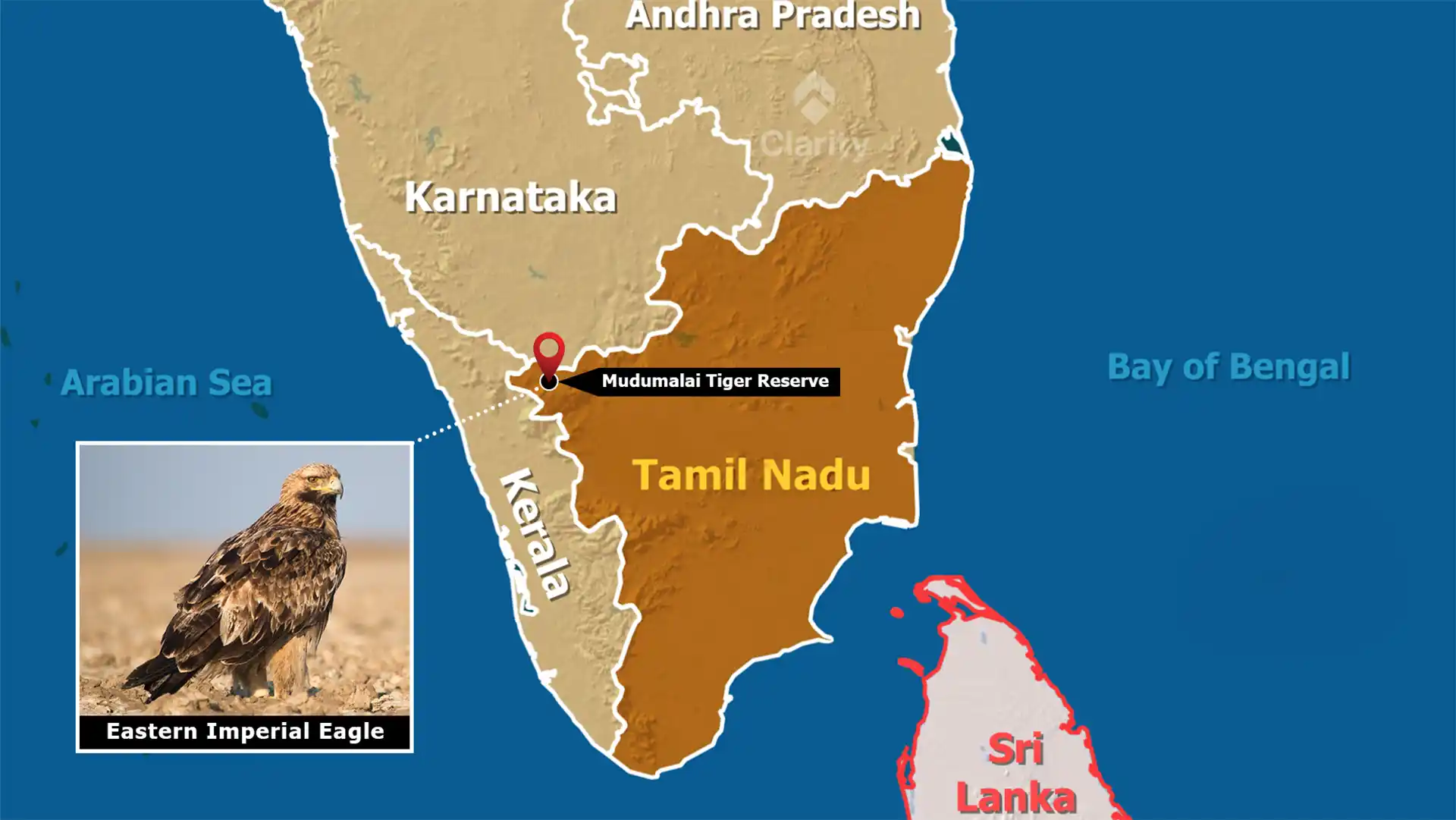
Why in news?
Birdwatchers at the Mudumalai Tiger Reserve in Tamil Nadu recently observed a rare Eastern Imperial Eagle during its winter migration. Sightings of this majestic raptor are uncommon in South India and highlight the ecological richness of the Nilgiri Biosphere Reserve.
Background on the species
The Eastern Imperial Eagle (Aquila heliaca) is a large bird of prey belonging to the family Accipitridae. It breeds in the forest‑steppe zones of Eastern Europe and Central Asia and migrates to Northern Africa, the Middle East and South and East Asia in the non‑breeding season. Adults measure about 92 cm in body length with a wingspan of up to 2.14 m and weigh around 3.6 kg. They have dark brown plumage with a pale golden head and nape, strong legs and sharp talons. The species is listed as Vulnerable on the IUCN Red List; threats include electrocution on power lines, habitat loss and direct persecution.
Mudumalai Tiger Reserve
- Location: Situated at the tri‑junction of Tamil Nadu, Karnataka and Kerala, the reserve covers about 321 sq km and forms part of the Nilgiri Biosphere Reserve.
- Diverse habitats: The landscape ranges from tropical evergreen and moist deciduous forests to dry teak forests, grasslands and swamps, providing shelter for a wide variety of fauna.
- Wildlife haven: Besides elephants, tigers, leopards and gaurs, the reserve supports many bird species, making it a favourite destination for ornithologists.
Significance of the sighting
- Indicator of habitat health: The arrival of a migratory raptor suggests that the reserve offers adequate prey and safe resting areas along its migration corridor.
- Awareness for conservation: Such sightings draw attention to the need for protecting habitats not only for resident species but also for migratory birds that depend on them seasonally.
- Ecotourism potential: Responsible wildlife tourism focusing on birdwatching can generate income for local communities while fostering appreciation for biodiversity.
Conclusion
The unexpected appearance of an Eastern Imperial Eagle at Mudumalai underscores the global interconnectedness of wildlife. Conservation efforts in one part of the world can have ripple effects across continents, reminding us that protecting habitats benefits both resident and visiting species.
Source: The Hindu