Why in news?
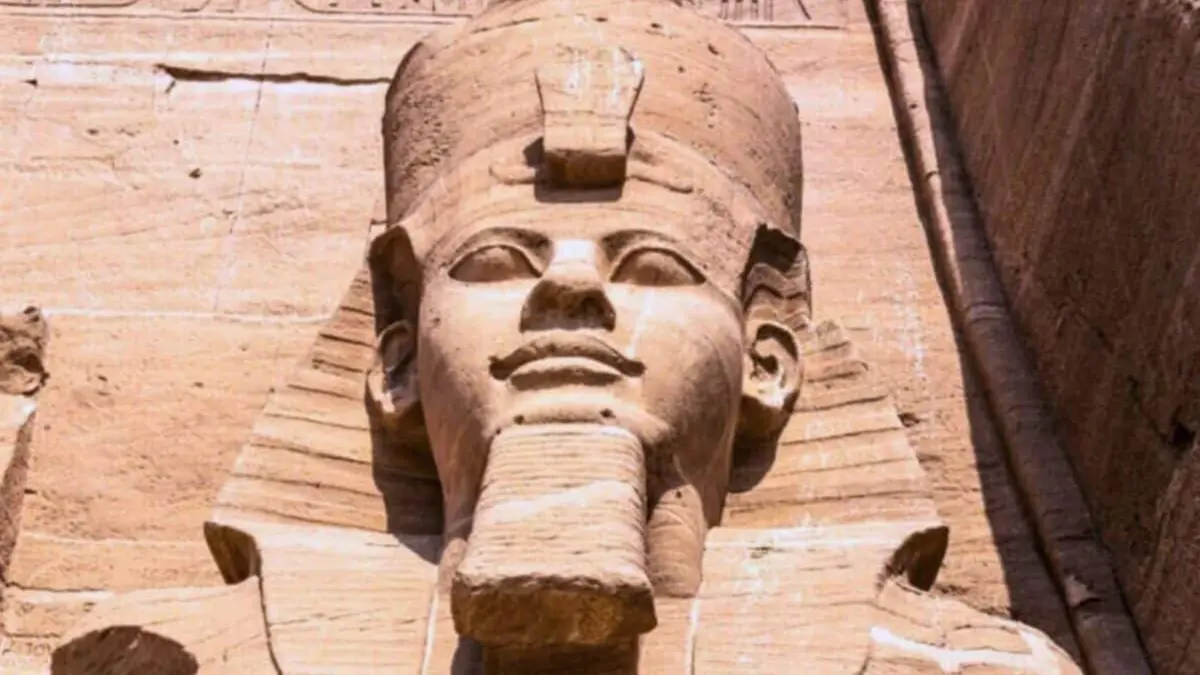
Archaeologists working at the ancient Egyptian town of El Ashmunein (Hermopolis Magna) unearthed a large limestone fragment that fits with a statue of Pharaoh Ramesses II discovered in 1930. The newly found piece shows the seated pharaoh wearing the double crown of Upper and Lower Egypt and carries hieroglyphs praising his royal titles. Together with the earlier find, the fragment completes a monumental sculpture dating to the 13th century BCE.
Background
El Ashmunein lies on the west bank of the Nile in Upper Egypt and was called Khmunu (“City of the Eight”) in ancient times. It served as the capital of the Hare nome and was sacred to Thoth, the god of wisdom and the moon. Excavations have revealed temples, catacombs and a necropolis near Tunah al‑Jabal.
Ramesses II (reign c.1279–1213 BCE) was one of Egypt’s most powerful pharaohs. Huge statues and inscriptions were erected across his empire to proclaim his might. In 1930 a fragmentary statue of the enthroned ruler was unearthed at Hermopolis. The recent discovery — a 3.8‑metre‑high limestone block carved with hieroglyphs — perfectly joins the earlier piece. The combined statue depicts Ramesses II seated, wearing the double crown, and the inscriptions list his royal epithets. The fragment was found by a joint Egyptian–U.S. mission near the temple of Thoth.
Significance
- Completing a lost monument: The new piece allows experts to reconstruct a statue that had been incomplete for nearly a century, offering fresh insights into the artistic style of the New Kingdom.
- Insight into religious life: The site of Hermopolis was a major centre for worship of Thoth; discoveries there illuminate how pharaohs appropriated local cults and deities to legitimise their rule.
- Boosting heritage tourism: High‑profile finds attract global interest and can help sustain conservation efforts and tourism in Upper Egypt.
Source: IDR