Why in news?
The Telangana government has announced plans to promote eco‑tourism and community‑based conservation in Eturnagaram Wildlife Sanctuary, bringing the protected area back into public discourse. Authorities hope that sustainable tourism will generate livelihoods for local tribal communities while preserving wildlife.
Background
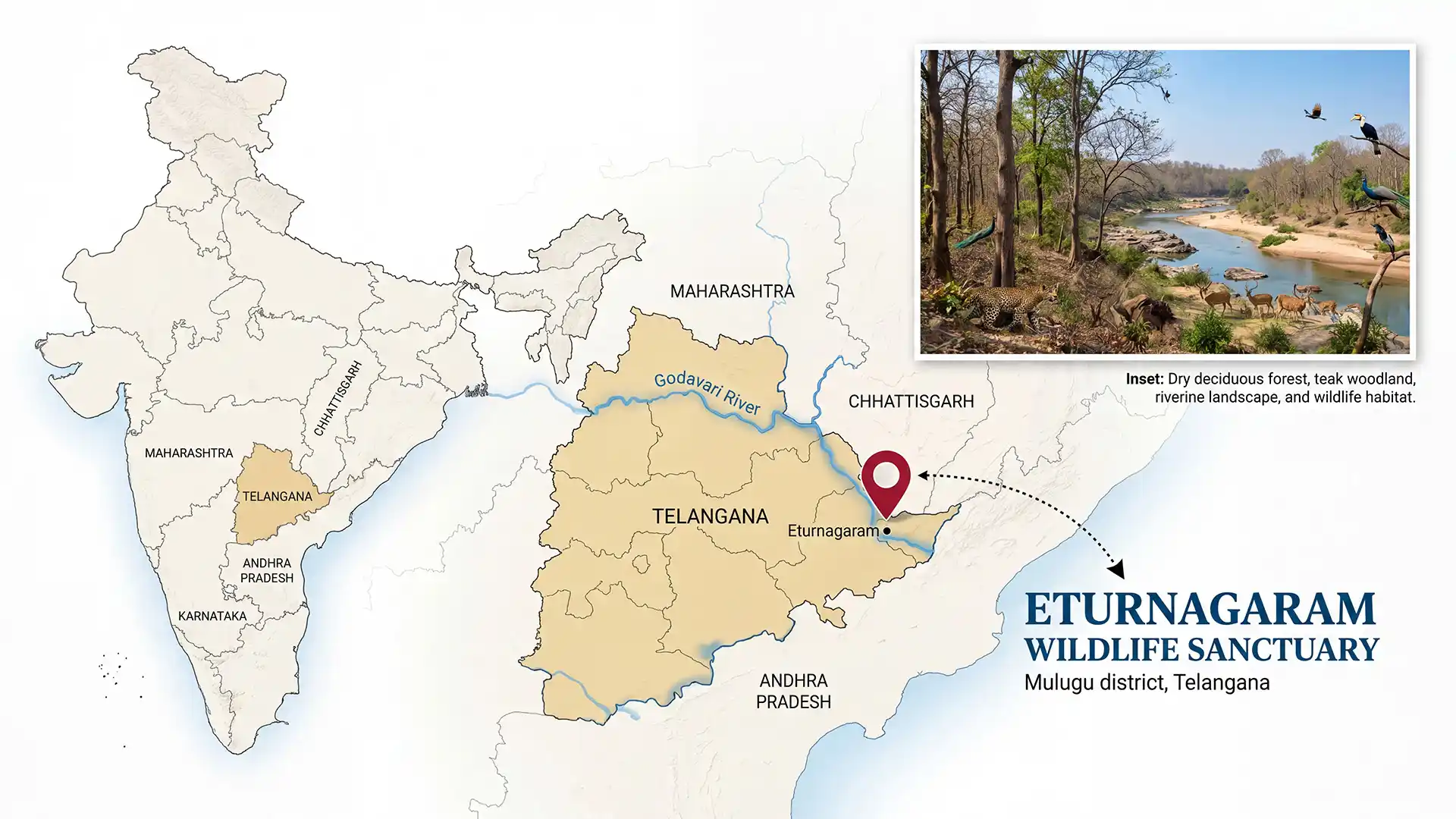
Established in 1952, Eturnagaram Wildlife Sanctuary lies in Mulugu district of Telangana near the borders of Maharashtra and Chhattisgarh. Covering about 812 square kilometres, it consists of gently undulating plains and low hills. The Godavari River flows along one edge and its tributary Dayyam Vagu divides the sanctuary into two blocks, providing perennial water. The vegetation is dry deciduous forest dominated by teak, bamboo and sandalwood. The area shelters large mammals such as tigers, leopards, wolves, sloth bears, gaur, sambar, blackbuck and nilgai, as well as a variety of reptiles including mugger crocodiles and numerous bird species. The Koya tribal community traditionally coexists with wildlife here and practices shifting cultivation along the fringes.
Key features
- Riverine habitat: The Godavari and Dayyam Vagu sustain rich riparian vegetation and attract elephants and deer during the dry season.
- Flora: Dry deciduous forests with teak, bamboo, anogeissus and terminalia species provide fodder and shelter for herbivores and support a variety of medicinal plants.
- Fauna: Apex predators such as tigers and leopards share the landscape with ungulates, primates, sloth bears and reptiles. Birds include crested serpent eagles, grey hornbills and parakeets.
- Community involvement: Local Koya tribes collect forest produce and participate in conservation programmes, making the sanctuary an example of people‑and‑parks coexistence.
Significance
- Biodiversity hotspot: The sanctuary forms a crucial link between the forests of Telangana and Chhattisgarh, allowing gene flow for wide‑ranging species.
- Eco‑tourism potential: Controlled nature trails and homestays can generate income while educating visitors about conservation and tribal culture.
- Cultural heritage: Ancient megalithic burial sites and tribal customs add archaeological value to the landscape.
Conclusion
Eturnagaram’s mix of rivers, forests and culture makes it a unique protected area in central India. With responsible tourism and community stewardship, it can remain a safe haven for wildlife and a source of pride for local people.
Source: Wikipedia · Telangana Forest Department