

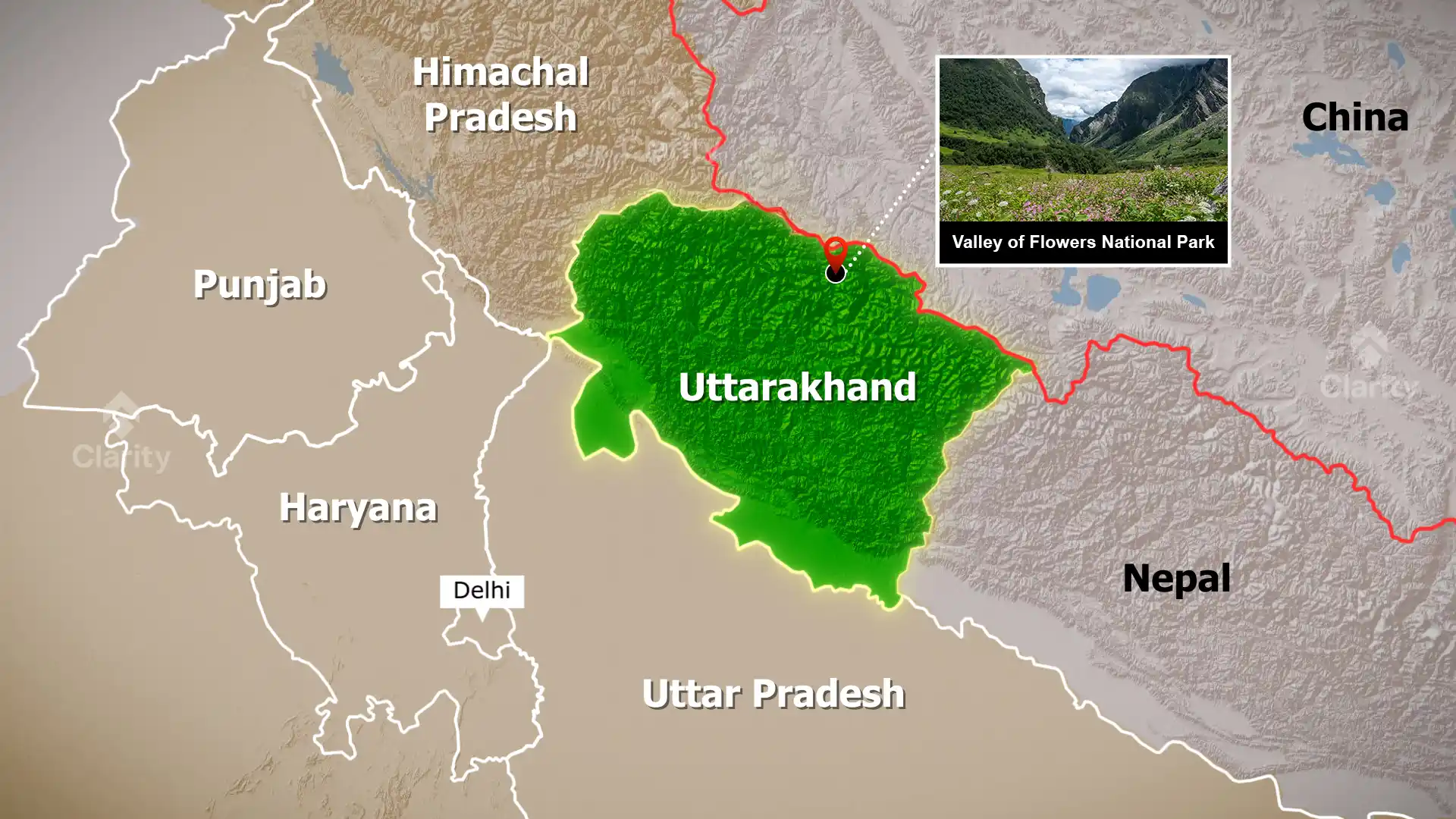
Why in news?
On 9 January 2026 a forest fire broke out in the high‑altitude forests of Chamoli district, Uttarakhand, close to the famous Valley of Flowers National Park. Dry weather and scant snowfall allowed dry leaves and pine needles to catch fire. Thankfully, natural barriers prevented the blaze from reaching the core zone of the park.
Background on the Valley of Flowers
The Valley of Flowers National Park is located in Uttarakhand’s Chamoli district and forms part of the Nanda Devi Biosphere Reserve. It was discovered by British mountaineer Frank S. Smythe in 1931 and officially notified as a national park in 1982. The valley sits at altitudes between 3,200 m and 6,675 m and is famous for its meadows carpeted with alpine flowers during the monsoon season.
Key features
- Biodiversity hotspot: More than 520 species of high‑altitude flowering plants, including orchids, poppies and primulas, bloom here. Rare fauna such as the snow leopard, Asiatic black bear, blue sheep and musk deer inhabit the surrounding mountains.
- Glacial landscape: The valley lies between the Zanskar and Greater Himalaya ranges. It was carved by glaciers, resulting in a U‑shaped valley with hanging tributaries. The Pushpawati and Lakshman Ganga rivers run nearby and act as natural firebreaks.
- Climate and access: The region experiences heavy snowfall in winter and monsoon rains from June to September. The park opens to visitors from June to October when the snow melts and flowers bloom.
- Heritage status: In 2005 the Valley of Flowers, together with the Nanda Devi National Park, was inscribed as a UNESCO World Heritage Site for its outstanding natural beauty and ecological significance.
Recent fire and response
- The fire erupted at around 11,500 feet in the Gopeshwar range, about 7 km from the Valley of Flowers. Dry conditions after an unusually snowless winter allowed pine needles and grass to ignite.
- Forest officials stated that the blaze remained confined to surface vegetation and did not spread to the valley itself. The Pushpawati and Lakshman Ganga rivers formed natural barriers that prevented the fire from reaching the core zone.
- Local communities and forest guards worked together to contain the fire by cutting fire lines and removing fuel. The state government encouraged villagers to collect dry pine needles for use as fuel under a livelihood scheme, reducing the fire hazard.
- Climate scientists note that rising temperatures and shifting precipitation patterns have increased the frequency of forest fires in Uttarakhand. The 2023 State of Forest Report recorded over 1,800 sq km of burnt area in the state.
Significance
- The Valley of Flowers is a global treasure; preserving its fragile ecosystems requires proactive fire management and adaptation to climate change.
- Community participation, such as collecting dry needles and reporting fires promptly, is essential to reduce fuel loads and safeguard forests.
- The incident underscores the need for early warning systems, better coordination among agencies and sustained funding for forest fire mitigation.