
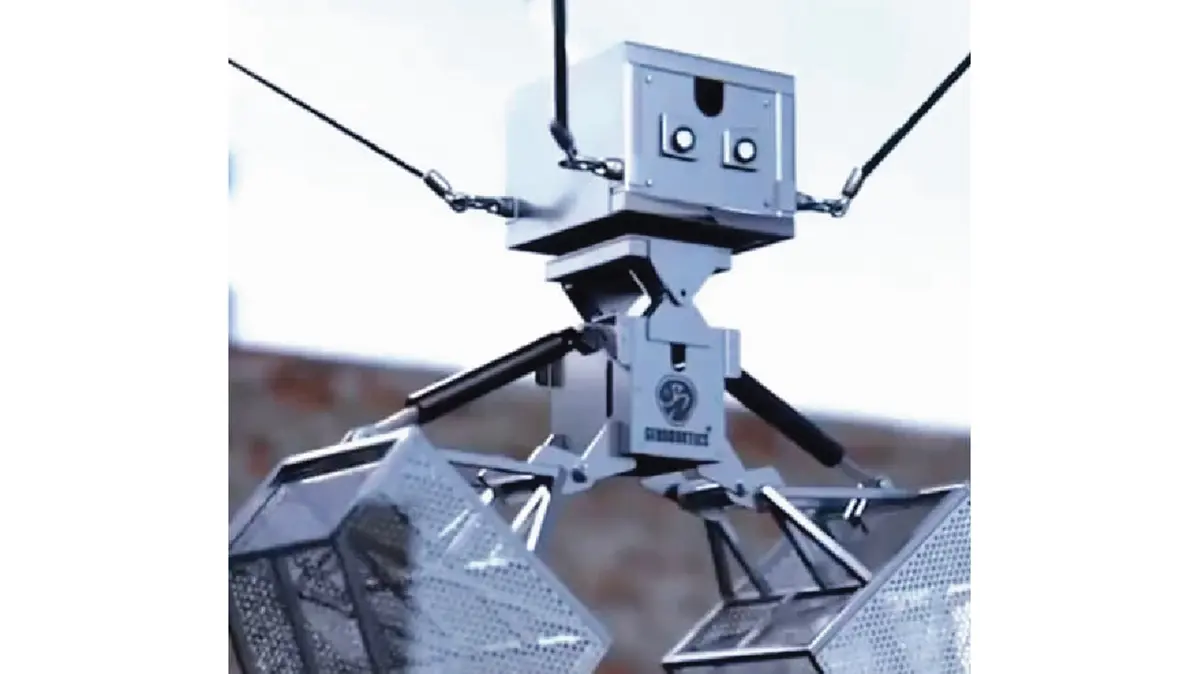
Why in news?
The Government of India’s Swachh Bharat Mission introduced an innovative robot called “G-SPIDER” to clean drains and canals without sending workers into hazardous conditions. The robot was deployed in several cities to eliminate manual scavenging and improve sanitation. Officials described it as a milestone in using technology for public health and worker safety.
Background
Manual cleaning of drains and sewers often exposes workers to toxic gases and dangerous waste. Despite laws banning manual scavenging, many sanitation workers still enter drains to remove solid waste. The G-SPIDER robot was designed under the Swachh Bharat Mission 2.0 to mechanise this task.
How the robot works
- Cable-Driven Parallel Robot: The robot moves using cables suspended above the drain. It can navigate uneven surfaces and reach difficult corners without entering the water.
- AI-assisted vision: Cameras and sensors allow the robot to detect obstacles and differentiate between organic and inorganic waste. It uses artificial intelligence to guide its claw and scoop mechanisms.
- Claw and collection system: A biomimetic claw grabs solid waste, which is lifted out of the drain and placed into a container. Workers can empty the container without touching the waste.
- Remote operation: Trained operators control the robot from a safe location, reducing exposure to harmful gases and pathogens.
Benefits
The robot promotes dignity and safety for sanitation workers by replacing manual scavenging with mechanised cleaning. It also improves efficiency because it can operate continuously and reach areas that humans cannot. By ensuring drains are free from solid waste, the robot helps reduce flooding and improve urban hygiene.
Source: Press Information Bureau

