

Why in news?
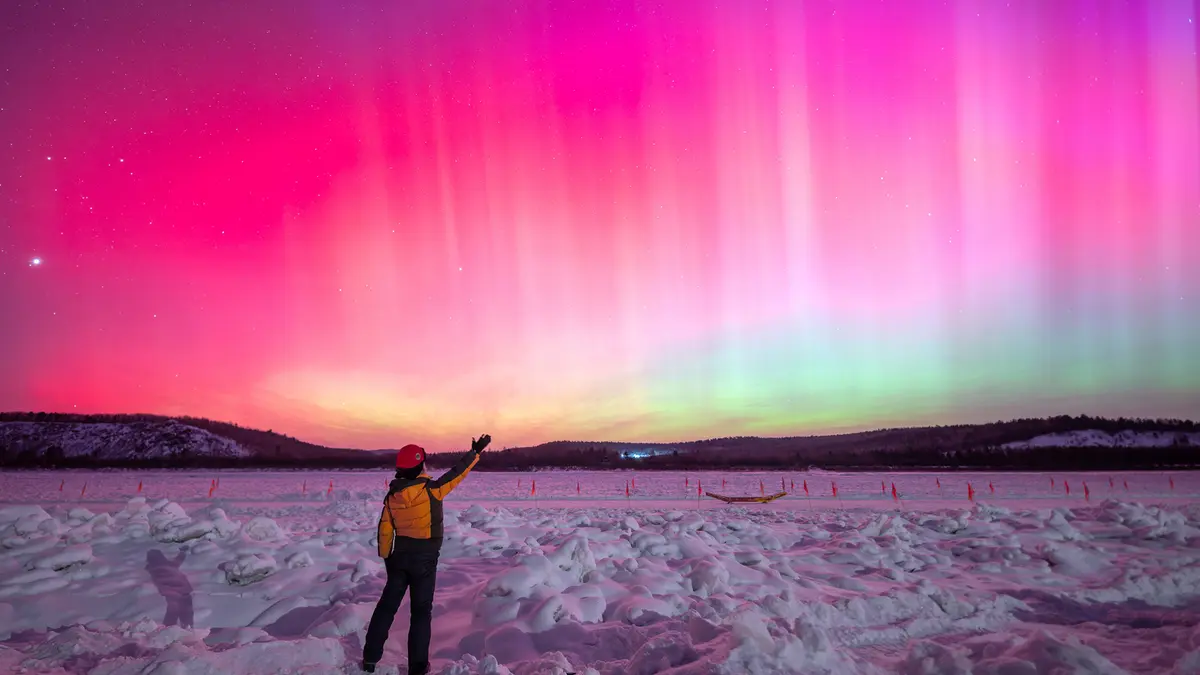
On 19–20 January 2026 the Sun ejected a large cloud of charged particles that struck Earth’s magnetic field. The resulting G4 (severe) geomagnetic storm triggered spectacular auroras that were visible far beyond the polar regions and prompted warnings to satellite operators and power companies.
Background
Earth is shielded by a magnetic field that deflects most solar particles. Occasionally, the Sun releases a coronal mass ejection (CME), a huge burst of plasma and magnetic field from its outer atmosphere. When this fast‑moving cloud hits Earth, it transfers energy into the magnetosphere, creating a geomagnetic storm. Storms are graded from G1 (minor) to G5 (extreme) depending on their intensity. A G4 storm like the one observed can disturb radio communications, navigation signals and power grids, though the atmosphere and magnetic field protect people on the ground from harm.
How geomagnetic storms develop
- Solar wind interaction: The constant stream of protons and electrons flowing from the Sun, known as the solar wind, normally travels at 400–800 km/s. When a CME catches up with and compresses this wind, it delivers a shock wave that stirs Earth’s magnetic field.
- Magnetic reconnection: If the CME’s magnetic field points southward, opposite Earth’s northward field, the fields can reconnect. This allows energy and charged particles to pour into the magnetosphere.
- Auroras and disturbances: Energised particles spiral along magnetic field lines toward the poles, where they collide with oxygen and nitrogen atoms, producing the shimmering lights known as auroras. At the same time, fluctuations in the magnetosphere can induce currents in power lines and pipelines and increase drag on satellites.
Potential impacts
- Communication disruptions: High‑frequency radio signals that bounce off the ionosphere may fade or become noisy during storms, affecting aviation and maritime communications.
- Navigation errors: Changes in the ionosphere can cause inaccuracies in GPS and other satellite‑based navigation systems.
- Satellite risk: Increased radiation can charge satellite electronics, potentially damaging components. The heated upper atmosphere expands, increasing drag on satellites and making their orbits harder to predict.
- Power grids: Rapid magnetic field changes can induce currents in long power transmission lines and pipelines. Operators may temporarily adjust loads to prevent blackouts or equipment damage.
Conclusion
This severe geomagnetic storm provided a vivid reminder of our connection to the Sun. While auroras delighted sky‑watchers, space‑weather agencies monitored the event to protect infrastructure. Continued investment in solar observation and forecasting helps operators prepare for storms and minimise disruption.