

Why in news?
A comprehensive survey by the Wildlife Institute of India, released in January 2026, found 3,037 gharials across 13 rivers in the Ganga basin. The assessment, covering more than 7,600 km of river channels, provides the first basin‑wide snapshot of this critically endangered crocodilian and points to both recovery and continuing vulnerabilities.
Background
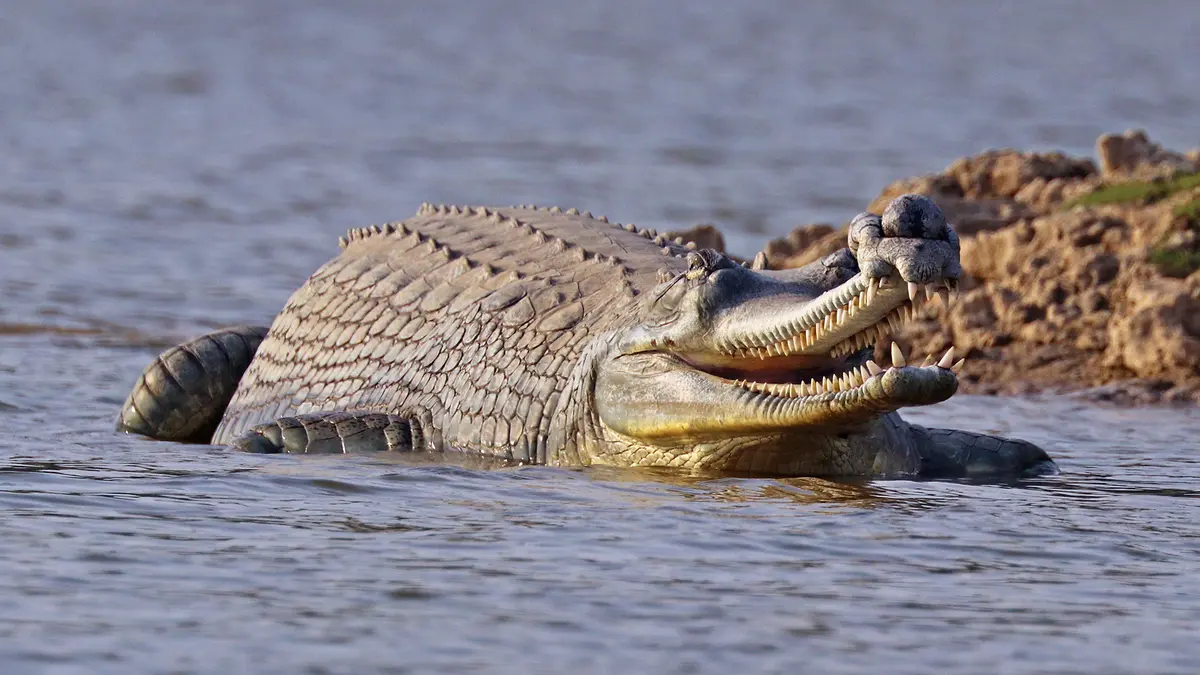
The gharial (Gavialis gangeticus) is a fish‑eating crocodilian endemic to the Indian subcontinent. It has a very long, slender snout with a bulbous ghara at the tip in adult males. Adults can reach 5–6 metres in length, with males larger than females. Historically, gharials inhabited the Indus, Ganges, Brahmaputra and Mahanadi river systems. They live almost entirely in water, favouring deep, clear rivers with sandbanks for basking and nesting. Females lay clutches of eggs in burrows dug into sandy banks, and hatchlings receive no parental care. Over the last century, the species declined precipitously due to habitat loss, pollution, dam construction, sand mining and accidental drowning in fishing nets. The International Union for Conservation of Nature lists it as Critically Endangered.
Survey highlights
- Numbers and distribution: The survey counted 3,037 gharials in 13 of the 22 rivers surveyed. The Chambal River alone holds 2,097 individuals — more than two‑thirds of the total. The Ghaghra supports about 463 gharials and the Girwa roughly 158. In contrast, the Ramganga in Uttarakhand yielded only 48 individuals, and some historical ranges recorded none.
- Methodology: From November 2020 to March 2023, researchers conducted boat‑based visual counts along 7,680 km of river in seven states. They estimated minimum population sizes and calculated encounter rates to gauge density.
- Habitat suitability: Only about 5.6 percent of the surveyed river stretches were classified as highly suitable for gharials; over 92 percent were deemed unsuitable, largely due to human disturbance, altered flows, pollution and sand mining. The few high‑quality habitats are concentrated in the Chambal, Yamuna, Sind, Gandak and Girwa rivers.
- Conservation insights: The survey underscores that sustained protection and restocking programmes drive recovery in strongholds like the Chambal. Elsewhere, populations remain fragmented and dependent on ongoing conservation. Juvenile survival is extremely low — fewer than 0.5 percent reach adulthood — highlighting the importance of protecting nesting sites and reducing threats from fishing gear and habitat degradation.
Looking forward
The report recommends focusing reintroduction efforts on river stretches with proven suitability, controlling sand mining and pollution, regulating river flows and engaging local communities. Long‑term monitoring, habitat restoration and coordinated conservation across states will be essential to move the gharial from “critically depleted” toward ecological recovery.
Source: NIE