

Why in news?
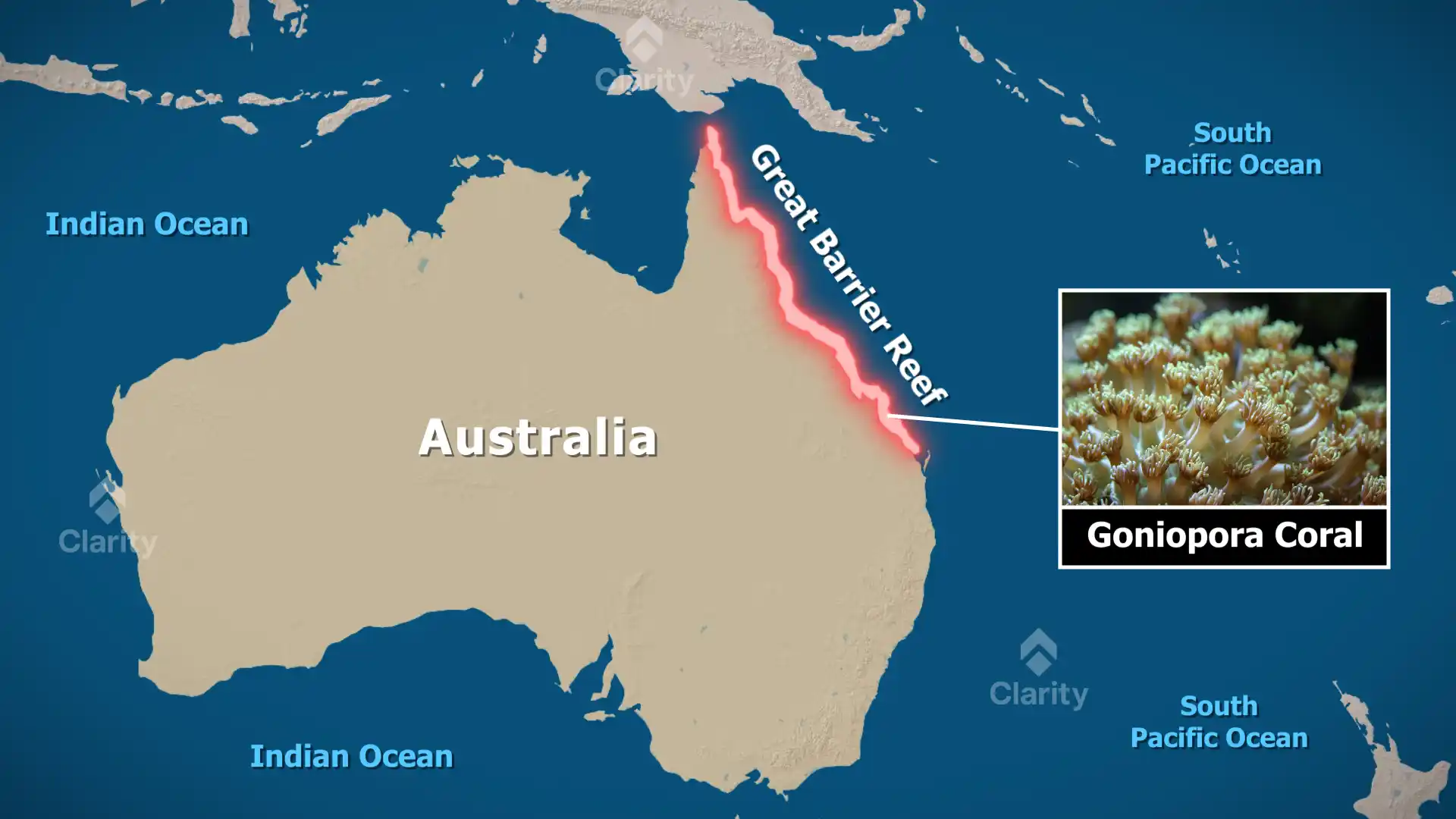
Marine biologists from the University of Sydney reported that an unprecedented combination of marine heatwave conditions and a necrotic disease wiped out three‑quarters of the Goniopora (flowerpot) coral colonies at One Tree Reef in Australia’s Great Barrier Reef during the record‑breaking 2024 bleaching event. The study, published in the Proceedings of the Royal Society B in December 2025, warns that climate change is pushing even thermally resilient corals toward collapse.
Background
Goniopora are large, long‑lived corals often called flowerpot or daisy corals because of their distinctive shape. They are considered relatively tolerant to heat and are found on lagoons and turbid reefs. Black band disease (BBD) is a bacterial infection characterised by a dark band of microbes that moves across a coral colony, killing tissue as it spreads. BBD is common in the Caribbean but rare on the Great Barrier Reef.
What the study found
- During the 2024 El Niño‑driven heatwave, sea‑surface temperatures around One Tree Reef remained above 28 °C for 74 consecutive days, with peaks of 34–35 °C. This caused 75 percent of the monitored Goniopora colonies to bleach.
- Initially only about 4 percent of colonies showed BBD. By April 2024, more than half of the bleached corals were infected, and the disease spread rapidly.
- Researchers tagged 112 Goniopora colonies and tracked them through October 2024. Three‑quarters died, while only one‑ quarter showed partial recovery. Surveys of over 700 colonies revealed the same pattern.
- This is the first recorded epizootic (animal epidemic) of black band disease on the Great Barrier Reef. The outbreak underscores how heat stress can trigger disease outbreaks even in remote, relatively pristine reefs.
Implications
- Loss of reef structure: Goniopora form large massive corals that provide habitat for fish and other organisms. Their loss reduces biodiversity and weakens shoreline protection.
- Climate warning: The study emphasises that climate change is driving more frequent and severe marine heatwaves. Even “hardy” corals are vulnerable when heat stress coincides with disease.
- Need for emissions reduction: Scientists argue that ambitious global action to reduce greenhouse gas emissions is the only way to prevent catastrophic loss of coral reefs worldwide.
- Monitoring and research: Long‑term monitoring stations like the University of Sydney’s One Tree Island Research Station are essential for understanding and documenting reef health. Without detailed data, such collapses might go unnoticed.
Conclusion
The Goniopora crisis is a stark reminder that coral resilience has limits. When extreme heat is followed by disease, even robust species succumb. Protecting coral reefs will require both global climate action and local conservation measures to reduce stressors like pollution and overfishing.
Sources: DTE