

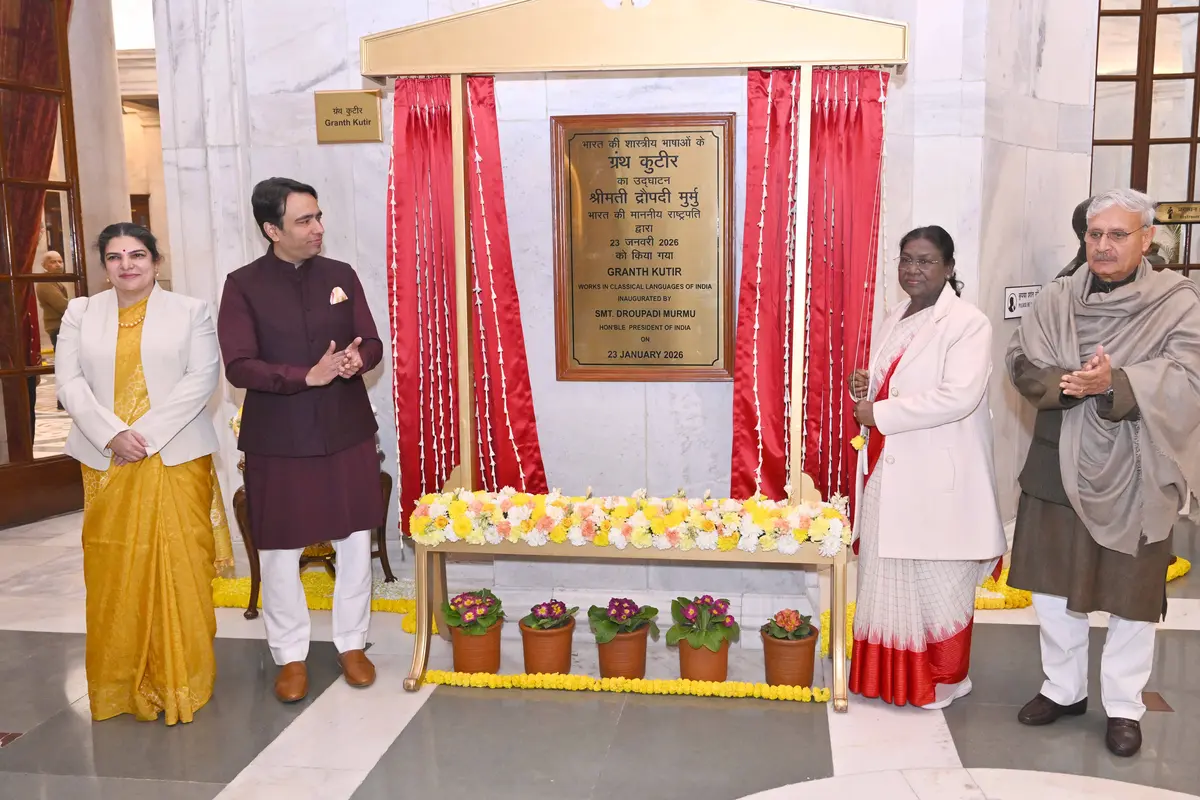
Why in news?
The President of India inaugurated the Granth Kutir on 23 January 2026 at the Rashtrapati Bhavan. This curated library houses thousands of books and manuscripts in India’s eleven officially recognised classical languages. The opening ceremony highlighted the importance of preserving linguistic heritage and promoting the study of ancient texts among young Indians.
Background
India’s classical languages — Tamil, Sanskrit, Kannada, Telugu, Malayalam, Odia, Marathi, Pali, Prakrit, Assamese and Bengali — reflect centuries of literary and philosophical development. Many of their works are preserved only in fragile manuscripts written on palm leaves, birch bark, handmade paper or cloth. The Granth Kutir was conceptualised under the Ministry of Culture’s Gyan Bharatam Mission, which aims to survey, digitise and conserve India’s manuscript heritage. Scholars from universities and the Indira Gandhi National Centre for the Arts assisted in sourcing texts from across the country.
Collection and features
- Books and manuscripts: The library holds roughly 2,300 books and about 50 manuscripts in 11 classical languages. Manuscripts are preserved in climate‑controlled cabinets to prevent decay.
- Wide subject range: The collection covers epics such as the Ramayana and Mahabharata, treatises on philosophy and linguistics, histories, jurisprudence, natural sciences, devotional literature and even the Constitution of India translated into classical languages.
- Collaborative effort: Central and state governments, universities, research institutions, cultural organisations and private donors contributed to assembling the collection.
- Educational purpose: Granth Kutir is intended as a research and learning centre. Students can consult rare texts under supervision, and plans are underway to digitise manuscripts for wider access.
- Promotion of classical languages: During the inauguration the President urged young people to learn at least one classical language to connect with their cultural roots.
Significance
- Preserving heritage: By safeguarding manuscripts that might otherwise deteriorate, Granth Kutir protects a vital part of India’s civilisational memory.
- Knowledge dissemination: The library offers scholars a central repository of classical literature spanning diverse disciplines, facilitating research and translation.
- Cultural pride: The initiative showcases India’s rich linguistic diversity and reinforces the status of classical languages.
Source: PIB