

Why in news?
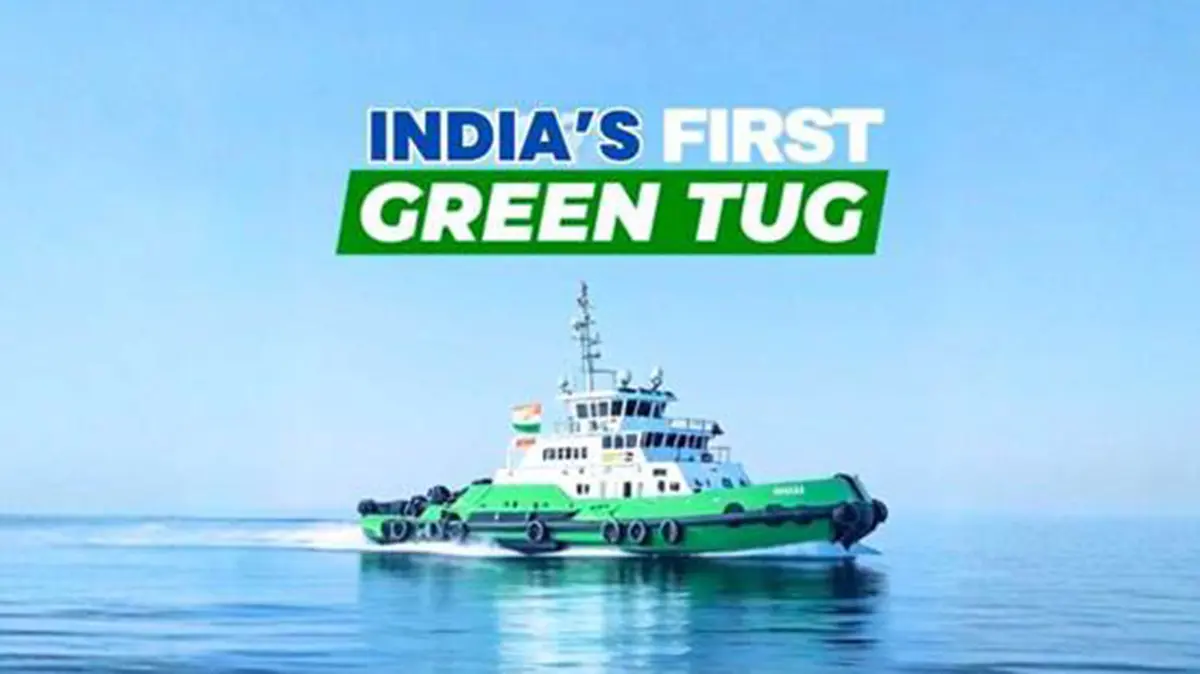
Union Minister for Ports, Shipping and Waterways Sarbananda Sonowal virtually flagged off construction of India’s first all‑electric green tug on 4 December 2025. The vessel, being built for the Deendayal Port Authority (DPA) in Kandla, is part of the government’s Green Tug Transition Programme (GTTP) to decarbonise harbour operations.
Background
Tugs are small yet powerful vessels used to guide larger ships during berthing, towing and emergency response. Most Indian ports currently rely on diesel‑powered tugs, which emit greenhouse gases and create noise pollution. To align with India’s commitments under the Paris Agreement and the Maritime India Vision 2030, the Ministry of Ports launched the GTTP in 2023. The programme aims to replace or retrofit diesel tugs with green alternatives powered by batteries, green hydrogen or ammonia.
Features of the first electric tug
- Zero‑emission operation: The tug will be powered entirely by batteries, ensuring silent manoeuvring and no direct carbon emissions.
- High pulling power: It will have a bollard pull capacity of 60 tonnes, enabling it to handle large cargo vessels. Advanced energy storage and control systems will optimise performance.
- Indigenous build: The tug is being built by Atreya Shipyard (Mandovi Drydocks) under a contract valued at about ₹385 crore. Kongsberg Maritime will supply permanent magnet thrusters, energy storage systems and digital controls.
- Delivery timeline: The vessel is expected to be delivered by late 2026 and will operate at the DPA in Gujarat. It will also serve as a testbed for gathering operational data on electric tugs.
Green Tug Transition Programme roadmap
- Phase I (2024–27): The GTTP plans to induct 16 green tugs—two each for the Deendayal, Paradip, Jawaharlal Nehru and V.O. Chidambaranar port authorities. These will include fully electric and hybrid models.
- Long‑term goal: By 2030, the programme aims to deploy at least 50 green tugs across major Indian ports, replacing a significant portion of the diesel fleet.
- Broader impact: Electric tugs can cut emissions by 100 %, while hybrid models reduce emissions by 25–35 %. The initiative supports India’s goal of achieving net‑zero emissions by 2070.
- Alignment with policy: The GTTP is part of the Maritime Amrit Kaal Vision 2047, which envisions sustainable ports and logistics. It also promotes the Make in India programme by encouraging domestic shipbuilding and technology.
Significance
The commissioning of the first all‑electric tug marks a milestone in India’s transition to green maritime operations. It demonstrates that advanced propulsion technologies can be developed domestically and scaled up. Successful deployment will reduce fuel costs, lower maintenance and set a precedent for other sectors to adopt clean propulsion systems.
Source: PIB