

Why in news?
Bharat Electronics Limited (BEL) has signed a joint venture agreement with France’s Safran Electronics & Defence to manufacture the Highly Agile Modular Munition Extended Range (HAMMER) weapon system in India. The deal, finalised on 24 November 2025, aims to indigenise a precision‑guided air‑to‑ground weapon used on Rafale fighter jets and eventually supply it to the Indian Air Force and Navy.
Background
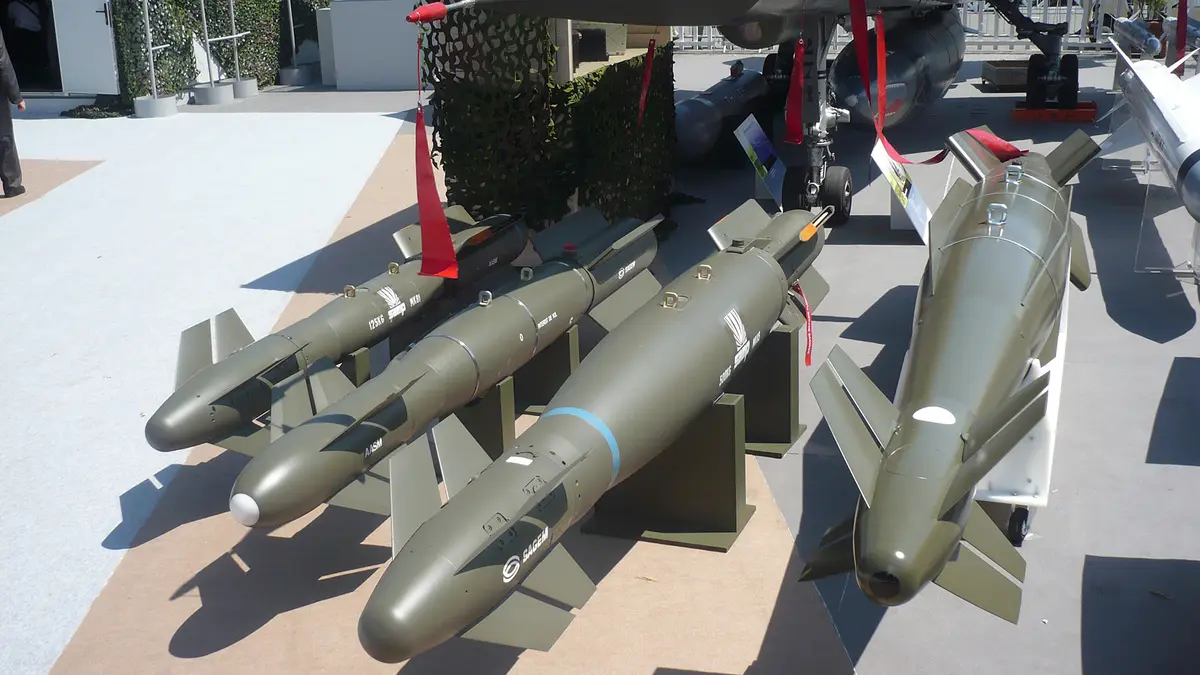
The HAMMER, also known in French as AASM (Armement Air–Sol Modulaire), is a guidance and range‑extension kit that converts conventional unguided bombs into smart munitions. Developed by Safran, it first entered service with the French Air Force in 2008 and has since been exported to several countries. The kit consists of a guidance module attached to the front of a bomb and a propulsion unit with fins at the rear, giving it extended range and accuracy. It can be fitted to 125 kg, 250 kg, 500 kg and 1,000 kg bombs.
Key features
- Guidance options: The HAMMER offers three guidance configurations — inertial navigation plus GPS; inertial navigation, GPS and infrared seeker; and inertial navigation, GPS and laser homing. Depending on the variant it can achieve precision of about one metre.
- Extended range: A small rocket motor and aerodynamic fins give the weapon a range of more than 70 kilometres, allowing aircraft to strike targets while staying outside enemy air defences.
- Modular design: The kit attaches to existing bombs, turning them into smart munitions without the need for new stockpiles. This reduces costs and logistical complexity.
- Jamming resistance: The guidance system is hardened against electronic jamming, enabling reliable operation in contested environments.
- Aircraft compatibility: The weapon can be integrated with a variety of aircraft, including the Rafale, Mirage 2000, Tejas and MiG‑29.
India–France joint venture
- Indigenisation target: The joint venture plans to progressively increase Indian content to about 60 percent. BEL will handle final assembly, integration and testing in India, while Safran will supply critical components.
- Maintenance and support: The facility will also provide maintenance, repair and overhaul services for HAMMER weapons operated by Indian forces, creating local expertise.
- Potential customers: Beyond equipping Rafale jets, the weapon could arm India’s light combat aircraft Tejas and future naval fighters. It may also be offered for export to friendly nations.
Significance
- Enhancing air power: Precision‑guided munitions like the HAMMER allow aircraft to strike hardened bunkers, bridges and runways with minimal collateral damage.
- Boost to Make in India: Manufacturing the weapon domestically supports self‑reliance in defence technology and creates skilled jobs.
- Strategic partnership: The venture deepens defence cooperation between India and France, which already includes joint exercises and technology transfers.
Conclusion
The HAMMER joint venture demonstrates how international collaboration can accelerate India’s defence modernisation. As indigenous content increases, the partnership will help build expertise in precision munitions and strengthen the country’s aerospace industry.
Source: The Indian Express,